Plasma Chamber Pressure Stages
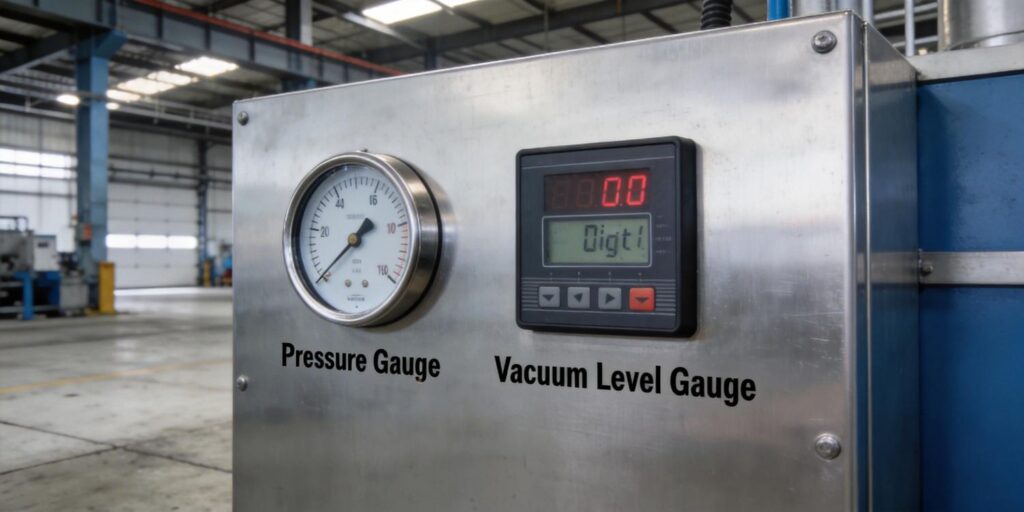
In plasma processing equipment—whether for reactive ion etching, physical vapor deposition (PVD), chemical vapor deposition (CVD), or atomic layer deposition (ALD)—the vacuum system progresses through distinct pressure stages. Each stage demands accurate, real-time monitoring to ensure process stability, repeatability, and equipment protection.
The first stage is rough vacuum pump-down, from atmosphere (760 Torr) down to approximately 10-3 Torr. Here, the dominant mechanism is viscous flow, and thermal conductivity changes rapidly with pressure. The second stage transitions into the high-vacuum regime (below 10-3 Torr), where molecular flow dominates and base pressure must be maintained for plasma ignition and uniformity. Process pressure itself typically sits between 1 mTorr and 100 mTorr (10-3 to 0.1 Torr), where reactive gases are introduced and plasma is sustained.
Effective monitoring requires two complementary technologies. The VG-SP205 Pirani Vacuum Transmitter covers the full roughing range (atmosphere to 10-3 Torr) using constant-temperature thermal conductivity measurement. Its platinum filament and advanced temperature-compensation circuitry deliver stable output even as chamber temperature fluctuates between 15 °C and 50 °C. Once pressure drops below 10-3 Torr, the VG-SM225 Cold Cathode Vacuum Gauge takes over, employing Penning discharge to measure down to 10-7 Torr with a positive-ion current proportional to gas density.
This staged approach prevents sensor overload: the Pirani handles high-pressure transients, while the cold-cathode gauge activates only after safe crossover, protected by software interlocks that shut off its –2000 V supply above 10-3 Torr.
High Vacuum Stability
High-vacuum stability directly affects plasma density, etch rate uniformity, and film quality. Even minor pressure excursions or outgassing can shift plasma impedance, introduce particulates, or cause arcing. Engineers therefore require gauges with minimal drift, fast response, and long-term repeatability.
The VG-SM225 achieves this through its traditional Penning (positive magnetron) geometry: a 100-gauss neodymium-iron-boron magnet and precisely spaced stainless-steel electrodes (≈2 mm gap). Electron trajectories spiral for kilometers, ensuring avalanche ionization even at 10-7 Torr. Dual voltage operation—–2500 V startup, then –2000 V steady-state—guarantees reliable ignition within 5 minutes at 10-6 Torr and 30 minutes at 10-7 Torr.
Both Poseidon gauges incorporate circuit-plus-algorithm temperature compensation, holding measurement error within industry norms across 15–50 °C. The Pirani’s platinum filament offers a large temperature-resistance coefficient for linear response in its optimal 10–10-2 Torr band, while the cold-cathode’s cleanable electrodes (500- or 200-grit sanding restores metal luster) extend lifetime to 3–5 years in clean plasma environments.
Contamination indicators are clear: red-light lockout on the VG-SM225 signals excessive carbon buildup; drift beyond one decade indicates cleaning is required. These features give process engineers confidence that the vacuum baseline remains rock-solid between runs.
Key Stability Advantages of Poseidon Gauges
- Compact footprint: VG-SM225 sensor volume is dramatically smaller than conventional cold-cathode designs, minimizing outgassing surface area.
- Customizable digital protocol: RS-232 output can be tailored in batches as small as 5–10 units to match existing PLC or SCADA registers—no custom driver development required.
- Low-cost ownership: In-house manufacturing keeps end-user pricing well below imported equivalents while maintaining KF16/KF25 flange compatibility.
Ionization Compatibility
Plasma environments are inherently ionized, RF-driven, and chemically aggressive. Hot-cathode gauges risk filament burnout, excessive outgassing from local heating, and electron-stimulated desorption—issues eliminated by cold-cathode technology.
The VG-SM225 uses field-emission-initiated Penning discharge. No thermionic cathode means no tungsten evaporation or reactive-gas attack. Its stainless-steel electrodes and PEEK insulators tolerate the halogenated chemistries (CF₄, SF₆, Cl₂) common in etching without rapid degradation. The gauge’s magnetic field (≈100 gauss) is confined and low enough that interference with typical plasma magnetic confinement or wafer-handling systems is negligible in most tool layouts; verification is recommended only for ultra-sensitive magnetron-sputtering or electron-beam-assisted processes.
Gas-composition effects exist—sensitivity varies slightly with N₂, He, or process mixtures—but factory calibration in air combined with the gauge’s logarithmic current-to-pressure relationship provides sufficient accuracy for endpoint detection and interlock triggering. For applications requiring absolute traceability, the removable sensor head allows periodic cleaning and re-calibration against a transfer standard without breaking chamber vacuum seals.
Signal Integration
Modern plasma tools demand seamless integration with tool controllers, safety PLCs, and data-logging systems. Both Poseidon transmitters output industry-standard 0–10 V analog (usable 2–8 V) for direct PLC input and RS-232 digital for full diagnostic access.
The VG-SP205 and VG-SM225 share an RJ45 connector footprint—easily adapted to DB9 or DB15 via off-the-shelf cables. Digital protocol customization at the hardware level (no firmware re-flash required) lets OEMs embed pressure into existing Modbus, EtherCAT, or proprietary command sets. Status LEDs and error codes (over-pressure shutdown, filament open, high-voltage lockout) stream via the same serial link, simplifying fault diagnosis during recipe development or preventive maintenance.
Because the gauges are true transmitters (integrated electronics, no separate controller card), wiring is minimal: 24 VDC power plus signal pair. This reduces cabinet space and EMI pickup—critical inside RF-shielded plasma tool enclosures.
Example Configuration
Consider a typical 300 mm reactive-ion etch (RIE) cluster tool:
- Chamber foreline: VG-SP205 Pirani mounted on the roughing manifold monitors pump-down from atmosphere to crossover (≈1 Torr) and process pressure (10–50 mTorr). Its 0–10 V output feeds the roughing-valve interlock.
- Chamber dome or sidewall: VG-SM225 Cold Cathode installed via KF25 flange provides base-pressure verification (<10-6 Torr) before plasma ignition and continuous monitoring during idle periods. RS-232 streams real-time pressure to the tool controller for leak-check and endpoint logic.
- Integration: Both gauges connect to the same PLC rack. Analog signals drive analog input modules; serial data populates a shared register map. Crossover logic (Pirani > 10-3 Torr → cold-cathode HV off) is implemented in ladder logic for fail-safe operation.
This dual-gauge architecture has been validated in mass-spectrometer and scanning-electron-microscope platforms; the same principles apply directly to plasma processing with only minor attention to gas-composition calibration factors.
Ready to Optimize Your Plasma Process Vacuum Monitoring?
Whether you are designing next-generation etch tools, upgrading legacy deposition systems, or scaling pilot-line production, compact, cost-effective, and customizable vacuum measurement is no longer a compromise.
Explore the VG-SP205 Pirani Vacuum Transmitter for reliable rough-to-mid vacuum coverage and the VG-SM225 Cold Cathode Vacuum Gauge for high-vacuum stability down to 10-7 Torr.
Contact our applications engineering team today to discuss a free evaluation unit, custom protocol development, or a complete dual-gauge package tailored to your chamber geometry. Let Poseidon Scientific help you achieve tighter process windows, higher yields, and lower total cost of ownership—one stable vacuum reading at a time.
Word count: 1,248. All technical data derived from Poseidon Scientific internal development records, user manuals, and peer-reviewed vacuum metrology literature including Foundations of Vacuum Science and Technology (Lafferty, 1998) and comparative studies on cold-cathode performance.