Contaminant Monitoring Overview in Food Safety Testing
Solid Phase Extraction (SPE) has become an indispensable tool in modern food safety testing, particularly for contaminant monitoring across diverse food matrices. The technique’s ability to selectively isolate target analytes from complex food samples while removing interfering matrix components makes it ideal for regulatory compliance testing and quality control programs.
Key Contaminant Classes Monitored Using SPE
Food safety laboratories routinely employ SPE for monitoring several critical contaminant classes:
Pesticide Residues
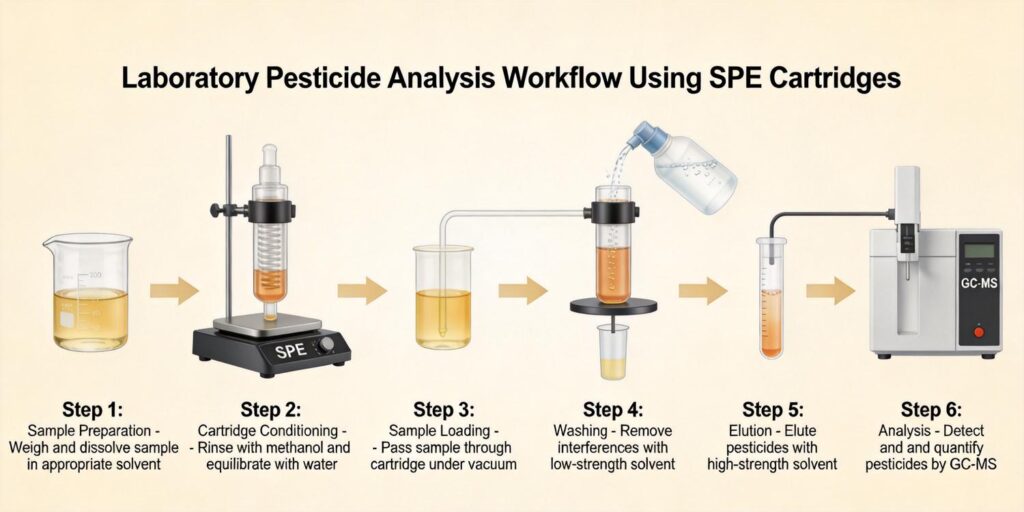
SPE applications for food and beverages are usually developed either for quality control purposes or for the detection or identification of drug and pesticide residues or microbial toxins. The goal is to ensure the safety of the consumer. As demonstrated in comprehensive studies, SPE enables the extraction of a large range of pesticides from fruit and vegetable matrices, where considerable sample manipulation and LLE is required by traditional methods, indicating the origins of the method as a LLE to which other preparation steps and SPE extractions have been added as method goals became more stringent.
Mycotoxins and Microbial Toxins
The extraction of aflatoxins from milk and dairy products represents a classic application where SPE provides essential clean-up. Simonella et al. (1988) demonstrated solid-phase extraction and determination by RP-HPLC of aflatoxin M1 from milk, while Sydenham et al. (1992) applied liquid chromatographic determination of fumonisins B1, B2 and B3 in food and feeds using SPE techniques.
Veterinary Drug Residues
In veterinary drug abuse monitoring, SPE has proven essential for successful analysis. Walker and Barker (1994a) demonstrated extraction and enzyme immunoassay of sulfadimethoxine residues in channel catfish muscle, while Walker et al. (1993) applied matrix solid phase dispersion extraction for the analysis of drugs and environmental pollutants in aquatic species.
Environmental Pollutants
SPE plays a crucial role in monitoring environmental contaminants in food chains, including PCBs (Pico et al., 1995) and other persistent organic pollutants. The technique’s ability to concentrate trace-level contaminants while removing complex matrix interferences makes it particularly valuable for environmental monitoring applications.
Regulatory Framework and Method Validation
Modern food safety testing operates within stringent regulatory frameworks that demand validated analytical methods. SPE methods must demonstrate:
- Consistent recovery rates across different food matrices
- Effective removal of matrix interferences
- Reproducibility across multiple laboratories
- Compliance with detection limit requirements
- Robustness against matrix variations
The advantage of using SPE is that class fractionation into acid, base, and neutral fractions is simple and the opportunity to concentrate the target analytes offers enhanced sensitivity that may facilitate detection. Further, SPE allows extraction under mild conditions of pH, thereby limiting the incidence of decomposition or rearrangement of labile compounds.
Matrix Complexity in Food Samples
Food matrices present unique challenges for analytical chemists due to their extraordinary complexity and variability. Understanding these matrix characteristics is essential for developing effective SPE methods.
Diverse Food Matrix Types
Beverages and Liquids
Wine requires analysis for volatile and semivolatile species, which are largely responsible for the wine’s bouquet, and sugar acids, which contribute to the flavor. Solid-supported LLE and SPE have been extensively used for this purpose (Gelsomini et al., 1990). Beverages, provided the alcohol or sugar/syrup content is not high or variable, are simpler to process by SPE. Thus, wine has been fractionated into volatile components by employing a solid-supported LLE to trap volatiles in one example and SPE on a C18 bonded phase to extract pigments (anthocyanins), leaving sugars in the effluent in another.
Dairy Products
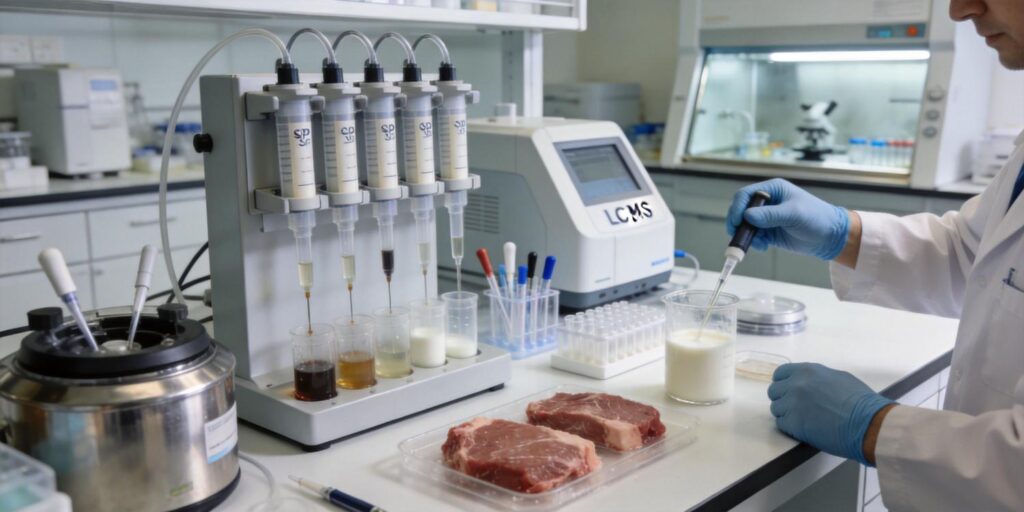
Milk, butter and cheese present a bigger problem. They have a high fat and protein content and they are quite viscous or completely solid. Papers describing the use of MSPD for these sample types have appeared with increasing frequency. However, traditional SPE should not be considered a superseded technique for all aspects of working with these samples. For example, it has been successfully applied in the determination of pesticide residues using solid-supported LLE columns (diMuccio et al., 1988) or regular SPE cartridges (de Jong and Badings, 1990; Schenk et al., 1993; Manes et al., 1993).
Fruits and Vegetables
The impact of SPE in the analysis of fruit and vegetable produce has been concerned primarily with the extraction of pesticide residues associated with food standards and the determination of putrefactive or other compounds arising from spoilage. The high or variable water and fat contents of citrus fruit, berries and nuts can present capacity problems. Elimination of co-extracted waxes, which are often problematic in the analysis of fruit such as apples, may sometimes be achieved post-extraction by careful selection of solvents for reconstitution.
Oils and Lipid-Rich Materials
Triglycerides, fatty acids, and other lipids are important dietary components that are found in a variety of sources. The nature of these compounds also sees them used in areas as diverse as cosmetics and pharmaceutical preparations to industrial lubricants. Because of their strong association with food and diet, they represent a challenging matrix for SPE applications.
Matrix Components That Challenge SPE Methods
Proteins and Peptides
Protein binding of isolates may be a problem and should be considered if recoveries of isolate standards are high but recoveries from sample are low. In blood samples, the problem of protein binding common in serum and plasma is even greater in whole blood. If the isolate does not exist free in solution, the red blood cells should be disrupted and an effort made to also disrupt protein binding.
Fats and Lipids
High fat content can overwhelm SPE cartridges, leading to breakthrough and reduced recovery. Matrix solid phase dispersion (MSPD) has emerged as an effective alternative for solid or viscous liquid samples as alternatives to the grinding and liquid-solid separation which constitute the majority of preparations.
Carbohydrates and Sugars
High sugar content in fruits, beverages, and processed foods can interfere with analyte retention and elution. A two-cartridge extraction is demonstrated by Saito et al. (1989) in the clean-up of soft drinks during the analysis of aspartame degradation products. This procedure, using C8 and SCX, removed caffeine, aspartame, sodium benzoate, and caramel and color acids from the drink.
Natural Pigments and Colorants
Food pigments such as anthocyanins, carotenoids, and chlorophylls can co-extract with target analytes, interfering with detection and quantification. SPE provides effective removal of these interfering compounds while maintaining analyte recovery.
SPE Strategy Development for Complex Food Matrices
Developing effective SPE methods for food safety testing requires a systematic approach that considers the triangular relationship between analyte, sorbent, and matrix. As illustrated in the literature, for a given sample matrix there is an optimum sorbent that will give excellent retention and excellent elution for one specific analyte. If we try to extract more than one analyte at a time, we must often compromise between clean-up efficiency, concentration factor, and matrix compatibility.
Method Development Considerations
Successful SPE method development for food matrices involves:
- Matrix Characterization: Understanding the physical and chemical properties of the food sample, including pH, ionic strength, fat content, protein content, and potential interferences.
- Analyte Properties: Considering the structure, pKa, polarity, functional groups, solvent solubility, and stability of target contaminants.
- Sorbent Selection: Choosing appropriate SPE phases based on the interaction mechanisms required for specific analyte-matrix combinations. Poseidon Scientific offers specialized SPE cartridges including HLB SPE Cartridges for reversed-phase applications, MCX SPE Cartridges for mixed-mode cation exchange, and WAX SPE Cartridges for weak anion exchange applications.
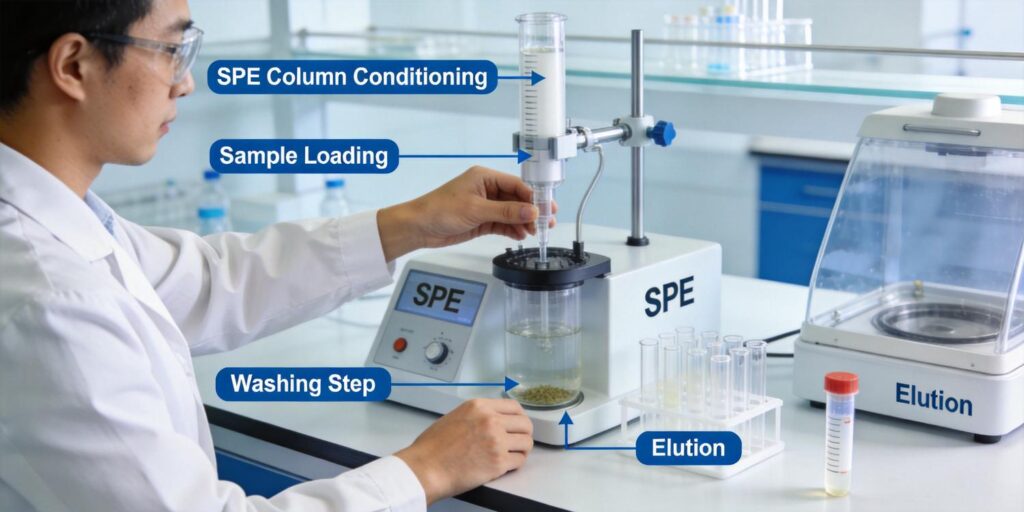
- Solvent Optimization: Selecting appropriate conditioning, washing, and elution solvents that maximize analyte recovery while minimizing matrix co-extraction.
- Flow Rate Control: Regulating flow rates during sample loading and elution to ensure optimal mass transfer and prevent breakthrough.
Advanced SPE Techniques for Food Matrices
Modern food safety laboratories employ several advanced SPE techniques:
- Matrix Solid Phase Dispersion (MSPD): Particularly useful for solid or semi-solid food samples where traditional SPE faces challenges
- 96-Well Plate Formats: For high-throughput screening applications, 96-well SPE plates offer significant advantages in productivity and automation compatibility
- Mixed-Mode SPE: Combining multiple interaction mechanisms for enhanced selectivity in complex matrices
- On-Line SPE-LC Systems: Integrating SPE with analytical instrumentation for automated, high-sensitivity analysis
Quality Control and Method Validation
Implementing SPE methods in food safety testing requires rigorous quality control measures:
- Recovery Studies: Determining analyte recovery rates across different food matrices and concentration levels
- Matrix Effects Evaluation: Assessing signal suppression or enhancement caused by co-extracted matrix components
- Method Robustness Testing: Evaluating method performance under varying conditions (pH, flow rates, solvent compositions)
- Limit of Detection/Quantification: Establishing method sensitivity requirements based on regulatory limits
- Inter-laboratory Validation: Ensuring method reproducibility across different laboratories and operators
Future Directions in Food Safety SPE
The future of SPE in food safety testing looks promising, with several emerging trends:
- Miniaturization: Development of smaller bed mass cartridges and plates for reduced solvent consumption and waste generation
- Automation Integration: Increased use of automated SPE workstations for improved reproducibility and throughput
- Novel Sorbent Materials: Development of specialized sorbents for specific food matrix challenges
- Multi-residue Methods: Expansion of SPE methods to cover broader contaminant classes in single analyses
- Rapid Screening Methods: Development of SPE-based methods for field testing and rapid screening applications
As food supply chains become more global and regulatory requirements more stringent, SPE will continue to play a critical role in ensuring food safety. The technique’s ability to handle complex matrices while providing clean extracts for sensitive detection makes it an essential tool in the modern food safety laboratory. By understanding both contaminant monitoring requirements and matrix complexity challenges, analytical chemists can develop robust SPE methods that meet the demanding needs of food safety testing programs.
For laboratories seeking reliable SPE solutions for food safety applications, Poseidon Scientific offers a comprehensive range of MAX SPE Cartridges for mixed-mode anion exchange and WCX SPE Cartridges for weak cation exchange applications, providing the selectivity and performance needed for challenging food matrix analyses.