Overview of Automated SPE Systems
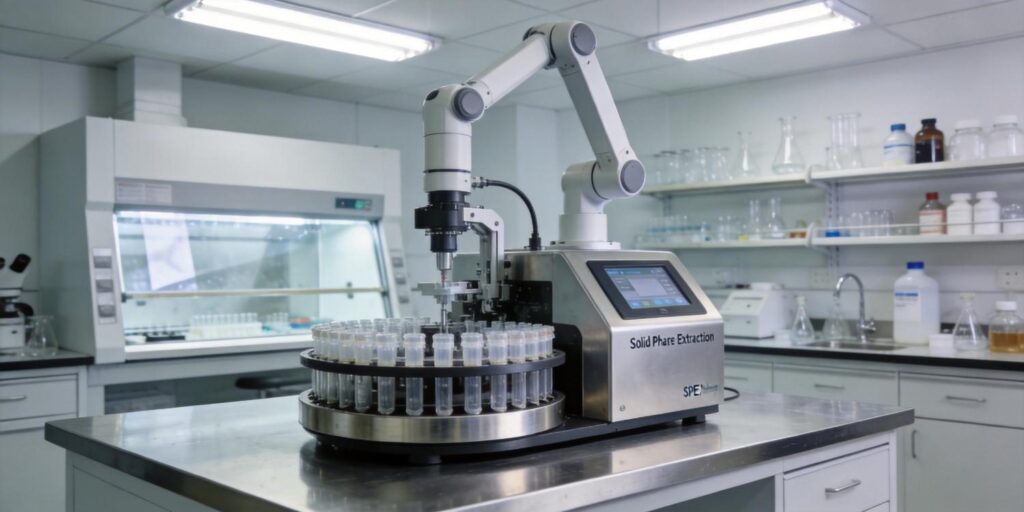
Automated Solid Phase Extraction (SPE) systems represent a significant advancement in modern laboratory workflows, transforming what was once a labor-intensive manual process into a streamlined, high-efficiency operation. As laboratories face increasing sample volumes and regulatory pressures, automated SPE workstations have become essential tools for maintaining analytical quality while improving throughput.
SPE automation originated from the need to process large numbers of samples quickly without increasing laboratory personnel. According to Jordan (2000), automation is seldom considered by analysts with only a few samples to analyze but becomes essential for laboratories with high sample volumes. The fundamental principle of automated SPE involves using workstations—devices designed to accomplish specific tasks at specific locations—to perform the sequential steps of SPE with minimal human intervention.
Core Components of Automated SPE Systems
Modern automated SPE systems typically consist of several key components:
- Liquid Handling Systems: Precise pumps and dispensers that control solvent delivery
- Cartridge/Plate Handling: Mechanisms for positioning and processing SPE cartridges or 96-well plates
- Vacuum/Pressure Control: Systems to regulate flow rates through SPE media
- Software Control: Programming interfaces for method development and execution
- Fraction Collection: Automated collection of eluates for downstream analysis
These systems can operate in either sequential mode (processing one sample at a time) or batch mode (performing each step on all samples simultaneously). The choice between these modes depends on sample volume, solvent requirements, and throughput needs.
Advantages Over Manual Extraction
Improved Precision and Accuracy
Automated SPE eliminates many variables associated with manual extraction, resulting in improved precision, accuracy, and recovery. As noted in the literature, automated equipment performs an identical sequence of steps on each sample, reducing the chance for error. With fewer manual steps compared to manual methods, laboratories typically experience a reduction in the number of samples that must be rerun due to enhanced consistency.
Enhanced Documentation and Regulatory Compliance
In today’s regulatory environment, automated SPE provides formal documentation of sample preparation processes. These systems record precise details of every extraction step in electronic form, creating comprehensive audit trails that satisfy regulatory requirements. This documentation capability is particularly valuable in pharmaceutical, environmental, and forensic laboratories where method validation and traceability are critical.
Operator Safety and Reduced Exposure
Automated systems significantly reduce operator exposure to potentially hazardous samples and reagents. This is especially important in laboratories handling biological fluids (with risks of AIDS and Hepatitis), environmental samples containing unknown pollutants, or pharmaceutical compounds with unknown risks. By minimizing direct handling, automated SPE enhances laboratory safety protocols.
Financial and Operational Efficiency
The financial benefits of automated SPE extend across multiple areas:
- Reduced Labor Costs: Automation frees technical staff from repetitive tasks for more value-added activities
- Lower Solvent Consumption: Precise volume control minimizes solvent usage and waste generation
- Improved Instrument Utilization: Faster sample preparation keeps expensive analytical instruments operating at full capacity
- Reduced Reruns: Better consistency means fewer samples need to be repeated
Technical Advantages
Automated systems offer technical advantages that are difficult to achieve manually:
- Flow Rate Control: Automated systems can maintain consistent, optimized flow rates (as low as 0.33 mL/minute) that significantly impact recovery rates
- Timing Precision: Exact timing of solvent contact and washing steps
- Temperature Control: Some systems offer temperature-regulated processing
- Carryover Reduction: Automated washing protocols minimize cross-contamination
High Throughput Workflows
96-Well Plate Technology
The development of 96-well SPE plates revolutionized high-throughput sample preparation. These plates allow parallel processing of up to 96 samples simultaneously, dramatically increasing throughput compared to sequential cartridge processing. Modern automated systems can handle multiple 96-well plates in sequence, enabling overnight processing of hundreds of samples.
Integration with Analytical Systems
Advanced automated SPE systems offer seamless integration with downstream analytical instruments:
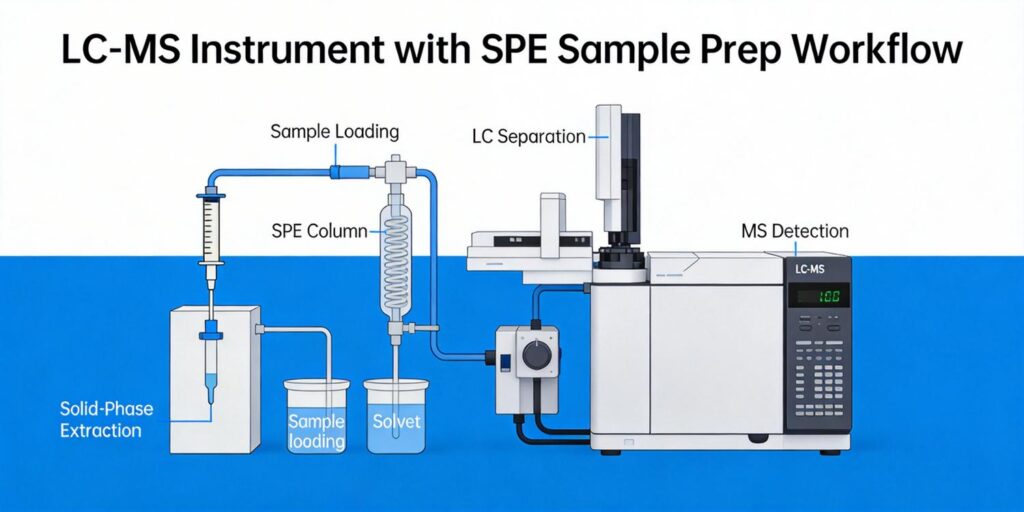
- On-line SPE-LC/MS: Direct coupling with liquid chromatography-mass spectrometry systems
- Automated Evaporation/Reconstitution: Integration of solvent evaporation and sample reconstitution steps
- Direct Injection Capability: Elution directly into analytical instrument sample loops
Method Development and Optimization
Automated SPE workstations excel at method development through systematic optimization of key parameters:
| Parameter | Optimization Approach |
|---|---|
| Sorbent Selection | Parallel testing of different sorbent chemistries |
| Solvent Optimization | Systematic variation of solvent compositions and volumes |
| Flow Rate Optimization | Precise control and testing of different flow rates |
| pH Optimization | Automated adjustment of sample and solvent pH |
Applications in Modern Laboratories
Automated SPE systems find applications across diverse fields:
Pharmaceutical and Clinical Research
In drug discovery and development, automated SPE enables high-throughput analysis of pharmacokinetic samples, metabolite profiling, and bioanalytical method development. The consistency of automated systems is particularly valuable for GLP/GMP compliant laboratories.
Environmental Analysis
Environmental laboratories benefit from automated SPE for monitoring pesticides, PAHs, and other contaminants in water samples. The ability to process large sample volumes with minimal solvent usage aligns with green chemistry principles.
Forensic Toxicology
Forensic laboratories use automated SPE for drug screening in biological matrices. Complex extraction procedures involving multiple wash and elution steps are ideally suited for automation, improving both throughput and reproducibility.
Food Safety and Quality Control
Automated SPE systems enable rapid screening of contaminants, mycotoxins, and residues in food products, supporting compliance with food safety regulations.
Future Trends and Considerations
As analytical demands continue to evolve, automated SPE systems are adapting to meet new challenges:
- Miniaturization: Development of smaller bed mass cartridges and plates for limited sample volumes
- Increased Automation: Integration of pre- and post-SPE steps into fully automated workflows
- Smart Systems: Implementation of artificial intelligence for method optimization and troubleshooting
- Sustainability: Focus on reducing solvent consumption and waste generation
When implementing automated SPE, laboratories should carefully assess their specific needs, considering factors such as sample volume, method complexity, regulatory requirements, and available budget. Successful automation requires proper planning, staff training, and realistic expectations about implementation timelines.
For laboratories seeking to enhance their SPE capabilities, Poseidon Scientific offers a comprehensive range of HLB SPE cartridges, MAX SPE cartridges, MCX SPE cartridges, WAX SPE cartridges, WCX SPE cartridges, and 96-well SPE plates that are compatible with most automated SPE systems.