
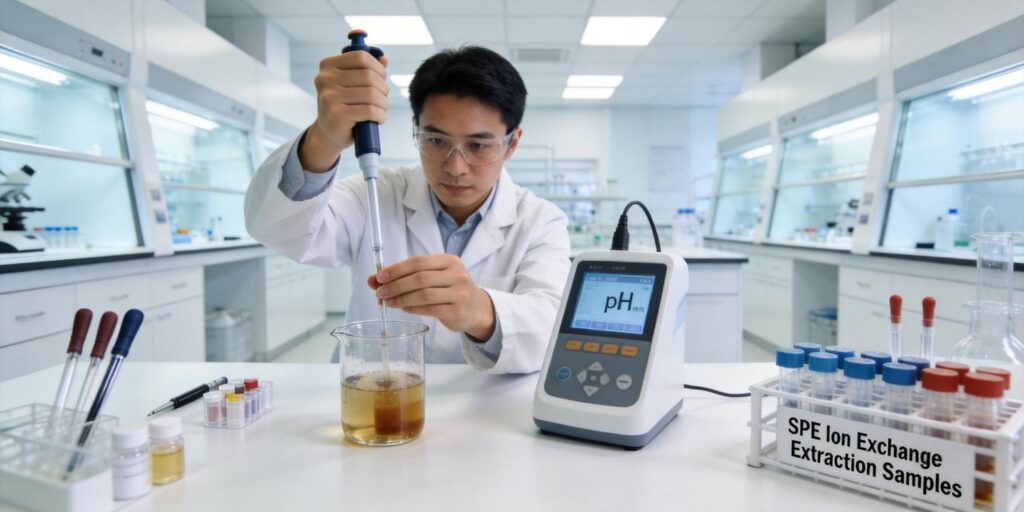
Ionization of Analytes in Acidic and Basic Environments
The foundation of ion exchange solid-phase extraction (SPE) lies in understanding how analytes ionize under different pH conditions. According to the Brønsted-Lowry theory, acids donate protons while bases accept them. The extent of ionization is quantified by the acid dissociation constant (Ka) and its negative logarithm, pKa.
For weak acids like acetic acid (CH3COOH), dissociation in water is minimal—typically around 1%—forming hydronium ions (H3O+) and acetate ions (CH3COO–). The pKa represents the pH at which an analyte is 50% ionized. To achieve approximately 99% ionization, the sample pH should be at least two units above the pKa for acidic compounds and two units below for basic compounds.
This principle is critical in SPE method development. For instance, ibuprofen (pKa = 5.9) shows increased recovery on hydrophobic phases when sample pH is lowered from 6.0 to 5.0 because the drug becomes less ionized and more available for hydrophobic interactions. Conversely, for ion exchange mechanisms, analytes must be in their ionic form to interact with oppositely charged sorbents.
Mechanism of Cation and Anion Exchange Interactions
Ion exchange SPE operates through electrostatic interactions between charged analytes and oppositely charged functional groups on the sorbent surface. These interactions are fundamentally different from hydrophobic or polar mechanisms and offer superior selectivity for ionic compounds.
Cation Exchange
Cation exchange sorbents contain negatively charged functional groups such as benzenesulfonic acid (strong), propylsulfonic acid (strong), or carboxylic acid (weak). Basic analytes are manipulated to carry positive charges by adjusting pH below their pKa values. Common applications include extraction of basic drugs, catecholamines, pharmaceuticals, herbicides, and positively charged metal ions.
The kinetics of ion exchange are slower than non-polar or polar mechanisms due to several factors: slow diffusion of ionic species (which often drag water molecules, increasing their effective size) and the displacement process of counter-ions associated with the ion exchanger. This has practical implications for sample loading rates and elution volumes.
Anion Exchange
Anion exchange sorbents feature positively charged functional groups, typically quaternary ammonium compounds. Acidic analytes are manipulated to carry negative charges by adjusting pH above their pKa values. These sorbents are particularly effective for extracting organic acids, wine acids, halides, and other anionic species.
Copolymeric Mixed-Mode Exchange
Mixed-mode sorbents combine ion exchange with hydrophobic interactions, offering enhanced selectivity. For example, mixed-mode cation exchange/hydrophobic phases (like SCX/C8) allow simultaneous retention of basic drugs through ionic interactions and neutral/acidic compounds through hydrophobic interactions. This enables class separation on a single column—acids, neutrals, and bases can be selectively eluted using different solvent combinations.
pH Adjustment Strategies Before Sample Loading
Proper pH adjustment before sample application is crucial for successful ion exchange SPE. The buffer serves two primary purposes: controlling sample pH (and thus analyte ionization state) and modifying ionic strength. Both effects improve extraction reproducibility, with proper pH selection always enhancing recovery.
When using ion exchange columns, it’s recommended to apply 1 mL of buffer after conditioning to ensure optimal sorbent pH for desired interactions. The analyte and sorbent should carry opposite charges: anions [-] on anion-exchange sorbents [+]; cations [+] on cation-exchange sorbents [-]. During sample application, the analyte binds by displacing a counter-ion on the sorbent.
It’s important to note that quoted pKa values pertain to specific conditions of temperature, concentration, and environment. The effective acidity or basicity near a bonded silica surface may differ significantly. Therefore, while literature values provide guidance, experimental verification is essential.
Maintaining Optimal Ionic Conditions During Washing
The washing step in ion exchange SPE serves to remove interferences while retaining target analytes. Ionic bonds are strong enough to withstand washing with high percentages (up to 100%) of polar or nonpolar organic solvents, providing excellent cleanup capabilities.
For optimal washing, maintain pH at least two units away from the relevant pKa of both analyte and sorbent to ensure both remain charged. For copolymeric mixed-mode sorbents, high organic strength washes can remove interferences retained by hydrophobic interactions, while aqueous or weak aqueous/organic washes can disrupt ionic binding for polar interferences.
Drying the column between aqueous and organic phases is critical. Maximum vacuum for 5 minutes typically ensures proper drying—if the column feels cold, solvent is still evaporating. Proper drying prevents water from interfering with subsequent elution steps, especially important for GC analysis where water can damage injection liners and columns.
Elution Strategies Using pH Change or Ionic Strength
Elution in ion exchange SPE typically employs one of two strategies: displacement by a stronger counter-ion or neutralization of the sorbent or analyte through pH change. In practice, these mechanisms often operate simultaneously.
pH-Based Elution
For cation exchange, basic elution solvents (typically containing ammonium hydroxide) neutralize analytes by raising pH above their pKa values. For anion exchange, acidic elution solvents lower pH below analyte pKa values. The elution solvent pH should be at least two units above the analyte pKa for basic compounds or two units below for acidic compounds to ensure complete neutralization.
Ammonium hydroxide solutions require careful handling as they quickly lose potency when exposed to air. Fresh preparation and small bottle purchases are recommended to maintain consistent pH.
Ionic Strength-Based Elution
High ionic strength buffers containing stronger counter-ions can displace analytes through competitive binding. The selectivity of counter-ions follows established patterns: for cations, selectivity typically increases with charge density and size; for anions, selectivity varies with hydration energy and polarizability.
Mixed-Mode Elution
For copolymeric sorbents, elution requires simultaneous disruption of both ionic and hydrophobic interactions. Solvent mixtures combining organic solvents with acidic or basic additives (e.g., methylene chloride-isopropanol-ammonium hydroxide) provide superior cleanup by selectively eluting target analytes while leaving more ionic and polar interferences on the column.
Case Study in Drug Metabolite Extraction
A practical example demonstrates the power of pH-controlled ion exchange SPE. Consider the extraction of a neutral drug and its acidic metabolite using a copolymeric anion-exchange column. When applied at pH 6.0, the acidic metabolite’s carboxylic acid groups may be negatively charged, allowing ionic bonding to the positively charged sorbent, while the neutral parent drug bonds through hydrophobic interactions.
After washing with water or weak aqueous buffer (pH 6.0) to remove hydrophilic interferences, the column is dried. The neutral parent drug is then eluted with a minimally polar solvent like hexane/ethyl acetate (80:20). Finally, the acidic metabolite is eluted using an acid to neutralize its charge, releasing ionic interaction and allowing elution in an appropriate solvent mixture.
This approach has been successfully applied in forensic and clinical applications for drugs of abuse screening, where mixed-mode materials with C8/strong cation exchange (SCX) phases separate compounds into classes based on their ionization properties and hydrophobic characteristics.
Common Mistakes When Adjusting pH in SPE Workflows
Several common errors can compromise ion exchange SPE results:
1. Overreliance on Literature pKa Values
While pKa values provide useful guidance, the effective acidity or basicity near bonded silica surfaces often differs from solution values. Always verify pH conditions experimentally rather than relying solely on literature data.
2. Inadequate pH Control During Elution
For cation exchange, the elution solvent pH must be at least two units above the analyte pKa to fully protonate compounds. Ammonium hydroxide solutions degrade when exposed to air, leading to inconsistent results. Use fresh solutions and proper storage.
3. Insufficient Drying Between Steps
Residual water interferes with organic elution solvents, reducing recovery and selectivity. Proper drying (5 minutes under maximum vacuum) is essential, especially when changing between aqueous and organic phases.
4. Excessive Flow Rates
Ion exchange kinetics are slower than other SPE mechanisms. Sample loading at rates exceeding 1-1.5 mL/min can reduce retention efficiency. Similarly, elution benefits from slower flow rates, with gravity flow often providing optimal results.
5. Neglecting Ionic Strength Effects
High ionic strength can compete with analyte binding, reducing retention. Conversely, too low ionic strength may not provide adequate buffering capacity. Balance pH control with appropriate ionic strength for reproducible results.
6. Incomplete Counter-Ion Conversion
When switching counter-ions on specialty columns (e.g., from chloride to acetate), incomplete conversion reduces binding capacity. For higher selectivity ions, use 2-5 bed volumes of 1M buffer; for lower selectivity ions, calculate based on selectivity ratios.
By understanding these principles and avoiding common pitfalls, analysts can leverage ion exchange SPE for highly selective extractions with excellent cleanup, particularly valuable in complex matrices like biological fluids, environmental samples, and forensic specimens.


