
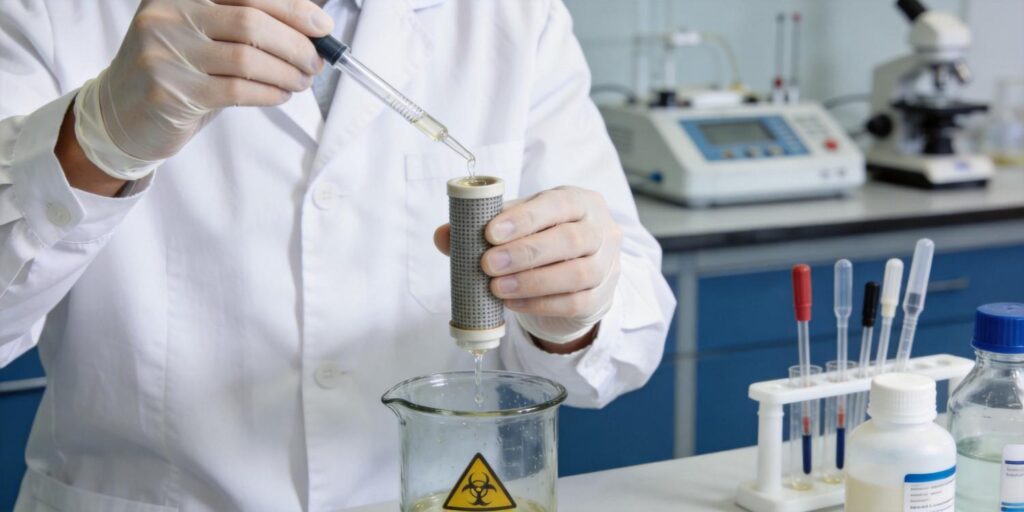
Purpose of Conditioning in SPE Workflows
Solid-phase extraction (SPE) conditioning serves as the critical foundation for successful analyte recovery and reproducible results. When SPE cartridges are shipped, they arrive in a dry state for stability and packaging purposes. The primary function of conditioning is to activate the sorbent’s functional groups by expanding them away from the solid surface, exposing them to the diffusive flow of samples and reagents.
According to established SPE literature, conditioning achieves several essential objectives:
- Wetting the hydrophobic surface: For reversed-phase sorbents like C18, C8, or polymeric phases, the bonded alkyl chains must be solvated to create a receptive stationary phase. Without proper conditioning, these “waterproof” surfaces cannot effectively interact with aqueous samples.
- Opening the bonded phase structure: Conditioning solvents penetrate into the bonded layer, allowing water molecules and analytes to diffuse into the bonded phase. This creates the most open structure possible for optimal analyte interaction.
- Removing contaminants: The conditioning step helps extract impurities from improperly purified sorbents, including residual hydrocarbons, plasticizers, and other extractables that could interfere with sensitive analytical methods.
- Reducing interfacial tension: Conditioning lowers the interfacial surface tension between the solid phase and aqueous sample, improving the kinetics of partitioning and allowing better penetration of sorbent pores.
Selecting Proper Conditioning Solvents
The choice of conditioning solvent depends on several factors including the sorbent chemistry, analyte properties, and sample matrix. Characteristics of an ideal conditioning solvent include:
- Complete miscibility with aqueous matrices
- Low surface tension for easy diffusion into sorbent pores
- High mass transfer of hydrogen-carbon bonds with sorbent alkyl chains
- Universal elution capability for polar and nonpolar contaminants
Methanol is the most commonly used conditioning solvent for reversed-phase applications because it meets all these criteria effectively. Research shows methanol wets the surface of the sorbent and penetrates bonded alkyl phases, allowing water to wet the silica surface efficiently. The solvent vapor travels up and floods into the chamber where it comes into contact with the sample, with the condenser ensuring any solvent vapor cools and drips back down.
For certain applications, isopropanol can be particularly effective for hydrocarbon-like C18 silica sorbents. Its surface tension (20.93 mN/m) is closest among commonly used alcohols to that of hexane (19.65 mN/m), which resembles the sorbent surface. Isopropanol is completely miscible with hexane, whereas methanol is only partially miscible.
Other solvents like acetonitrile or tetrahydrofuran may be selected based on specific application requirements, though methanol remains the universal choice for most reversed-phase SPE workflows.
Equilibration Steps to Prepare the Sorbent
Following conditioning, equilibration prepares the sorbent bed for sample loading by replacing the organic conditioning solvent with a solvent similar to the sample matrix. The standard equilibration protocol involves:
- Conditioning: Typically 3-5 mL of methanol (or appropriate organic solvent) passed through the sorbent bed at controlled flow rates (0.5-3.0 mL/min)
- Equilibration: 3-5 mL of water or aqueous buffer passed through to remove excess organic solvent and prepare the bed for aqueous sample loading
The equilibration step serves several critical functions:
- Removing excess organic solvent that could interfere with analyte retention
- Establishing the proper chemical environment for optimal analyte-sorbent interactions
- Preventing channeling by maintaining proper bed solvation
- Ensuring consistent flow characteristics during sample loading
Proper flow control during equilibration is essential. Excessive flow rates (typically above 3.0 mL/min) or excessive vacuum can create channels or tunnels in the sorbent bed. Channeling reduces available surface area for sample contact, effectively decreasing sorbent capacity and compromising recovery. Flow rates between 0.5 and 3.0 mL/min generally allow sufficient solvent-sorbent contact for proper solvation without causing channeling.
Impact of Incomplete Conditioning on Analyte Recovery
Incomplete or improper conditioning directly impacts analyte recovery through several mechanisms:
Reduced Sorbent Capacity
When sorbent functional groups remain collapsed or inaccessible due to insufficient solvation, the effective surface area available for analyte interaction decreases significantly. This reduction in capacity means analytes may breakthrough prematurely or fail to be retained altogether.
Poor Wettability and Flow Issues
Inadequately conditioned hydrophobic sorbents resist aqueous sample penetration, leading to uneven flow patterns, increased backpressure, and potential sample loss through channeling. The sample may take the path of least resistance rather than interacting uniformly with the sorbent bed.
Inconsistent Secondary Interactions
For silica-based sorbents, residual silanol groups play a significant role in secondary interactions, particularly with basic compounds. Incomplete conditioning affects how these silanols are exposed and available for interaction, leading to variable retention behavior and recovery.
Channeling and Reduced Efficiency
As noted in forensic SPE applications, excessive flow during conditioning or allowing the bed to dry completely can create channels in the sorbent bed. Once channels form, reconditioning will not correct the problem, and the cartridge should be replaced. Channeling reduces extraction efficiency because successive liquid steps will flow faster through the channels, reducing contact time for effective mass transfer.
Solvent Volume Recommendations
Optimal solvent volumes for conditioning and equilibration depend on cartridge size, sorbent mass, and specific application requirements:
Standard Cartridge Guidelines
- 1 mL cartridges: 1-2 mL conditioning solvent, followed by 1-2 mL equilibration solvent
- 3 mL cartridges: 3-5 mL conditioning solvent, followed by 3-5 mL equilibration solvent
- 6 mL cartridges: 5-10 mL conditioning solvent, followed by 5-10 mL equilibration solvent
Sorbent Mass Considerations
- 30-60 mg sorbent: 1-3 mL conditioning, 1-3 mL equilibration
- 100-200 mg sorbent: 3-5 mL conditioning, 3-5 mL equilibration
- 500-1000 mg sorbent: 5-10 mL conditioning, 5-10 mL equilibration
The general rule is to use sufficient solvent to completely wet the sorbent bed and replace the void volume 2-3 times. For most applications, 3-5 mL of methanol followed by 3-5 mL of water or buffer provides adequate conditioning and equilibration for standard 3 mL cartridges containing 100-500 mg of sorbent.
Flow Rate Considerations
Solvent viscosity significantly affects processing speed. Methanol (viscosity 0.6 cP at 20°C) flows approximately twice as fast as ethanol (1.2 cP) and four times faster than isopropanol (2.37 cP). When time is critical, methanol may be preferred despite potentially different elutropic properties.
Differences for Polymeric vs Silica Cartridges
While the fundamental principles of conditioning apply to both polymeric and silica-based SPE cartridges, important differences exist in their conditioning requirements:
Silica-Based Cartridges
Silica sorbents feature surface silanol groups that play a significant role in secondary interactions. The conditioning process for silica-based phases must consider:
- Silanol activity: Residual silanols can interact with basic analytes through cation-exchange mechanisms
- pH sensitivity: Silica stability varies with pH, typically stable between pH 2-8
- Water content: Excessive water carry-over to subsequent analytical steps (like GC) can be problematic with silica sorbents due to both chemical binding and physical retention in pores
For silica-based reversed-phase sorbents, the conditioning solvent penetrates into the bonded layer and permits water molecules and analytes to diffuse into the bonded phase. After conditioning, water is passed to remove excess solvent prior to adding the sample.
Polymeric Cartridges
Polymeric sorbents like polystyrene-divinylbenzene (PS-DVB) or specialized polymers like those in Poseidon Scientific’s HLB cartridges offer distinct advantages:
- Wider pH stability: Typically stable from pH 1-14
- Reduced secondary interactions: Absence of silanol groups eliminates cation-exchange interactions with basic compounds
- Higher capacity: Polymeric sorbents often provide 2-3 times greater capacity than silica-based equivalents
- Better water compatibility: Reduced water carry-over concerns for subsequent analytical steps
Polymeric sorbents generally require similar conditioning protocols but may be more forgiving of minor variations in solvent volumes or flow rates. Their higher capacity means you can often use less sorbent mass compared to silica-based alternatives.
Conditioning Efficiency Comparison
Research indicates that solvent effects on sorbent retention are generally less important for polymeric sorbents than for silica-based materials. The system constants for various sample processing solvents show smaller variations for polymeric phases, making method transfer between laboratories more straightforward.
Quality Control Checks Before Loading Samples
Implementing quality control checks after conditioning and before sample loading ensures consistent SPE performance and reliable results:
Visual Inspection
- Bed integrity: Check for cracks, channels, or settling in the sorbent bed
- Proper wetting: Ensure the entire sorbent bed appears uniformly wetted without dry spots
- Frit condition: Verify that inlet and outlet frits are properly seated and free from debris
Flow Rate Verification
- Consistent flow: Apply a small volume of equilibration solvent and observe flow characteristics
- Proper drainage: Ensure the bed drains appropriately without excessive solvent retention
- No air bubbles: Check for air entrapment that could indicate channeling or poor wetting
Chemical Environment Confirmation
- pH verification: For pH-sensitive applications, confirm the effluent pH matches expected values
- Solvent compatibility: Ensure no immiscibility issues between conditioning solvent and sample matrix
- Ionic strength: For ion-exchange applications, verify proper ionic environment establishment
Procedural Controls
- Timing: Load samples immediately after equilibration to prevent bed drying
- Solvent evaporation: Allow gravity flow to remove excess solvent but avoid complete drying
- Consistency: Maintain consistent flow rates and volumes across all samples in a batch
Troubleshooting Common Issues
If you encounter problems during conditioning or equilibration:
- Excessive flow resistance: Reduce applied vacuum or pressure; check for bed compaction
- Poor wetting: Increase conditioning solvent volume or contact time
- Channeling: Replace cartridge if channels have formed; improve flow control in future runs
- Inconsistent recovery: Standardize conditioning protocols and verify solvent purity
Proper conditioning and equilibration form the foundation of successful SPE workflows. By understanding the principles behind these critical steps and implementing consistent protocols, laboratories can achieve reproducible, high-recovery extractions across diverse applications. Whether working with silica-based sorbents like C18 or advanced polymeric phases like HLB, attention to conditioning details pays dividends in analytical performance and data quality.


