
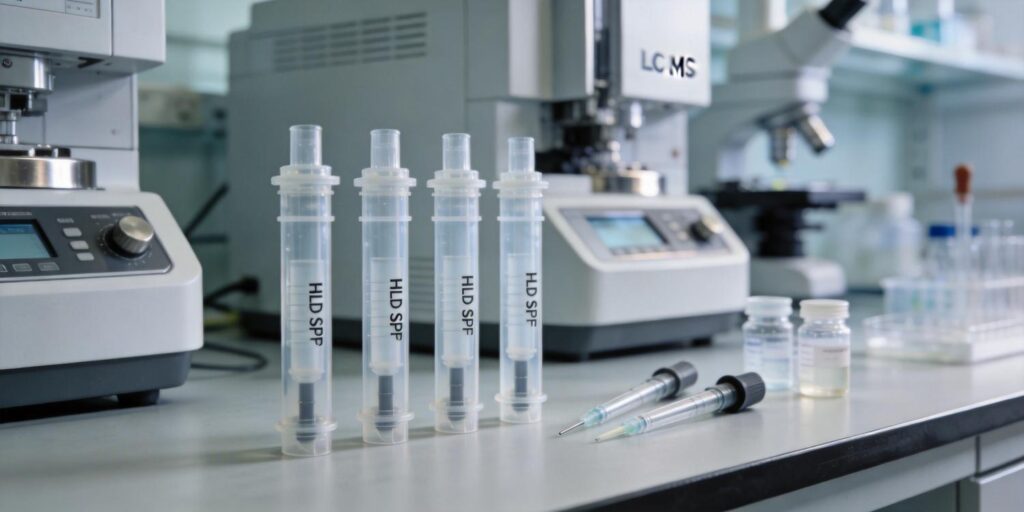
Structural Composition of Hydrophilic-Lipophilic Balanced (HLB) Polymeric Sorbents
Hydrophilic-lipophilic balanced (HLB) polymeric sorbents represent a significant advancement in solid-phase extraction technology, first introduced commercially in 1996 with Waters’ Oasis HLB. Unlike traditional silica-based sorbents, HLB materials are constructed from a unique water-wettable copolymer that combines both hydrophilic and lipophilic properties in a balanced architecture.
The fundamental structure of HLB sorbents typically involves a polymeric backbone, often based on styrene-divinylbenzene (SDVB) or similar copolymers, that has been specifically engineered to incorporate both hydrophobic and hydrophilic moieties. This balanced composition is achieved through careful selection and polymerization of monomers with different polarity characteristics. As noted in the literature, “The proper choice of the main monomer and/or cross-linking agent can moderate the overall hydrophobicity of the completely organic sorbent” (Pesek and Matyska, 2000).
The hydrophilic components are typically incorporated through functional groups such as N-vinylpyrrolidone or other polar monomers, while the lipophilic character comes from aromatic or aliphatic hydrocarbon chains. This dual nature creates a sorbent that is “water-wettable” – a critical property that distinguishes HLB materials from traditional polymeric sorbents. The balanced structure allows the sorbent to maintain its retention properties across a wide range of aqueous and organic solvent conditions without requiring extensive conditioning steps.
Mechanisms of Reversed-Phase and Hydrophilic Interactions in HLB Materials
HLB sorbents operate through a sophisticated combination of retention mechanisms that enable them to capture a broad spectrum of analytes. The primary retention mechanisms include:
Reversed-Phase Interactions
The lipophilic components of HLB sorbents provide traditional reversed-phase retention through hydrophobic interactions. These involve van der Waals forces and non-polar interactions between the hydrophobic regions of the sorbent and non-polar analytes. As described in SPE literature, “The high degree of hydrophobicity of these polymeric materials generally gives them a large capacity” (Pesek and Matyska, 2000). This reversed-phase character allows HLB sorbents to retain non-polar compounds, including hydrocarbons, steroids, and various pharmaceutical compounds.
Hydrophilic Interactions
The hydrophilic components enable retention of polar compounds through mechanisms including hydrogen bonding, dipole-dipole interactions, and π-π interactions. These polar interactions occur when “a distribution of electrons between individual atoms in functional groups is unequal, causing negative and positive polarity” (Forensic and Clinical Applications of Solid Phase Extraction). This dual functionality allows HLB sorbents to retain compounds that would typically be poorly retained on traditional reversed-phase sorbents.
The balanced nature of HLB sorbents means they can simultaneously retain both polar and non-polar compounds, making them particularly valuable for multi-residue analysis where analytes span a wide range of polarities.
Comparison with Traditional Silica-Based C18 Sorbents
HLB polymeric sorbents offer several distinct advantages over traditional silica-based C18 materials:
Water-Wettability and Simplified Protocols
Unlike silica-based C18 sorbents that require conditioning and equilibration steps to wet the hydrophobic surface, HLB sorbents are inherently water-wettable. As Waters documentation notes, “Since Oasis HLB is a water-wettable sorbent, the analytes can interact with the sorbent and are retained when loaded directly onto the sorbent in an aqueous sample solution. This eliminates the condition and equilibration steps from the traditional solid-phase extraction protocol and reduces the number of processing steps from 5 to 3” (Waters Oasis Catalog). This simplification results in significant time savings and reduced solvent consumption.
Absence of Silanol Interactions
Silica-based sorbents contain residual silanol groups that can cause secondary interactions, particularly with basic compounds. These interactions can lead to irreversible adsorption or poor recovery. HLB polymeric sorbents, being completely organic, eliminate these silanol interactions, providing more predictable and reproducible recovery for a wide range of compounds, especially basic pharmaceuticals.
Enhanced Capacity for Polar Compounds
While C18 sorbents excel at retaining non-polar compounds, they often struggle with highly polar analytes. HLB sorbents, with their balanced chemistry, provide superior retention for polar compounds while maintaining excellent retention for non-polar species. This makes them particularly valuable for environmental applications where polar degradation products must be captured along with parent compounds.
pH Stability Advantages of Polymeric Sorbents
One of the most significant advantages of HLB polymeric sorbents is their exceptional pH stability. Traditional silica-based sorbents are limited to a pH range of approximately 2-8 due to the hydrolysis of siloxane bonds at extreme pH values. In contrast, HLB polymeric sorbents are stable across the entire pH range from 0-14.
This pH stability offers several practical advantages:
Method Development Flexibility
Analysts can use strong acids or bases for sample pretreatment or elution without concern for sorbent degradation. This allows for more aggressive cleanup strategies and improved recovery of challenging analytes.
Long-Term Storage Stability
HLB cartridges can be stored under a wider range of conditions without degradation of performance, making them more robust for routine laboratory use.
Reduced Method Variability
The stability of polymeric sorbents across pH extremes reduces method variability that can occur with silica-based sorbents when pH conditions drift slightly outside the optimal range.
As noted in the literature, “At present the main advantage of polymeric materials lie in their ability to withstand pH extremes not achievable with silica-based sorbents” (Pesek and Matyska, 2000).
Applications in Pharmaceutical and Environmental Analysis
HLB sorbents have found widespread application in both pharmaceutical and environmental analysis due to their versatile retention properties.
Pharmaceutical Applications
In pharmaceutical analysis, HLB sorbents are particularly valuable for:
- Bioanalytical Sample Preparation: Extraction of drugs and metabolites from biological matrices such as plasma, serum, and urine
- Multi-Class Drug Screening: Simultaneous extraction of acidic, basic, and neutral compounds from complex matrices
- Impurity Profiling: Cleanup of pharmaceutical formulations for impurity analysis
- Metabolite Studies: Capture of both parent drugs and their metabolites with varying polarities
Environmental Applications
Environmental laboratories benefit from HLB sorbents for:
- Multi-Residue Pesticide Analysis: Simultaneous extraction of pesticides and their degradation products with varying polarities
- Emerging Contaminant Monitoring: Extraction of pharmaceuticals, personal care products, and endocrine disruptors from water samples
- Wide Polarity Range Compounds: Capture of compounds ranging from non-polar PCBs to polar herbicides
- Water Quality Monitoring: Trace enrichment of contaminants from large volume water samples
Example Workflow Using HLB Cartridges for Multi-Analyte Extraction
A typical workflow for multi-analyte extraction using HLB cartridges demonstrates the simplicity and efficiency of this technology:
Step 1: Sample Loading
Unlike traditional SPE methods, HLB cartridges do not require conditioning or equilibration steps. The aqueous sample can be loaded directly onto the sorbent. For optimal recovery, the sample pH should be adjusted to ensure analytes are in their neutral form for maximum hydrophobic interaction.
Step 2: Washing
A wash step using 5% methanol in water is typically employed to remove weakly retained matrix components while maintaining retention of target analytes. The water-wettable nature of HLB sorbents ensures that the sorbent bed does not dry out during this step, maintaining optimal retention conditions.
Step 3: Elution
Target analytes are eluted using an appropriate organic solvent, typically methanol or acetonitrile, or mixtures thereof. The balanced nature of HLB sorbents allows for efficient elution of both polar and non-polar compounds with relatively small solvent volumes.
This simplified three-step protocol represents a significant improvement over traditional five-step SPE methods, resulting in “an average reduction in solvent consumption of up to 70% and a 40% savings in sample preparation time” (Waters Oasis Catalog).
Practical Tips for Optimizing HLB SPE Performance
Flow Rate Optimization
Maintain consistent flow rates during sample loading and elution. Excessive flow rates can lead to breakthrough of analytes, particularly for highly polar compounds. Typical flow rates range from 1-5 mL/min for 1-3 cc cartridges.
pH Adjustment
For optimal retention of ionizable compounds, adjust sample pH to suppress ionization. For acidic compounds, use pH 2-3; for basic compounds, use pH 9-10. The pH stability of HLB sorbents allows for aggressive pH adjustment without sorbent degradation.
Solvent Selection
Choose elution solvents based on analyte polarity. Methanol is generally effective for most applications, but acetonitrile or methanol-acetonitrile mixtures may provide better recovery for specific compound classes.
Cartridge Capacity Considerations
Select appropriate cartridge sizes based on sample volume and analyte concentration. HLB sorbents typically offer higher capacity than silica-based sorbents, but overloading can still occur with highly concentrated samples or complex matrices.
Matrix Effects Management
For complex matrices, consider using additional cleanup steps or selecting specialized HLB products like Oasis PRiME HLB, which is designed to remove “95% of common matrix interferences such as salts, proteins, and phospholipids” (Waters Oasis Catalog).
Method Validation
Always validate recovery for target analytes in your specific matrix. While HLB sorbents offer broad-spectrum retention, recovery may vary for specific compounds and should be verified experimentally.
The balanced chemistry of HLB sorbents, combined with their pH stability and simplified protocols, makes them an excellent choice for a wide range of sample preparation applications. Their ability to retain compounds across a broad polarity range while eliminating the need for conditioning steps represents a significant advancement in SPE technology that benefits both routine analysis and method development laboratories.


