
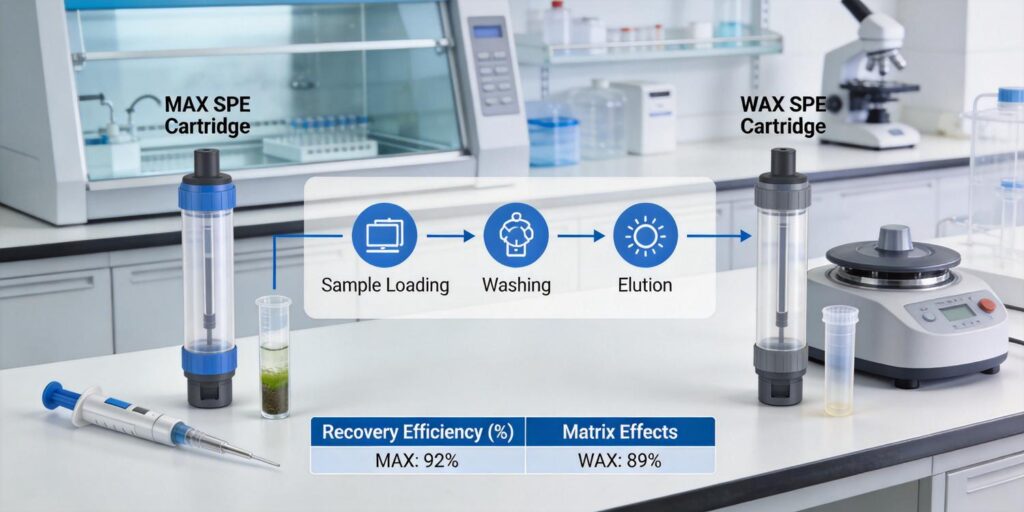
Differences Between Strong and Weak Anion Exchange Sorbents
In solid phase extraction (SPE), understanding the fundamental differences between strong and weak anion exchange sorbents is crucial for selecting the appropriate cartridge for acidic compound extraction. The key distinction lies in their ionization behavior across the pH spectrum.
MAX (Mixed-mode Anion eXchange) is a strong anion exchange sorbent featuring a quaternary amine functional group that remains positively charged across the entire pH range (0-14). This means it maintains its ion-exchange capacity regardless of sample pH, providing consistent retention for acidic compounds. According to Waters documentation, MAX has a tightly controlled ion-exchange capacity of 0.25 meq/g, ensuring reproducible SPE protocols for extraction of acidic compounds and metabolites from biological fluids.
WAX (Weak Anion eXchange), in contrast, contains a weak anion exchange functional group with a pKa around 6. This means it’s only charged within a specific pH range and can be neutralized under certain conditions. As noted in forensic SPE literature, “Weak ion-exchangers are only charged in a given pH range and can be neutralized to release strong anions and cations.” This property makes WAX particularly suitable for strong acidic compounds with pKa values below 1.0.
The structural differences translate to practical implications: strong ion-exchangers like MAX require neutralization of the analyte itself for elution, while weak ion-exchangers like WAX allow neutralization of either the analyte or the sorbent, providing more flexibility in method development.
Chemical Characteristics of Acidic Analytes Affecting Retention
The retention behavior of acidic compounds on anion exchange sorbents depends primarily on their pKa values and degree of ionization. According to fundamental SPE principles, acidic compounds are negatively charged above their pKa, with approximately 99% ionization occurring at pH values 2 units above the pKa.
Strong acids (pKa < 1.0), such as sulfonic acids and certain pharmaceuticals, remain ionized across most of the pH range and require specialized sorbents like WAX for optimal retention. These compounds include sulfonates, phosphates, and other highly acidic functional groups that maintain negative charges even at low pH.
Weak to moderate acids (pKa 2-8), including carboxylic acids, phenols, and many pharmaceutical compounds, exhibit pH-dependent ionization. These compounds are best retained on MAX sorbents when sample pH is adjusted to at least 2 units above their pKa to ensure complete ionization.
The degree of ionization directly impacts retention efficiency. As noted in forensic applications, “The extent of the dissociation of any weak acid in water is indicated by the magnitude of its acid dissociation constant (Ka), which is the equilibrium constant for the dissociation reaction for that acid.” Understanding these ionization characteristics is essential for predicting retention behavior on both MAX and WAX sorbents.
Sample pH Adjustment Strategies for MAX vs WAX
Proper pH adjustment is critical for maximizing retention efficiency on both MAX and WAX sorbents, though the strategies differ significantly due to their distinct chemical properties.
MAX pH Strategy
For MAX sorbents, sample pH should be adjusted to at least 2 pH units above the pKa of the target acidic compounds. This ensures complete ionization of weak to moderate acids, allowing optimal interaction with the permanently charged quaternary amine groups. Common approaches include:
- Adding ammonium hydroxide or sodium hydroxide to raise pH
- Using buffer systems like ammonium acetate or phosphate buffers at pH 8-9
- Adjusting to pH 9-10 for compounds with pKa values around 6-7
WAX pH Strategy
For WAX sorbents, pH adjustment focuses on maintaining the sorbent’s charge state while ensuring analyte ionization. Since WAX has a pKa around 6, it remains charged at pH values below this point. Recommended strategies include:
- Adjusting sample pH to 4-6 to maintain sorbent charge while ionizing strong acids
- Using formic acid or acetic acid buffers for pH control
- For very strong acids (pKa < 1), pH can be as low as 2-3 while maintaining retention
As noted in ion-exchange principles, “When using weak ion-exchangers with weak acids or bases, we can choose to neutralize either the compounds themselves or the packing depending on what conditions we hope to achieve in the final elution.” This flexibility is a key advantage of WAX sorbents.
Washing Solvent Strength and Selectivity Considerations
Washing steps are crucial for removing interferences while retaining target analytes. The choice of washing solvents differs between MAX and WAX due to their different retention mechanisms.
MAX Washing Strategy
For MAX sorbents, washing typically involves:
- Water or aqueous buffers at pH 8-9 to remove hydrophilic interferences while maintaining ionic interactions
- Methanol or methanol-water mixtures (20-40%) to remove moderately polar interferences through reversed-phase interactions
- 2% formic acid in water or methanol to protonate and remove weakly retained acidic compounds
The Waters Oasis documentation shows a typical MAX protocol with “Wash 1: 2% Formic acid” followed by “Wash 2 or Elute 1: 100% MeOH,” demonstrating the sequential removal of different interference classes.
WAX Washing Strategy
For WAX sorbents, washing protocols are designed to maintain the weak anion exchange interaction:
- Water or weak acidic buffers (pH 4-6) to remove neutral and basic interferences
- Methanol or acetonitrile with 1-2% formic acid to remove compounds retained through reversed-phase interactions
- 5% ammonium hydroxide in methanol as a wash step in some protocols to remove specific interference classes
The selectivity of washing steps is enhanced by the mixed-mode nature of both sorbents. As noted in forensic applications, “By matrix and sorbent manipulations, drug classes can be quantitatively isolated, then selectively eluted for chromatographic analysis.”
Elution Strategies for Both Cartridge Types
Elution strategies differ fundamentally between MAX and WAX due to their strong vs weak anion exchange characteristics.
MAX Elution Strategy
Since MAX maintains its positive charge across all pH values, elution requires neutralization of the acidic analytes themselves. This is typically achieved by:
- Acidic elution solvents: 2-5% formic acid in methanol or acetonitrile
- Combination eluents: Methanol with hydrochloric acid or trifluoroacetic acid
- Two-step elution: First with organic solvent (100% MeOH) to elute neutral compounds, then with acidic solvent to elute ionized acids
The Waters protocol shows “Elute 2: 5% NH4OH in MeOH” for some applications, though acidic elution is more common for acidic compounds.
WAX Elution Strategy
For WAX sorbents, elution can be achieved by either neutralizing the analyte or neutralizing the sorbent, providing greater flexibility:
- Acidic elution: 2% formic acid in methanol to protonate acidic analytes (neutralize analyte)
- Basic elution: 5% ammonium hydroxide in methanol to neutralize the weak anion exchange sites (neutralize sorbent)
- High ionic strength elution: Buffers with competing anions to displace analytes
As noted in ion-exchange principles, “In the case of weak ion-exchangers, neutralization can occur on either the sorbent or the analyte of interest. Either will disrupt the bond of the desired compound.”
Comparative Recovery Results for Environmental Acids
Studies comparing MAX and WAX performance for environmental acidic compounds reveal important practical differences. While specific recovery data varies by application, general trends emerge from method development experience:
Strong Acidic Compounds (pKa < 1)
- WAX typically shows superior recovery (85-95%) for sulfonic acids, certain herbicides, and strong pharmaceutical acids
- MAX may show lower recovery (60-80%) due to overly strong retention that’s difficult to disrupt completely
- Examples include perfluorinated compounds, sulfonated dyes, and certain drug metabolites
Moderate Acidic Compounds (pKa 2-8)
- MAX typically provides excellent recovery (90-98%) for carboxylic acids, phenols, and most pharmaceutical acids
- WAX shows variable recovery (70-95%) depending on exact pKa and method conditions
- Examples include ibuprofen, salicylic acid, chlorophenols, and most environmental organic acids
Very Weak Acids (pKa > 8)
- Both sorbents may show reduced retention unless sample pH is carefully controlled
- Often better handled by reversed-phase or mixed-mode approaches
Comparative studies in forensic applications have shown that “When compared to other sample preparation techniques, SPE offers faster sample prep, lower cost, greater recoveries, greater accuracy, powerful enrichment of analytes, and additional selectivity and specificity.”
Practical Decision Guide for Method Development
Selecting between MAX and WAX for acidic compound extraction requires systematic consideration of analyte properties and method requirements. Follow this decision guide for optimal results:
Step 1: Determine Analyte pKa
- If pKa < 1.0: Start with WAX for strong acids
- If pKa 2-8: Start with MAX for moderate acids
- If pKa > 8: Consider alternative approaches or specialized methods
Step 2: Consider Sample Matrix
- Complex biological matrices: WAX often provides cleaner extracts due to different selectivity
- Environmental waters: MAX typically offers better recovery for common organic acids
- Food and beverage samples: Consider both and optimize based on specific interferences
Step 3: Evaluate Required Selectivity
- High selectivity needed: WAX may provide better discrimination between compound classes
- Broad spectrum extraction: MAX often captures wider range of acidic compounds
- Specific interference removal: Test both with your specific matrix
Step 4: Method Development Protocol
- Start with manufacturer-recommended protocols for each sorbent type
- Optimize sample pH for maximum retention (2 pH units above pKa for MAX, pH 4-6 for WAX)
- Test washing solvents to maximize interference removal while maintaining recovery
- Optimize elution conditions for complete recovery and compatibility with downstream analysis
- Validate recovery and precision with matrix-matched standards
Step 5: Consider Using Both
For challenging applications or method development, consider using Waters’ Oasis Sorbent Selection Plate or Cartridge Kits containing both MCX, MAX, WCX, and WAX sorbents. As noted in their documentation, “Having all four Oasis Ion-exchange Sorbents in a single plate or a cartridge kit is convenient for scouting the best methods to accomplish efficient isolation of unknown analytes, zwitterionic compounds, or mixtures of analytes with different retention/elution properties.”
Remember that both MAX and WAX sorbents offer the advantages of water-wettable polymeric materials stable from pH 0-14, with no silanol interactions to complicate method development. The choice ultimately depends on your specific analytes, matrix, and analytical requirements, but following this systematic approach will lead to optimal SPE method development for acidic compound extraction.


