Fundamentals of Reversed-Phase SPE
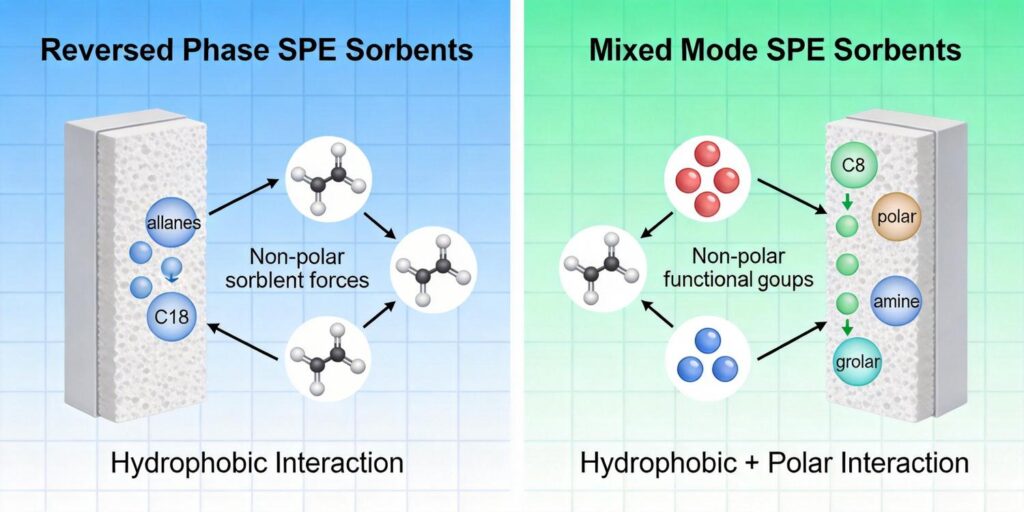
Reversed-phase solid-phase extraction (SPE) is one of the most widely used sample preparation techniques in analytical laboratories. This method relies on hydrophobic interactions between non-polar analytes and non-polar stationary phases. The fundamental principle involves partitioning compounds between a polar aqueous sample matrix and a non-polar solid phase, typically composed of silica particles bonded with alkyl chains such as C18, C8, C2, or phenyl groups.
The retention mechanism in reversed-phase SPE is primarily driven by van der Waals forces or dispersion forces, with bond strengths ranging from 1–5 kcal/mol. As noted in the literature, “Hydrophobic bonding, also called reversed phase or nonpolar bonding, occurs via attraction of like hydrocarbon groups.” The capacity of reversed-phase sorbents depends on the alkyl chain configuration and total carbon loading on the silica substrate.
Typical reversed-phase SPE procedures follow a standardized workflow: conditioning with methanol followed by water or buffer, sample loading, washing with aqueous solutions containing small percentages of organic solvent (typically 5% methanol in water), and elution with strong organic solvents like 100% methanol or acetonitrile. This approach is particularly effective for isolating non-polar to moderately polar compounds from aqueous matrices.
Mixed-Mode Mechanisms
Mixed-mode SPE represents a significant advancement in sample preparation technology, employing two or more binding mechanisms within a single sorbent. As described in forensic applications literature, “Mixed-mode SPE columns are prevalent in drug extractions because they offer multiple binding mechanisms for improved sensitivity and excellent sample cleanup.” The most common configuration combines reversed-phase hydrophobic interactions with ion-exchange functionality.
True copolymeric mixed-mode sorbents contain hydrophobic and ion-exchange functional groups uniquely polymerized to a silica substrate, rather than simply blending two separate packings. This design provides superior sample cleanup, recovery, and reproducibility. According to research, “Copolymers allow for the extraction and ‘back-extraction’ on the same column with nothing more than a change of solvents.”
The dual retention mechanism enables simultaneous interaction with compounds through both hydrophobic and ionic forces. For basic compounds, the cation-exchange component provides strong retention through ionic interactions, while the hydrophobic chains retain neutral and acidic compounds. This orthogonal approach significantly enhances selectivity compared to single-mechanism SPE phases.
Differences in Selectivity
The selectivity differences between reversed-phase and mixed-mode SPE are substantial and directly impact method performance. Reversed-phase SPE primarily discriminates based on hydrophobicity—compounds with higher logP values are more strongly retained. This works well for separating non-polar compounds from polar matrices but offers limited selectivity for compounds with similar hydrophobicities.
Mixed-mode SPE provides orthogonal selectivity by combining multiple retention mechanisms. As Waters documentation notes, mixed-mode sorbents “provide orthogonality and selectivity” through their dual retention approach. This allows for more precise discrimination between compounds that might co-elute in reversed-phase systems. The ion-exchange component can be manipulated through pH control to selectively retain or release ionizable compounds.
Research demonstrates that mixed-mode phases show particular promise as general-purpose phases for simultaneous isolation of wide ranges of drug types including acids, bases, and neutrals. The combined C8/SCX phase, for example, enables controlled mixed-retention mechanisms that significantly outperform single-mechanism phases in complex matrices.
Advantages of Mixed-Mode Cleanup
Mixed-mode SPE offers several distinct advantages over traditional reversed-phase approaches, particularly in challenging applications. According to Waters product documentation, mixed-mode extraction provides:
- Cleanest extracts: Superior removal of matrix interferences
- Best reduction of matrix effects: More than 95% of common matrix interferences removed
- Highest sensitivity: Improved signal-to-noise ratios
- Dual retention mechanism: Enhanced selectivity for complex samples
Forensic applications literature provides compelling evidence of these advantages. Comparative studies show that while C18 columns provide reasonable recoveries, they offer little improvement in background interference removal. In contrast, high-efficiency copolymeric mixed-mode columns demonstrate both improved recovery and significant elimination of background interference. As one study notes, “Notice both improved recovery and elimination of a significant amount of background interference” when comparing mixed-mode to traditional C18 extraction.
The ability to perform sequential elutions targeting different retention mechanisms allows for fractionation of complex samples. Basic compounds can be retained via ion-exchange while neutral compounds are washed through, followed by selective elution of basic compounds under appropriate pH conditions.
Application Examples
Mixed-mode SPE finds extensive application in fields requiring high-purity extracts from complex matrices. Forensic and clinical laboratories routinely employ mixed-mode extraction for drug screening and confirmation analysis. As documented, “Mixed-mode separations allow maximum selectivity for extraction of acids, neutrals, and bases. This selectivity is ideal for both screening and confirmation analysis for virtually all drug categories.”
Specific applications include:
- Forensic toxicology: Broad-spectrum drug screening from biological fluids using Bond Elut Certify or similar mixed-mode cartridges
- Pharmaceutical analysis: Extraction of drug candidates from reaction mixtures, as demonstrated by successful application to water-soluble compounds like 6-amino-4-methyl-pyrid-2-one
- Environmental monitoring: Simultaneous extraction of acidic, basic, and neutral contaminants from water samples
- Clinical chemistry: Therapeutic drug monitoring and medical drug screening with reduced matrix effects
The Oasis product line exemplifies practical implementation with their “2 x 4 strategy”—using only 2 protocols and 4 sorbents (MCX for weak bases, MAX for weak acids, WCX for strong bases, and WAX for strong acids) to analyze all compound types across various matrices.
Decision Guide
Choosing between reversed-phase and mixed-mode SPE requires careful consideration of analytical requirements and sample characteristics. Follow this decision framework:
Choose Reversed-Phase SPE When:
- Analyzing non-polar to moderately polar compounds without ionizable groups
- Working with relatively clean matrices where extensive cleanup isn’t required
- Prioritizing simplicity and speed in routine analyses
- Budget constraints favor more economical sorbents
- Compatibility with existing method protocols is essential
Choose Mixed-Mode SPE When:
- Analyzing compounds with ionizable functional groups (acids, bases, zwitterions)
- Working with complex, dirty matrices (biological fluids, environmental samples, food extracts)
- Maximum sensitivity and minimal matrix effects are critical
- Simultaneous extraction of diverse compound classes is required
- Regulatory compliance demands highest quality extracts
- Instrument protection from matrix interferences is a priority
As Waters documentation succinctly states: “Choose mixed-mode if higher analyte specificity, sensitivity, and/or cleanliness required.” For routine reversed-phase cleanup, their PRiME HLB offers simplified protocols without conditioning steps while maintaining high capacity for polar compounds.
For laboratories analyzing diverse compound types across multiple matrices, implementing a mixed-mode strategy with appropriate sorbent selection (MCX, MAX, WCX, WAX based on compound pKa) provides the most robust and flexible approach. The initial investment in method development is offset by superior performance, reduced instrument downtime, and improved data quality.
Both Poseidon Scientific’s HLB SPE cartridges for reversed-phase applications and our MCX, MAX, WAX, and WCX mixed-mode products offer reliable performance for their respective applications. For high-throughput needs, our 96-well SPE plates provide automated solutions for both reversed-phase and mixed-mode applications.