Overview of Liquid-Liquid Extraction (LLE) Principle
Liquid-liquid extraction (LLE), also known as solvent extraction, is a traditional separation technique that relies on the differential solubility of compounds between two immiscible liquid phases. The fundamental principle involves partitioning analytes between an aqueous sample matrix and an organic solvent based on their distribution coefficients. This equilibrium-driven process requires repeated extractions to achieve satisfactory recovery, as each extraction only transfers a fraction of the analyte according to the partition coefficient.
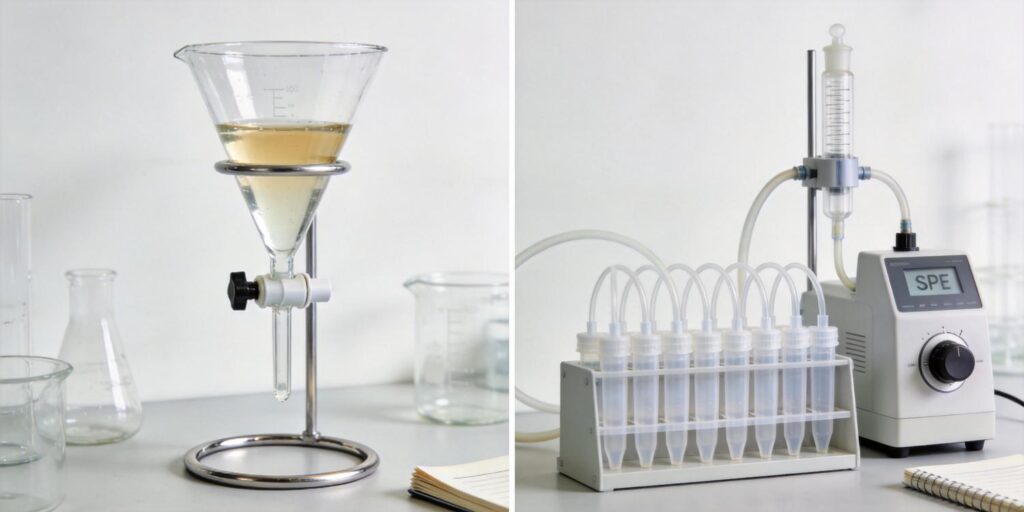
In practice, LLE typically involves shaking or mixing the aqueous sample with an organic solvent in a separatory funnel, allowing the phases to separate by gravity, and then collecting the organic layer containing the extracted analytes. The process often requires multiple extractions with fresh solvent to maximize recovery, particularly for compounds with unfavorable partition coefficients. This fundamental limitation stems from the equilibrium nature of the process, where complete extraction is theoretically impossible to achieve in a finite number of steps.
Limitations of Liquid-Liquid Extraction
Despite its widespread historical use, LLE presents several significant limitations that have driven the search for alternative sample preparation techniques:
Emulsion Formation
One of the most frustrating practical problems with LLE is the formation of stable emulsions, particularly when dealing with “real-world” samples containing surfactants, proteins, or other emulsifying agents. These emulsions can be difficult or impossible to break, leading to poor phase separation, reduced recovery, and increased analysis time. As noted in the literature, “For anyone who has ever experienced the frustration of attempting to ‘break’ an emulsion formed while extracting ‘real-world’ samples by LLE, this advantage alone might make SPE attractive.”
High Solvent Consumption
LLE typically requires large volumes of organic solvents, often in the range of 50-500 mL per extraction. This not only increases operational costs but also creates significant safety and environmental concerns. The disposal of large volumes of organic solvents has become increasingly expensive and regulated, with disposal costs often exceeding the purchase price of the solvents themselves.
Labor-Intensive and Time-Consuming
The manual nature of LLE procedures makes them labor-intensive and time-consuming. Each extraction requires careful attention to mixing, phase separation, and solvent transfer steps. When back-extractions are needed to improve selectivity or remove interferences, the time requirements increase substantially. Traditional LLE procedures can take 30-60 minutes per sample, making them impractical for high-throughput laboratories.
Equipment Limitations
Separatory funnels are expensive to purchase, tedious to clean, and subject to breakage. They also require significant bench space and cannot be easily automated. The glassware requirements for multiple extractions can become substantial when processing large sample batches.
Theoretical Limitations
As an equilibrium process, LLE suffers from fundamental theoretical limitations. Different analytes may exhibit vastly different distribution coefficients between extracting solvents and various matrices because of other contaminants. The equilibrium distribution may necessitate multiple extractions, and analysts may never know when equilibrium has been reached. This uncertainty can lead to variable recovery and poor reproducibility.
Introduction to Solid Phase Extraction (SPE) as Alternative
Solid phase extraction emerged as a revolutionary alternative to LLE, addressing many of its limitations while offering enhanced capabilities. SPE operates on principles similar to liquid chromatography, utilizing selective adsorption of analytes or interferences from complex matrices onto a solid sorbent phase. Unlike LLE’s equilibrium-based approach, SPE is fundamentally a non-equilibrium procedure, which provides significant theoretical advantages.
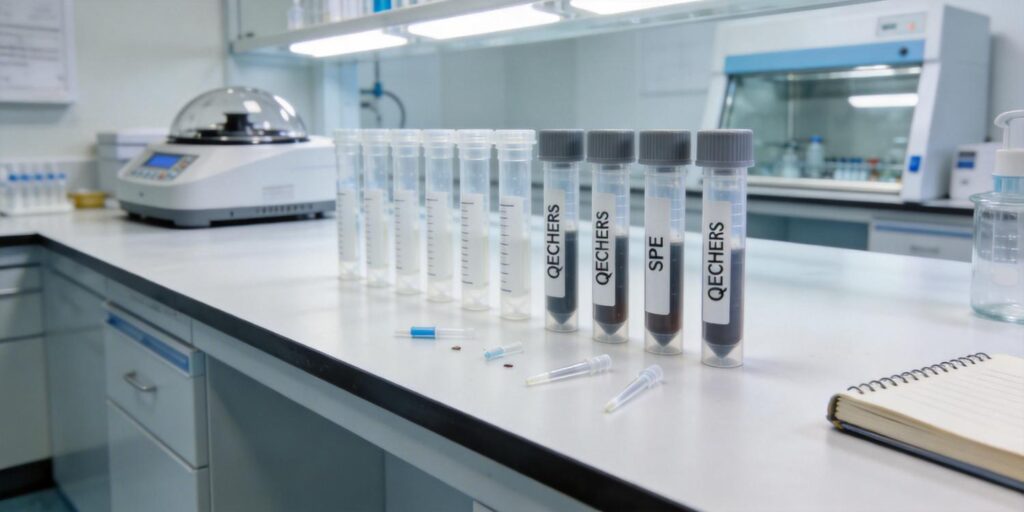
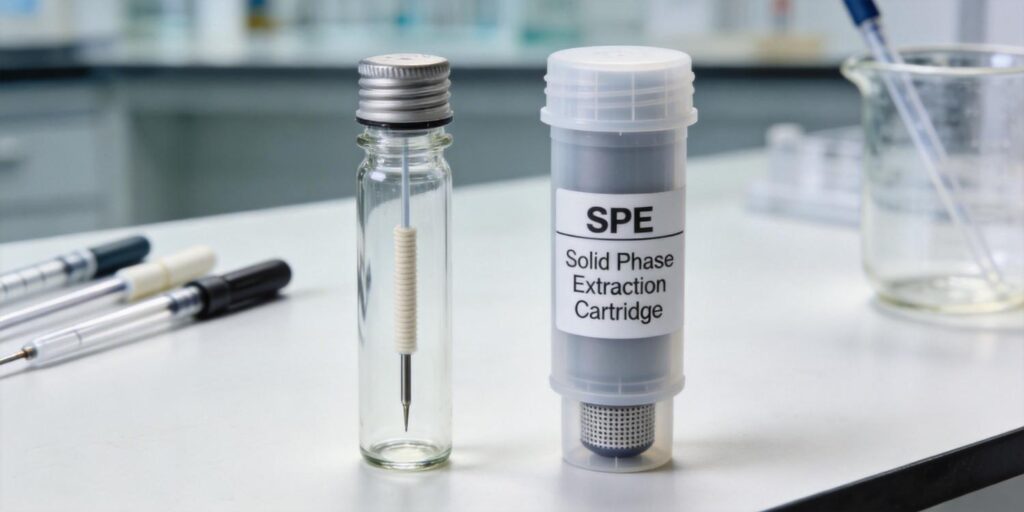
The SPE process typically involves four key steps: conditioning the sorbent, loading the sample, washing to remove interferences, and eluting the target analytes. This controlled sequence allows for precise manipulation of extraction conditions and provides cleaner extracts with higher selectivity. SPE devices come in various formats including cartridges, disks, and 96-well plates, offering flexibility for different sample volumes and throughput requirements.
One of the most significant advantages of SPE is its ability to use elution solvents that are miscible with the sample matrix. As explained in the literature, “An elution solvent may be used which is miscible with the sample in a solid-phase extraction, because the elution solvent and the sample never come into direct contact. Thus, our sample may be aqueous but our SPE elution solvent may be methanol, which is miscible in all proportions with water. Such a scheme, impossible in a LLE, is not only possible with SPE – it accounts for the majority of all solid-phase extractions!”
Comparison of Recovery Rates
The recovery performance of SPE versus LLE represents one of the most significant differences between the two techniques. SPE consistently demonstrates superior and more reproducible recovery rates across various applications.
SPE Recovery Performance
SPE recoveries should exceed 90% absolute recovery when parameters are properly optimized. The technique actually concentrates samples on the column and allows for reproducible results at very low analyte levels. High-efficiency copolymeric SPE columns have demonstrated significant improvements in recovery and selectivity compared to traditional C18 columns, particularly for challenging applications like opiate extraction from urine.
LLE Recovery Limitations
LLE not only has trouble achieving high recovery on a reliable, reproducible level but also suffers from diminishing returns with multiple extractions. The process can be compared to “a frog [that] jumps 50% of the distance out of a well each time it jumps” – theoretically never achieving 100% extraction. Each additional extraction yields diminishing returns, and the more extractions performed, the more sample is lost through handling and transfer.
Practical Evidence
Comparative studies consistently show SPE’s superiority in recovery. For example, in forensic applications, LLE of opiates from urine typically shows high levels of impurities and low recoveries, while SPE using high-efficiency copolymeric columns produces cleaner extracts with significantly higher recovery rates. The ability to achieve 85-95% recoveries in linear ranges for various analytes makes SPE the preferred choice for quantitative analysis.
Solvent Consumption Comparison
The reduction in solvent consumption represents one of SPE’s most compelling advantages over LLE, with environmental, economic, and safety benefits.
Quantitative Reduction
SPE typically reduces solvent consumption by 70-80% compared to traditional LLE methods. Data from comparative studies shows dramatic reductions: barbiturates extraction reduced from 18 mL to 4.25 mL (76% reduction), benzoylecgonine from 19 mL to 4.65 mL (76% reduction), and THC-COOH from 16.4 mL to 4.85 mL (73% reduction). These reductions translate directly to lower solvent purchase costs and dramatically reduced disposal expenses.
Environmental and Safety Benefits
Reduced solvent consumption means less exposure to potentially hazardous organic solvents for laboratory personnel. It also minimizes environmental impact through reduced waste generation. As noted in the literature, “Lab personnel need to be mindful of solvent usage as it costs more to dispose of solvents today than it does to buy them. This is especially true in the case of chlorinated hydrocarbons.”
Operational Advantages
Smaller elution volumes in SPE lead to faster dry-down times, reduced exposure to organic solvents during evaporation steps, and compatibility with modern analytical instruments that require small sample volumes. Reduced solvent volume extraction columns offer superior flow characteristics with less flow restriction from matrix proteins or particulates, making them more reliable for automated processing.
Automation Compatibility
The automation potential of SPE versus LLE represents a critical differentiator for modern laboratories seeking improved throughput, precision, and documentation.
SPE Automation Capabilities
SPE can be automated quite easily with a variety of currently available equipment, including liquid handling workstations and 96-well plate systems. Automated SPE eliminates many variables associated with manual methods, resulting in improved precision, accuracy, and recovery. The consistency of automated equipment performing identical sequences on each sample reduces the chance for error and decreases the number of samples requiring re-analysis.
Modern SPE automation systems provide formal documentation of sample preparation procedures, recording precise details of every extraction step in electronic form. This documentation capability is increasingly important in regulated environments. Automated systems also enable parallel processing of multiple samples, dramatically increasing throughput compared to serial LLE procedures.
LLE Automation Limitations
LLE is fundamentally difficult to automate due to its reliance on phase separation by gravity, emulsion formation issues, and the need for manual intervention at multiple steps. While some automated liquid-liquid extraction systems exist, they are generally more complex, less reliable, and more expensive than SPE automation platforms.
Throughput Considerations
SPE allows for increased production through multiple simultaneous extractions, with 96-well plate formats enabling processing of dozens of samples in parallel. In contrast, LLE procedures are inherently serial, with each sample requiring individual attention throughout the extraction process. This throughput advantage becomes particularly significant in high-volume testing environments.
When to Choose SPE vs LLE
While SPE offers numerous advantages, understanding when each technique is most appropriate ensures optimal method selection for specific applications.
Choose SPE When:
- High throughput is required: SPE’s compatibility with automation and parallel processing makes it ideal for laboratories processing large numbers of samples.
- Sample volumes are limited: SPE works effectively with small sample volumes (down to 100 μL or less) while maintaining good recovery.
- Clean extracts are essential: SPE provides cleaner extracts with fewer impurities, extending instrument column life and reducing downtime for source cleaning.
- Solvent reduction is important: For environmental, economic, or safety reasons, SPE’s dramatically lower solvent consumption provides significant advantages.
- Emulsion-prone samples: SPE eliminates emulsion formation problems common with LLE.
- Regulatory compliance: SPE’s better reproducibility and documentation capabilities support regulatory requirements.
Consider LLE When:
- Very non-polar compounds: Some extremely non-polar compounds may extract more efficiently with certain solvent systems in LLE.
- Legacy methods: When modifying established, validated LLE methods is not practical or permitted.
- Simple, infrequent extractions: For occasional extractions where automation benefits don’t justify equipment investment.
- Specific solvent compatibility: When target analytes require specific solvent systems not compatible with available SPE sorbents.
Hybrid Approaches
In some cases, combining SPE with other techniques provides optimal results. For example, initial crude extraction followed by SPE cleanup can leverage the strengths of both approaches. Diatomaceous earth extractions represent a transitional technology that combines aspects of both LLE and SPE principles.
Conclusion
The evolution from liquid-liquid extraction to solid phase extraction represents significant progress in sample preparation technology. SPE addresses the fundamental limitations of LLE while offering enhanced capabilities in recovery, selectivity, solvent reduction, and automation compatibility. While LLE remains useful for specific applications, SPE has become the preferred technique for most modern analytical laboratories due to its superior performance, efficiency, and compatibility with contemporary analytical requirements.
As sample preparation continues to evolve toward miniaturization, automation, and reduced environmental impact, SPE’s advantages become increasingly compelling. The development of new sorbent materials, including copolymeric phases and mixed-mode chemistries, continues to expand SPE’s applicability across diverse analytical challenges. For laboratories seeking to improve their sample preparation workflows, transitioning from LLE to SPE represents a strategic investment in quality, efficiency, and sustainability.
For more information about specific SPE products and applications, explore our HLB SPE cartridges, MAX SPE cartridges, MCX SPE cartridges, WAX SPE cartridges, WCX SPE cartridges, and 96-well SPE plates.