Overview of QuEChERS Technique
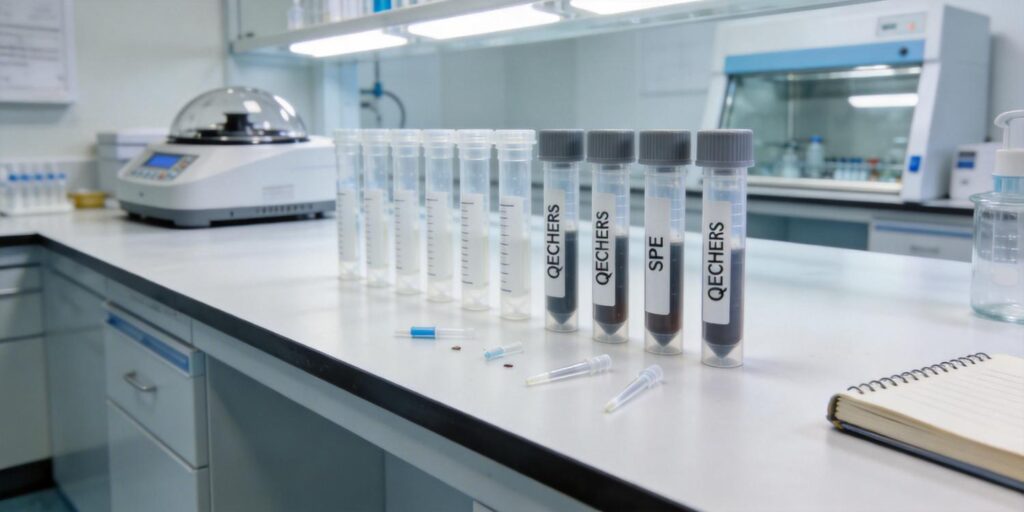
QuEChERS (Quick, Easy, Cheap, Effective, Rugged, and Safe) represents a modern approach to sample preparation that has revolutionized pesticide residue analysis in food and agricultural products. Developed as an alternative to traditional extraction methods, QuEChERS employs a simplified protocol involving acetonitrile extraction followed by dispersive solid-phase extraction (d-SPE) cleanup. The method typically involves homogenizing samples with acetonitrile, adding salts for phase separation, and then using d-SPE sorbents like PSA (primary secondary amine), C18, and graphitized carbon black for matrix cleanup.
According to Waters documentation, “QuEChERS methods offer a simple and straightforward sample preparation technique ideal for multi-residue analysis for pesticides, veterinary drugs, and mycotoxins in a wide variety of food and agricultural products.” The technique’s name perfectly describes its advantages: it’s quick (typically 30-40 minutes per batch), easy to perform with minimal training, cost-effective (approximately $1-3 per sample in materials), effective with high recoveries (typically 90-110%), rugged across different matrices, and safe with reduced solvent usage.
Typical Applications in Pesticide Analysis
QuEChERS has become the gold standard for pesticide residue analysis in various food matrices. The method excels in multi-residue analysis, with documented success analyzing up to 229 different pesticides in a single run. Typical applications include:
- Fruits and vegetables: Analysis of pesticide residues in lettuce, oranges, apples, and other produce
- Cereal products: Multi-residue analysis in cornmeal, wheat, and other grains
- Animal products: Pesticide screening in meat, milk, and dairy products
- Processed foods: Analysis of baby foods and other processed products
Research shows impressive performance metrics. In one study analyzing 229 pesticides, QuEChERS demonstrated excellent recovery rates: 80-90% of pesticides showed recoveries between 90-110% at 10 ng/g levels in lettuce and orange matrices. The method also showed good reproducibility, with most pesticides exhibiting RSD values below 5%.
Strengths and Limitations of QuEChERS
Strengths
- High Throughput: A single analyst can process 6-12 samples in 30-40 minutes
- Cost Efficiency: Material costs of approximately $1-3 per sample
- Minimal Waste: Generates less than 12 mL of waste per sample
- Broad Applicability: Suitable for a wide range of matrices and analytes
- Excellent Recovery: Most pesticides show 90-110% recovery rates
- Good Reproducibility: Typically achieves RSD values below 5%
Limitations
- Matrix-Specific Optimization: Different matrices may require specific d-SPE sorbent combinations
- Limited Selectivity: Less selective than traditional SPE for specific compound classes
- Sample Size Constraints: Typically limited to 10-15g sample sizes
- Cleanup Limitations: May not provide sufficient cleanup for extremely complex matrices
- Polar Compound Challenges: Some polar pesticides may require additional cleanup steps
SPE Advantages in Selectivity
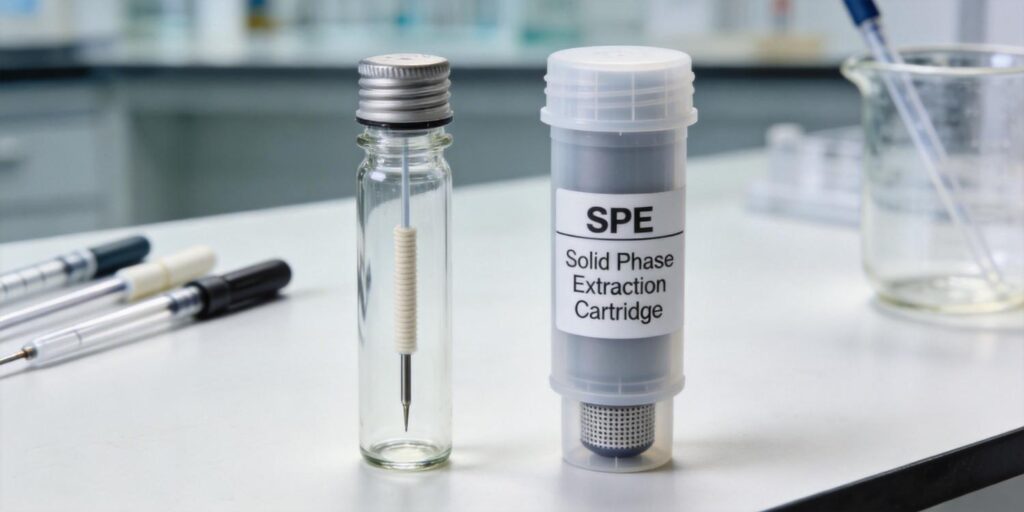
Solid Phase Extraction offers distinct advantages in selectivity that make it superior for certain applications. Unlike QuEChERS’ broad-spectrum approach, SPE provides targeted extraction capabilities through various mechanisms:
Mechanism-Based Selectivity
- Reversed-Phase SPE: HLB, C18, and C8 cartridges provide hydrophobic interactions ideal for non-polar compounds
- Mixed-Mode SPE: MCX (mixed-mode cation exchange) and MAX (mixed-mode anion exchange) cartridges combine hydrophobic and ionic interactions
- Ion Exchange SPE: WCX (weak cation exchange) and WAX (weak anion exchange) offer pH-dependent ionic interactions
- Normal Phase SPE: Silica-based cartridges for polar compound isolation from non-polar solvents
Application-Specific Advantages
SPE excels in applications requiring high selectivity. For example, in the analysis of tetracycline antibiotics in chicken tissue, SPE methods using specialized cartridges achieved recoveries of 67-96% across different compounds. Similarly, for sulfonamide analysis in milk, SPE provided excellent cleanup and concentration, enabling detection of 10 different sulfa drugs at approximately 0.03 mg/mL levels.
As noted in analytical literature, “SPE methods development requires understanding of target compounds and matrix physicochemical properties. This information guides selection of appropriate SPE cartridges.” This targeted approach allows for superior matrix cleanup and analyte enrichment compared to QuEChERS’ more generalized approach.
Matrix Cleanup Comparison
QuEChERS Cleanup Approach
QuEChERS employs dispersive SPE cleanup using various sorbent combinations:
- PSA: Removes polar interferences like sugars and organic acids
- C18: Removes hydrophobic interferences like fats and lipids
- Graphitized Carbon Black: Removes pigments like carotenoids and chlorophyll
- Magnesium Sulfate: Provides drying and salt-out effects
Different matrix types require specific sorbent combinations. For example, fatty matrices benefit from C18 addition, while pigmented matrices may require GCB. However, this approach provides generalized cleanup rather than targeted interference removal.
SPE Cleanup Capabilities
SPE offers superior matrix cleanup through several mechanisms:
- Multi-Step Cleanup: Sequential washing steps remove specific interferences
- Class Separation: Fractionation into acid, base, and neutral fractions
- Targeted Interference Removal: Specific sorbents for particular matrix components
- Concentration Effects: Up to 100-fold concentration of analytes
Research demonstrates SPE’s superior cleanup capabilities. In organochlorine pesticide analysis, certified SPE cartridges showed significantly cleaner extracts compared to competitor products, with quantitative removal of polar probes like trichlorophenol. This level of cleanup is particularly important for complex matrices like biological fluids, environmental samples, and fatty foods.
Cost and Throughput Considerations
QuEChERS: High Throughput, Low Cost
QuEChERS excels in high-throughput applications where cost efficiency is paramount:
- Cost per Sample: $1-3 in materials
- Throughput: 6-12 samples in 30-40 minutes per analyst
- Equipment Requirements: Minimal – centrifuge, vortex mixer, basic labware
- Training Requirements: Low – simple protocols with minimal training needed
- Waste Generation: Less than 12 mL per sample
These characteristics make QuEChERS ideal for routine screening laboratories processing large numbers of samples daily.
SPE: Higher Cost, Greater Flexibility
SPE offers different economic and operational advantages:
- Cost per Sample: Higher than QuEChERS but varies by application
- Throughput: Lower than QuEChERS but improved with automation
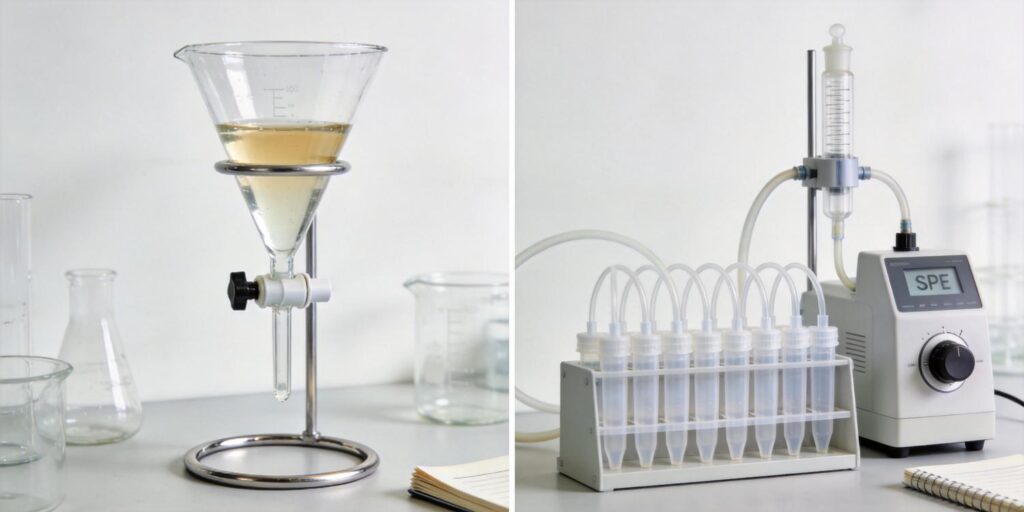
- Equipment Requirements: May require vacuum manifolds or automated systems
- Training Requirements: Higher – requires understanding of SPE principles
- Method Development: More complex but offers greater optimization potential
Automation Potential
Both techniques benefit from automation, but in different ways:
- QuEChERS Automation: Limited due to manual shaking and centrifugation steps
- SPE Automation: Well-established with 96-well plate formats and robotic systems
- On-line SPE: Direct coupling with analytical instruments for automated analysis
For laboratories requiring the highest throughput, 96-well SPE plates offer significant advantages. As documented in research, “High throughput liquid chromatographic/mass spectrometric bioanalysis using 96-well disk solid phase extraction plate for the sample preparation” demonstrates SPE’s automation capabilities.
Choosing the Right Method
When to Choose QuEChERS
- Routine multi-residue pesticide screening in food matrices
- High-throughput laboratories with limited budgets
- Applications where broad-spectrum analysis is sufficient
- Matrices where generalized cleanup is adequate
- Laboratories with minimal SPE expertise
When to Choose SPE
- Targeted analysis of specific compound classes
- Complex matrices requiring extensive cleanup
- Applications requiring high selectivity and sensitivity
- Regulatory methods specifying SPE protocols
- Laboratories with automation capabilities
- Research applications requiring method optimization
Hybrid Approaches
Some laboratories employ hybrid approaches, using QuEChERS for initial extraction followed by SPE for additional cleanup. This combines the throughput advantages of QuEChERS with the selectivity of SPE, particularly useful for challenging matrices or regulatory requirements.
Conclusion
The choice between SPE and QuEChERS depends on specific analytical requirements, laboratory capabilities, and application goals. QuEChERS offers unparalleled throughput and cost efficiency for routine multi-residue analysis, while SPE provides superior selectivity and cleanup for targeted applications. Understanding the strengths and limitations of each technique enables laboratories to make informed decisions that optimize analytical performance while managing costs and resources effectively.
For laboratories seeking SPE solutions, Poseidon Scientific offers a comprehensive range of HLB SPE cartridges, MAX SPE cartridges, MCX SPE cartridges, WAX SPE cartridges, WCX SPE cartridges, and 96-well SPE plates to meet diverse analytical needs.