Overview of SPME Technology
Solid Phase Microextraction (SPME) represents a revolutionary advancement in sample preparation technology that has transformed analytical workflows since its introduction. Unlike traditional extraction methods that require significant solvent use and multiple processing steps, SPME integrates extraction, concentration, and sample introduction into a single, streamlined device. The technique relies on a thin fused-silica fiber coated with a polymeric film that acts as an extraction phase, concentrating analytes from various sample matrices.
SPME operates on an equilibrium principle where analytes partition between the sample matrix and the fiber coating. This fundamental difference from exhaustive extraction techniques like Solid Phase Extraction (SPE) makes SPME particularly suitable for rapid screening and analysis where complete extraction isn’t necessary. The technology has gained widespread adoption in environmental monitoring, food analysis, forensic toxicology, and pharmaceutical applications due to its solvent-free nature and compatibility with both gas chromatography (GC) and liquid chromatography (LC) systems.
Fiber-Based Extraction Principle
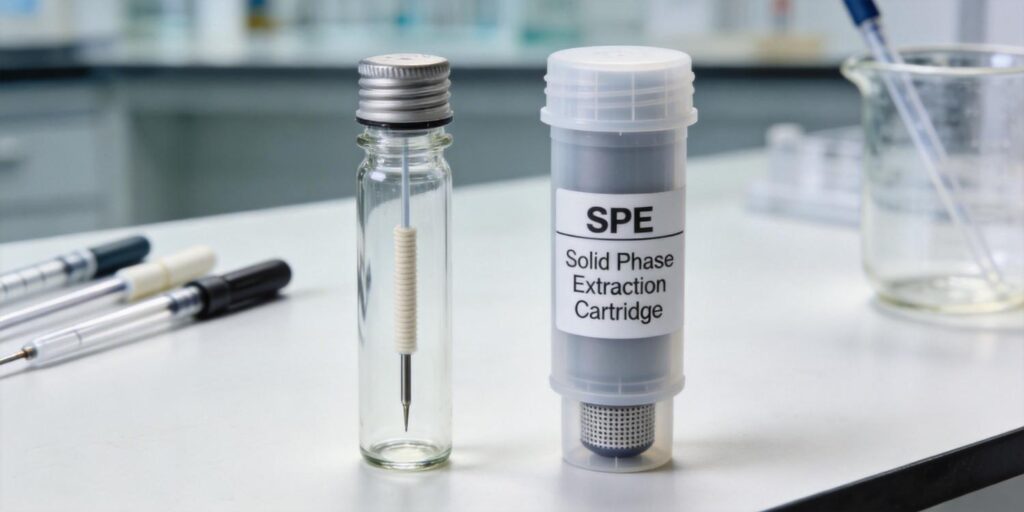
The core of SPME technology lies in its fiber-based extraction mechanism. A typical SPME device resembles a modified syringe containing a 1-2 cm long fused-silica fiber coated with a thin polymer film, typically ranging from 7 to 100 μm in thickness. Common coating materials include polydimethylsiloxane (PDMS) for non-polar analytes, polyacrylate (PA) for polar compounds, and mixed-phase coatings like Carboxen-PDMS or PDMS-divinylbenzene for broader selectivity.
The extraction process follows a simple yet elegant sequence: the fiber is exposed to the sample matrix (either through direct immersion or headspace sampling) for a predetermined period, during which analytes partition into the polymeric coating. According to equilibrium theory, the amount extracted (ws) is given by ws = KfsC0Vf where Kfs is the distribution constant between fiber and sample, C0 is initial analyte concentration, and Vf is fiber coating volume. This relationship demonstrates that SPME provides linear response proportional to analyte concentration while being independent of sample volume when Vf << Vs.
Two primary sampling modes exist: Direct Immersion (DI-SPME), where the fiber is immersed directly in liquid samples, and Headspace (HS-SPME), where the fiber is exposed to the vapor phase above the sample. HS-SPME offers significant advantages for volatile organic compounds (VOCs) since diffusion coefficients in the vapor phase are approximately four orders of magnitude higher than in solution, dramatically reducing equilibrium times.
Comparison with SPE
| Parameter | SPME | SPE |
|---|---|---|
| Extraction Principle | Equilibrium partitioning | Exhaustive extraction |
| Recovery Mechanism | Equilibrium-based (typically <100%) | Disequilibrium-based (typically >90%) |
| Solvent Consumption | Solvent-free | Requires elution solvents |
| Sample Volume | Small (2 mL typical) | Large (200 mL typical) |
| Analysis Time | 20 minutes (typical) | 90 minutes (typical) |
| Automation Simplicity | +++ (High) | + (Low) |
| Universality | +++ (Broad range) | ++++ (Very broad) |
| Reproducibility | 4-14% RSD | 1-15% RSD |
The fundamental distinction between SPME and SPE lies in their extraction mechanisms. SPME operates as an equilibrium technique where analytes partition between the sample matrix and fiber coating, while SPE functions as an exhaustive extraction method based on disequilibrium principles. This difference has profound implications for method development, quantification approaches, and application suitability.
SPE typically provides higher absolute recoveries (exceeding 90% when optimized correctly) compared to SPME’s equilibrium-based extraction. However, SPME offers superior speed, reduced solvent consumption, and simpler automation. The choice between techniques often depends on whether absolute quantification (favoring SPE) or rapid screening with relative quantification (favoring SPME) is required.
Sensitivity Differences
Sensitivity considerations between SPME and SPE reveal distinct advantages for each technique depending on analytical requirements. SPME-GC/MS systems typically achieve detection limits in the 0.2-5 μg/L range, while SPE-HPLC methods can reach 0.05-0.8 μg/L detection limits. However, these values are highly dependent on analyte properties, matrix composition, and instrumental configuration.
SPME’s sensitivity is fundamentally limited by the small volume of the extraction phase (typically less than 1 μL) and equilibrium partitioning. For analytes with large distribution constants (Kfs), equilibrium times can be considerable due to diffusion limitations through the static water layer surrounding the fiber. This challenge is particularly pronounced in direct immersion SPME of aqueous samples, where even vigorous agitation doesn’t completely eliminate the thin water film that slows analyte diffusion to the fiber surface.
SPE, in contrast, benefits from larger sorbent bed volumes and exhaustive extraction principles, allowing for greater concentration factors. SPE cartridges can process larger sample volumes (typically 200 mL versus SPME’s 2 mL), providing superior pre-concentration capabilities. This advantage makes SPE particularly valuable for trace analysis where maximum sensitivity is required.
Typical GC-MS Applications
Both SPME and SPE find extensive application in GC-MS analysis, though their implementation differs significantly. SPME-GC/MS has become particularly popular for volatile and semi-volatile organic compound analysis due to its solvent-free nature and compatibility with standard GC injectors. The technique excels in environmental applications for monitoring substituted benzene compounds, polyaromatic hydrocarbons, nitro- and chlorophenols, volatile organochlorine compounds, and polychlorinated biphenyl congeners.
SPE-GC/MS applications typically involve more complex sample matrices requiring extensive clean-up. Common applications include pharmaceutical impurity profiling (residual solvent analysis per USP 467), environmental monitoring of pesticides and herbicides, food chemistry analyses, and forensic toxicology screening. SPE’s ability to remove matrix interferences makes it invaluable for biological fluid analysis, where compounds like opiates, cocaine, amphetamines, tricyclic antidepressants, phenothiazines, and benzodiazepines must be isolated from complex matrices.
Online SPE-GC configurations represent an advanced implementation where the extraction cartridge is integrated into the chromatographic system, allowing automated sample processing and analysis. These systems provide improved reproducibility and reduced manual intervention compared to offline approaches.
When Each Technique is Preferred
When to Choose SPME
SPME is the preferred choice when:
- Rapid analysis is critical: SPME’s integrated extraction/desorption process significantly reduces total analysis time compared to multi-step SPE procedures
- Solvent elimination is desirable: Environmental concerns, cost reduction, or regulatory requirements favor solvent-free techniques
- Field sampling is necessary: SPME’s portability and stability make it ideal for on-site sampling, with samples potentially analyzed days later without significant volatile loss
- Volatile compound analysis is required: HS-SPME provides excellent sensitivity for VOCs with minimal matrix interference
- Limited sample volume is available: SPME works effectively with small sample volumes (as low as 2 mL)
When to Choose SPE
SPE becomes the technique of choice when:
- Absolute quantification is required: SPE’s exhaustive extraction provides more reliable absolute recovery data
- Complex matrices demand extensive clean-up: Biological samples, heavily contaminated environmental samples, or food matrices benefit from SPE’s superior interference removal
- Large sample volumes need processing: SPE cartridges can handle significantly larger volumes than SPME fibers
- High-throughput automation is needed: 96-well SPE plates enable parallel processing of multiple samples
- Method robustness is paramount: SPE generally offers better reproducibility (1-15% RSD) compared to SPME (4-14% RSD)
- Derivatization is required: On-cartridge derivatization techniques are well-established in SPE workflows
Hybrid Approaches and Future Directions
The analytical landscape increasingly recognizes that SPME and SPE are complementary rather than competing technologies. Advanced laboratories often maintain capabilities for both techniques, selecting the appropriate method based on specific analytical requirements. Emerging technologies like solid-phase microextraction techniques using sorbent-coated needles and SPE discs with extraction path lengths of 0.5-2 mm represent continued innovation in sample preparation.
For laboratories considering implementation of either technique, the decision should be guided by specific application requirements, available instrumentation, and throughput needs. SPME offers unparalleled advantages for rapid screening and volatile analysis, while SPE provides superior clean-up and quantification capabilities for complex matrices. Many modern analytical laboratories find value in maintaining expertise with both technologies to address the full spectrum of analytical challenges encountered in environmental, pharmaceutical, forensic, and food safety applications.
At Poseidon Scientific, we offer comprehensive HLB SPE cartridges, MAX SPE cartridges, MCX SPE cartridges, and 96-well SPE plates to support your sample preparation needs across various applications.