
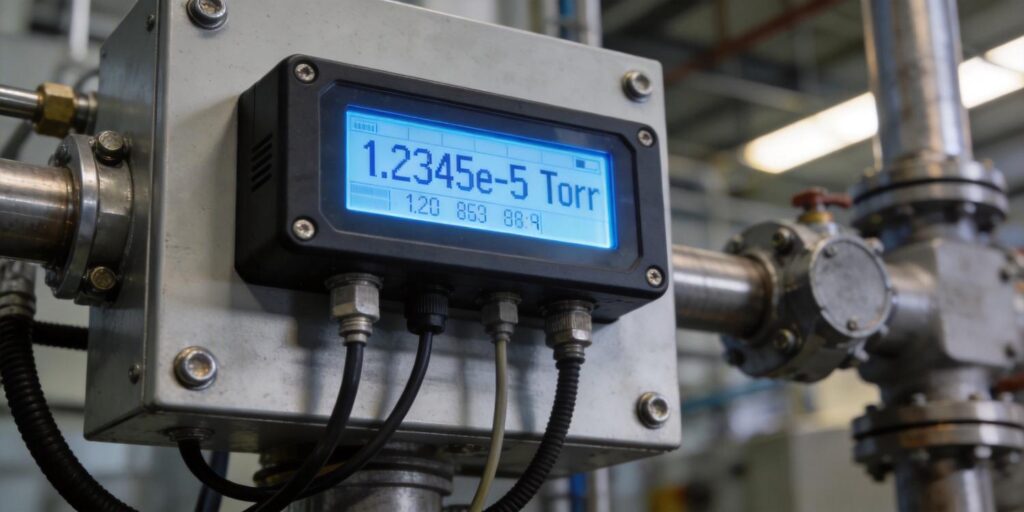
In vacuum technology, the terms “resolution” and “accuracy” are frequently conflated, yet they describe fundamentally different performance aspects. Engineers specifying vacuum gauges for production tools, analytical instruments, or research chambers often ask: how fine a resolution is truly necessary? Over-specifying resolution inflates cost without delivering proportional process benefit, while under-specifying it risks missing critical pressure excursions or failing to meet repeatability targets. This article clarifies the distinction, maps resolution requirements to real applications, and provides a practical framework for selecting the right level of performance when using thermal-conductivity (Pirani) and cold-cathode ionization gauges such as the Poseidon Scientific VG-SP205 and VG-SM225.
Defining Resolution vs Accuracy
Resolution is the smallest change in pressure that produces a detectable, repeatable change in the gauge output—typically expressed as the least significant digit in digital displays or the noise floor in analog signals. For example, a gauge with 0.01 Torr resolution can distinguish 1.00 Torr from 1.01 Torr under ideal conditions.
Accuracy, by contrast, is how closely the measured value matches the true pressure, usually stated as a percentage of reading or full scale (±X % rdg ± Y % FS). It includes systematic errors from calibration, temperature drift, gas composition, and long-term stability.
A high-resolution gauge can still be inaccurate if its output is offset or drifts; conversely, a lower-resolution gauge can be sufficiently accurate for many control tasks if noise is low and calibration is stable. In practice, cold-cathode gauges like the VG-SM225 achieve effective resolution limited by discharge-current noise (typically equivalent to ~5–10 % of reading in the 10⁻⁵ Torr region), while Pirani gauges such as the VG-SP205 offer smoother, sub-1 % resolution in their linear range (10 Torr to 10⁻² Torr) thanks to the platinum filament’s large temperature coefficient of resistance.
Application-Based Requirement
Resolution needs scale directly with process demands:
- Rough vacuum control (1–100 Torr): 0.1–1 Torr resolution suffices for pump crossover, valve sequencing, and leak detection. Most turbomolecular-pump controllers trigger at 5–10 Torr ±1 Torr tolerance.
- Transition / foreline monitoring (10⁻²–1 Torr): 0.01 Torr resolution supports tight process windows in reactive-ion etching or low-pressure CVD where small pressure fluctuations affect plasma stability.
- High-vacuum base pressure (10⁻⁵–10⁻⁷ Torr): 10–20 % relative resolution (e.g., distinguishing 5×10⁻⁶ from 6×10⁻⁶ Torr) is adequate for most sputtering, evaporation, and mass-spectrometer applications where absolute value matters less than trend stability.
- Ultra-high vacuum research (<10⁻⁸ Torr): Sub-10 % resolution becomes critical for surface-science experiments or synchrotron beamlines, often requiring specialized Bayard-Alpert or extractor gauges rather than standard cold-cathode designs.
In production environments—where uptime and cost dominate—engineers rarely need better than 10–15 % relative resolution at operating pressure. Excessive resolution can actually degrade system robustness by amplifying noise and false alarms.
High Vacuum Resolution Example (10⁻⁵ mbar Region)
Consider a typical magnetron sputtering chamber targeting 5×10⁻⁶ mbar (≈3.75×10⁻⁶ Torr) base pressure before argon admission. The VG-SM225 Cold Cathode Vacuum Gauge operates here with a logarithmic current-pressure characteristic. Literature on inverted-magnetron and standard magnetron cold-cathode gauges shows that ion current typically follows i⁺ ∝ P^n where n ≈ 1.0–1.2 in the linear region, transitioning to n ≈ 1.7 at very low pressures due to reduced collision probability.
For the VG-SM225 (positive magnetron geometry, ~100 G field, –2000 V), practical resolution in the 10⁻⁵ mbar decade is limited by discharge noise and electronics to roughly ±10–15 % of reading. This equates to distinguishing 4.5×10⁻⁶ from 5.5×10⁻⁶ mbar—sufficient for confirming chamber readiness and detecting gross leaks or outgassing spikes. Finer resolution (e.g., 1 % relative) would require signal averaging over seconds to minutes, which is impractical in dynamic production cycles.
In contrast, the VG-SP205 Pirani provides far higher relative resolution (≈0.5–1 %) in the 10⁻²–10 Torr range but loses sensitivity below 10⁻³ Torr, making it complementary rather than competitive in high vacuum.
Controller Integration
Modern vacuum controllers accept 0–10 V analog signals or digital streams and apply programmable filtering to enhance effective resolution without hardware upgrades. The VG-SP205 and VG-SM225 output 0–10 V (effective range 2–8 V), with the VG-SM225 using logarithmic compression to cover 10⁻³–10⁻⁷ Torr. PLCs or dedicated vacuum controllers can implement:
- Digital filtering (moving average or exponential) to reduce noise by 3–10×
- Trend-based alarming instead of absolute thresholds
- Custom RS232 protocol mapping (available from Poseidon for small batches) that delivers 16-bit equivalent data frames
These techniques frequently boost usable resolution by a factor of 2–5, allowing engineers to meet tighter process specs without selecting a more expensive gauge.
Cost vs Performance Trade-off
Higher resolution almost always comes at higher cost—through more sophisticated electronics, tighter manufacturing tolerances, or exotic materials. For example:
- Standard Pirani/cold-cathode combination (VG-SP205 + VG-SM225): excellent value for production monitoring where 10–20 % relative resolution suffices
- High-stability Bayard-Alpert or capacitance manometer: 1–5 % accuracy and sub-1 % resolution, but 5–10× higher price and greater maintenance
- Miniaturized magnetron gauges (e.g., 0.3 cm³ research prototypes): extreme compactness and potentially finer resolution in micro-systems, but limited commercial availability and higher unit cost
In most industrial applications, the incremental benefit of doubling resolution rarely justifies a 3–5× price increase. Poseidon’s self-developed cost structure (3000–3500 yuan manufacturing) allows engineers to deploy redundant or multi-point monitoring without budget overrun, improving overall system reliability more effectively than chasing ultra-fine resolution on a single gauge.
Selection Matrix
| Application | Typical Pressure Range | Required Relative Resolution | Recommended Gauge | Key Benefit |
|---|---|---|---|---|
| Roughing & crossover | 760–1 Torr | 1–5 % | VG-SP205 Pirani | Fast response, linear output, low maintenance |
| Transition & low process | 1–10⁻³ Torr | 0.5–2 % | VG-SP205 (primary) | High repeatability in viscous-to-molecular transition |
| High-vacuum base & monitoring | 10⁻³–10⁻⁶ Torr | 10–20 % | VG-SM225 Cold Cathode | Rugged, wide range, cleanable electrodes |
| Critical UHV research | <10⁻⁷ Torr | <5 % | Specialized Bayard-Alpert / extractor | Lower x-ray limit, higher stability |
Use this matrix as a starting point; adjust for gas species, temperature, and magnetic-field environment. Poseidon’s compact KF-flange designs minimize installation impact in either case.
CTA
Choosing the right vacuum gauge resolution balances process needs, system cost, and long-term reliability. The Poseidon Scientific VG-SP205 Pirani Vacuum Transmitter and VG-SM225 Cold Cathode Vacuum Gauge deliver practical, production-proven performance without unnecessary over-specification—ideal for engineers and procurement teams focused on value and uptime.
Review detailed specifications and user manuals:
VG-SP205 Pirani Vacuum Transmitter
VG-SM225 Cold Cathode Vacuum Gauge
Need help mapping your exact pressure-control requirements to the optimal resolution and gauge combination? Contact our applications engineering team today—we support custom protocol development, multi-gauge system design, and performance validation for both prototype and high-volume production environments.


