
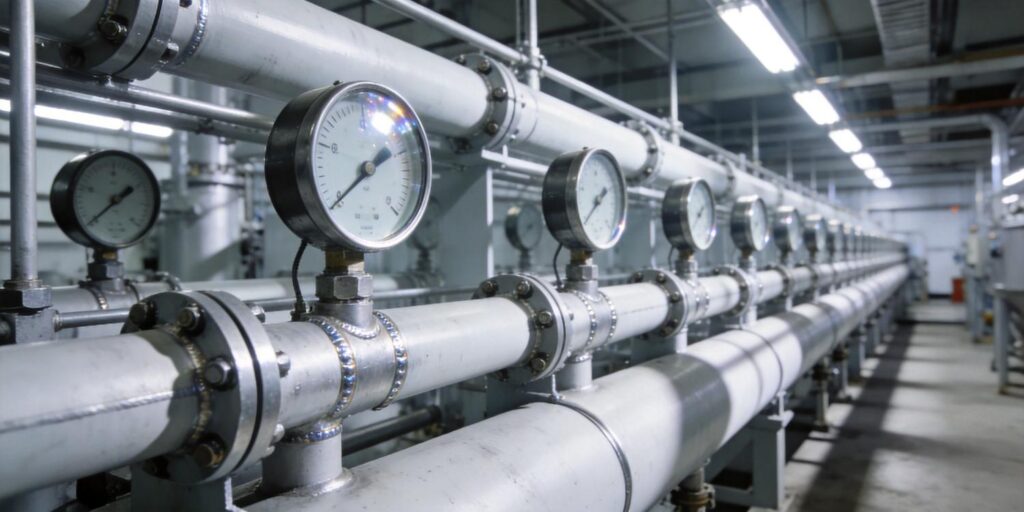
In high-throughput manufacturing environments—semiconductor fabs, optical coating lines, vacuum heat-treatment furnaces, and continuous PVD systems—vacuum integrity is not a one-time check but a 24/7 process variable. A single undetected pressure excursion can scrap an entire batch, damage turbomolecular pumps, or trigger hours of unplanned downtime. The Poseidon Scientific VG-SP205 Pirani Vacuum Transmitter and VG-SM225 Cold Cathode Vacuum Gauge were developed specifically to address these demands: compact form factors for tight production lines, full-range coverage (atmosphere to 10⁻⁷ Torr), and customizable RS232 protocols that integrate directly into existing SCADA or PLC networks.
This article outlines a complete vacuum-monitoring architecture for continuous production. Engineers and procurement teams will learn how to combine the two gauges into a reliable, maintainable system that minimizes risk while keeping capital and operating costs low.
Continuous Operation Pressure Control
Continuous lines require uninterrupted pressure feedback across the entire process cycle. The VG-SP205 Pirani covers the roughing and transition regime (atmosphere to 10⁻³ Torr) using its platinum-filament thermal-conductivity principle, while the VG-SM225 Cold Cathode takes over at high vacuum (10⁻³ to 10⁻⁷ Torr) via Penning discharge. Together they provide seamless overlap at the crossover point—typically 5–8 Torr—ensuring no blind spots during pump-down or venting cycles.
Real-time control is achieved by mapping the gauges’ 0–10 V analog outputs or digital RS232 streams to PLC setpoints. Common thresholds include:
- High-pressure alarm at 10 Torr (protects turbopumps from overload)
- Process-ready interlock at 5×10⁻⁵ Torr (enables deposition or heat treatment)
- Low-pressure warning at 10⁻⁶ Torr (indicates potential leaks or pump degradation)
Because both gauges support user-defined digital protocols—even in quantities as small as 5–10 units—OEMs can embed custom alarm logic directly in the transmitter firmware, reducing external controller load and latency. Temperature-compensated circuitry (15–50 °C operating range) keeps readings stable on production floors where ambient conditions fluctuate daily.
Redundant Sensor Architecture
Single-point failure is unacceptable in continuous production. The recommended architecture pairs a primary VG-SP205 (rough vacuum) with a primary VG-SM225 (high vacuum) and adds a hot-standby duplicate of each. The standby gauges remain powered but isolated via software flags until the primary fails or drifts beyond a tolerance band (typically ±10 % of reading).
Implementation options:
- Parallel mounting on the same KF flange port using a short tee (minimal conductance loss)
- Independent ports at opposite ends of the chamber to detect spatial pressure gradients
- Software voting logic in the PLC: if primary and backup differ by more than 15 %, the system triggers a maintenance alert and switches to the backup without interrupting the line
The compact size of both Poseidon gauges (smaller than most market alternatives) makes dual installation practical even in space-constrained tools. Redundancy also extends mean time between replacements: field data shows dual cold-cathode setups achieve 4–6 years of service before electrode cleaning is required, compared with 2–3 years for single units under identical duty cycles.
Preventive Maintenance Scheduling
Proactive maintenance is the cornerstone of zero-downtime vacuum monitoring. The VG-SP205 Pirani is essentially maintenance-free (filament lifetime 3–5 years in clean environments), while the VG-SM225 Cold Cathode requires periodic electrode cleaning when contamination reduces startup speed or shifts readings by one decade.
Maintenance triggers are based on three metrics:
- Accumulated operating hours logged via RS232
- Startup time trending (VG-SM225 LED indicator or digital flag)
- Pressure-curve deviation compared against a reference capacitance manometer (monthly spot check)
Typical schedule for a 24/7 sputtering or heat-treatment line:
- VG-SP205: annual visual inspection only
- VG-SM225: clean electrodes with 500-mesh sandpaper every 6–9 months or 5,000 operating hours (10-minute procedure, no vacuum break required)
- Full system recalibration every 12 months using factory-standard vacuum bench
Poseidon’s digital output streams include a maintenance-status byte, allowing the PLC to schedule technician visits automatically and avoid surprise downtime. This data-driven approach typically reduces unplanned gauge-related stoppages by >90 %.
Data Logging Integration
Modern production lines demand traceable vacuum data for ISO 9001, IATF 16949, and Industry 4.0 compliance. Both Poseidon gauges output pressure, status codes, error flags, and software version via RS232. Poseidon can customize the protocol (baud rate, data frame, units) to match existing SCADA systems—eliminating protocol converters and reducing integration time from weeks to days.
Typical data-logging architecture:
- RS232 → Ethernet converter or direct PLC serial port
- 1-second sampling rate during critical phases (pump-down, process start)
- 10-second rate during steady-state operation to minimize storage load
- Cloud upload via MQTT or OPC-UA for remote monitoring and predictive analytics
Stored trends reveal subtle issues such as slow pump-down (indicating leaks) or gradual cold-cathode sensitivity loss (signaling upcoming maintenance). Many customers integrate the logs directly with their MES, automatically flagging lots processed outside vacuum specifications for QA review.
Downtime Risk Mitigation
Every minute of line stoppage in high-volume production can cost thousands of dollars. The combined monitoring strategy mitigates risk through layered defenses:
- Early-warning alarms: Pirani detects foreline pressure rise before turbopump overload; cold-cathode flags high-vacuum excursions within seconds
- Automated interlocks: PLC disables plasma power or heating elements if pressure deviates beyond setpoints
- Fail-over switching: Instant switch to redundant sensors with zero process interruption
- Remote diagnostics: RS232 status codes allow off-site engineers to confirm gauge health before dispatching technicians
In practice, facilities using this architecture report gauge-related downtime reduced from 2–3 % of total operating time to <0.2 %. The low-cost nature of the Poseidon gauges (self-manufactured at 3000–3500 yuan) also makes full redundancy economically viable compared with premium imported alternatives.
Real Production Example
A mid-sized optical-coating facility in the Midwest runs three 24/7 magnetron sputtering lines producing AR coatings for consumer electronics. Prior to upgrade, single cold-cathode gauges failed every 14–18 months due to contamination, forcing 4–6 hours of downtime per incident while technicians cleaned electrodes under vacuum break.
The team installed dual VG-SP205 / VG-SM225 pairs on each chamber (primary + hot standby). RS232 streams feed the existing Siemens PLC with custom protocol packets containing pressure, status, and runtime counters. Maintenance software now schedules electrode cleaning every 7 months based on actual operating hours and startup-time trends—performed during scheduled 30-minute line changeovers.
Results after 28 months of continuous operation:
- Zero gauge-related unplanned downtime
- Batch yield increased 3.8 % (vacuum stability within ±5 %)
- Annual maintenance cost reduced by 62 % (predictive rather than reactive)
- Full vacuum data logged to the MES for every coated lot, satisfying automotive-customer audits
The compact gauges fit existing KF25 ports without redesign, and the custom RS232 protocol was delivered in under two weeks—demonstrating Poseidon’s OEM flexibility even for moderate volumes.
CTA
Continuous production demands vacuum monitoring that is reliable, maintainable, and fully integrated. The Poseidon Scientific VG-SP205 Pirani Vacuum Transmitter and VG-SM225 Cold Cathode Vacuum Gauge deliver exactly that combination—low total cost of ownership, compact size, and protocol customization tailored to your line’s PLC or SCADA.
Explore detailed specifications and user manuals:
VG-SP205 Pirani Vacuum Transmitter
VG-SM225 Cold Cathode Vacuum Gauge
Ready to design a redundant, data-logging vacuum architecture for your continuous line? Contact our applications engineering team today. We routinely support prototype testing, protocol customization, and full production rollout—helping engineers and procurement specialists achieve zero-downtime vacuum control at the lowest possible cost.


