Characteristics of Aminoglycoside Antibiotics
Aminoglycosides represent a class of broad-spectrum antibiotics with distinctive structural and chemical properties that present unique challenges for analytical extraction. These compounds, including gentamicin, tobramycin, streptomycin, and amikacin, share common features: multiple amino groups (typically 2-6), hydroxyl groups, and glycosidic linkages that contribute to their high polarity and water solubility.
From the pKa data available in forensic literature, we can identify key ionization characteristics: gentamicin has a pKa of 8.2, tobramycin shows pKa values of 6.7, 8.3, and 9.9, while dihydrostreptomycin exhibits a pKa of 7.8. These multiple pKa values reflect the presence of several amino groups that can protonate at different pH levels, creating complex ionization behavior that must be carefully managed during extraction protocols.
The high polarity of aminoglycosides (log P values typically negative) combined with their multiple charge centers makes traditional reversed-phase SPE methods ineffective. Their structural complexity requires specialized extraction approaches that can handle both their hydrophilic nature and their ability to form multiple ionic interactions.
Ionization Behavior at Neutral pH
At neutral pH (approximately 6.0-7.0), aminoglycosides exist predominantly in their protonated cationic forms due to their multiple amino groups. According to ion-exchange principles, basic compounds are positively charged below their pKa values. For aminoglycosides with pKa values ranging from 6.7 to 9.9, neutral pH ensures that most amino groups are protonated, creating multiply charged cations.
This ionization state is crucial for effective extraction using cation-exchange mechanisms. As documented in SPE literature, “bases may be isolated from urine at neutral pH, allowing the extraction of compounds that may be otherwise unstable.” The gentle pH conditions prevent degradation while maintaining optimal ionization for retention on cation-exchange sorbents.
The multiple charge centers create strong electrostatic interactions with negatively charged sorbent surfaces, but also increase the risk of irreversible binding if elution conditions are not properly optimized. Understanding this pH-dependent ionization is fundamental to developing successful extraction protocols.
WCX Cartridge Chemistry Advantages
Weak Cation Exchange (WCX) cartridges provide the ideal chemistry for aminoglycoside extraction through their mixed-mode retention mechanism. As described in Waters Oasis documentation, “The Oasis WCX (Weak Cation eXchange) SPE material was developed to provide better sample preparation for strong bases and quaternary amines. The retention mechanism is mixed mode (both ion-exchange and reversed-phase), which improves retention for all types of basic analytes, especially strong bases.”
The WCX sorbent typically contains carboxylate groups (pKa ~5) that provide weak cation-exchange functionality. This is particularly advantageous for aminoglycosides because:
- Controlled Ion-Exchange Capacity: WCX materials have tightly controlled ion-exchange capacity (typically 0.7 meq/g for Oasis WCX), ensuring reproducible extraction protocols
- pH-Dependent Functionality: The weak cation-exchange groups can be neutralized during elution, facilitating complete analyte recovery
- Mixed-Mode Retention: Combines ionic interactions with secondary hydrophobic interactions for enhanced selectivity
- Stability Across pH Range: Modern polymeric WCX sorbents are stable from pH 0-14, allowing flexible method development
Compared to strong cation exchangers (SCX), WCX cartridges offer better elution characteristics for multiply charged compounds like aminoglycosides, as the exchange groups can be neutralized by adjusting pH during the elution step.
Sample Conditioning and Dilution
Proper sample preparation is critical for successful aminoglycoside extraction. Biological samples typically require dilution with appropriate buffers to optimize pH and ionic strength. For urine or plasma samples containing aminoglycosides, dilution with phosphate buffer (pH 6.0-7.0) is recommended to maintain the analytes in their protonated forms while reducing matrix effects.
As noted in SPE methodology literature, “sample pH should be 6.0 ± 0.5” for basic drug extraction. This pH range ensures optimal ionization while being gentle enough to prevent degradation of sensitive compounds. The dilution also helps reduce sample viscosity and minimize non-specific binding to proteins or other matrix components.
For complex matrices, additional pretreatment such as protein precipitation may be necessary. However, care must be taken to avoid extreme pH conditions that could degrade aminoglycosides or alter their ionization state.
Salt Removal Washing Steps
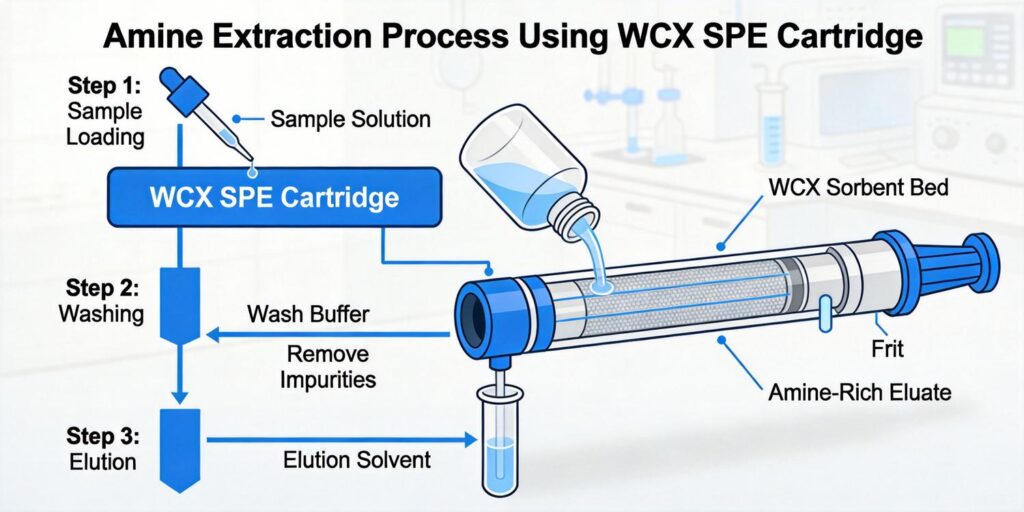
Effective washing protocols are essential for removing interfering salts and matrix components while retaining aminoglycosides on the WCX sorbent. The washing strategy typically involves sequential steps:
- Water or Dilute Buffer Wash: Removes unretained polar compounds and excess salts
- Organic Wash (Methanol or Acetonitrile): Eliminates hydrophobic interferences while maintaining ionic retention of aminoglycosides
- Optional: Acidified Organic Wash: For particularly dirty samples, a mild acid in organic solvent can remove additional interferences
Research demonstrates that “the column can be washed with relatively strong solvents such as methanol, hence giving effective removal of anionic and neutral interferences without seriously affecting the recovery of the analyte.” This is particularly important for aminoglycosides, as their strong ionic retention allows aggressive washing without significant loss.
The wash steps must be carefully optimized to balance cleanliness with recovery, as overly aggressive washing can displace analytes, especially those with weaker retention characteristics.
Elution Using Acidic Organic Solvents
Elution of aminoglycosides from WCX cartridges requires disruption of both ionic and secondary interactions. The most effective elution solvents combine organic modifiers with acidic components to neutralize the cation-exchange sites and solubilize the analytes.
Typical elution protocols employ methanol or acetonitrile containing 2-5% formic acid or similar volatile acids. The acidic conditions (pH 2-3) protonate the carboxylate groups on the WCX sorbent, neutralizing the ion-exchange capacity and releasing the retained aminoglycosides. Simultaneously, the organic solvent disrupts any hydrophobic interactions and provides good solubility for the eluted compounds.
As documented in mixed-mode extraction literature, “elution solvents are solvent mixtures of organic solvents with acids or bases added. This provides for superior sample clean up.” For aminoglycosides, the acidic organic eluent effectively releases the multiply charged cations while maintaining compatibility with subsequent LC-MS analysis.
Elution volume optimization is crucial, typically requiring 2-3 bed volumes to ensure complete recovery. The eluate should be collected in tubes compatible with the acidic conditions and suitable for evaporation if concentration is required.
LC-MS Detection Challenges
Aminoglycosides present significant challenges for LC-MS detection due to their physicochemical properties:
- Poor Chromatographic Retention: High polarity leads to poor retention on conventional reversed-phase columns
- Multiple Charge States: Can form singly, doubly, or triply charged ions in ESI, complicating mass spectral interpretation
- Matrix Effects: Prone to ion suppression in ESI due to competition for charge
- Limited Fragmentation: Often produce limited diagnostic fragments in collision-induced dissociation
To address these challenges, several strategies have been developed:
- Ion-Pairing Chromatography: Using heptafluorobutyric acid or other ion-pairing reagents to improve retention
- HILIC Separation: Hydrophilic interaction chromatography provides better retention for polar compounds
- Derivatization: Pre-column derivatization with reagents like FMOC-Cl can improve both chromatography and MS sensitivity
- Enhanced Sample Cleanup: The WCX extraction itself significantly reduces matrix effects
The clean extracts obtained from WCX SPE directly address many LC-MS challenges by removing interfering compounds that cause ion suppression and improving signal-to-noise ratios.
Recovery Optimization Experiments
Systematic optimization of WCX SPE for aminoglycosides involves several key parameters that must be evaluated experimentally:
pH Optimization
The sample application pH should be optimized to ensure complete protonation of aminoglycoside amino groups while maintaining sorbent functionality. Experiments typically evaluate pH values from 5.0 to 7.5 in 0.5 unit increments, using appropriate buffers that don’t interfere with subsequent analysis.
Wash Solvent Composition
Wash optimization balances cleanliness with recovery by testing different organic:aqueous ratios and additives. Common approaches include:
- Water or buffer washes (0-100% organic)
- Acidified washes (0.1-1% formic acid in water or organic)
- Mixed organic-aqueous washes
Elution Solvent Optimization
Elution efficiency depends on both the organic solvent and acid concentration. Optimization experiments typically test:
- Organic solvent type (methanol vs. acetonitrile)
- Acid type and concentration (formic, acetic, or trifluoroacetic acid)
- Elution volume (2-5 bed volumes)
Capacity and Breakthrough Testing
Given the multiple charge centers of aminoglycosides, capacity testing is essential. Experiments should determine the maximum sample load before breakthrough occurs, considering both the ion-exchange capacity and the hydrophobic capacity of the mixed-mode sorbent.
Matrix Effect Evaluation
Recovery experiments must be conducted in relevant matrices (urine, plasma, tissue homogenates) to account for matrix effects. Post-extraction spike comparisons can quantify both absolute recovery and matrix effects.
Documented SPE optimization principles emphasize that “when using mixed-mode extractions, the elution solvent must be able to reverse or disrupt all bonding mechanisms simultaneously, so pH, polarity, and solubility must all be considered.” This comprehensive approach ensures robust method development for aminoglycoside extraction.
Conclusion
WCX SPE represents an optimal approach for aminoglycoside antibiotic extraction, leveraging mixed-mode chemistry to address the unique challenges posed by these multiply charged, highly polar compounds. The controlled ion-exchange capacity of WCX sorbents, combined with their pH-dependent functionality, provides the selectivity and recovery needed for sensitive detection in complex biological matrices.
Successful implementation requires careful attention to sample conditioning, pH optimization, wash stringency, and elution conditions. When properly optimized, WCX SPE delivers clean extracts that significantly improve LC-MS analysis of aminoglycosides, addressing challenges related to poor chromatographic retention, matrix effects, and detection sensitivity.
For laboratories analyzing aminoglycosides in clinical, forensic, or research applications, WCX SPE offers a robust, reproducible solution that can be adapted to various matrices and concentration ranges, providing the foundation for accurate and sensitive quantification of these important therapeutic agents.