Amine-Containing Drug Compounds Overview
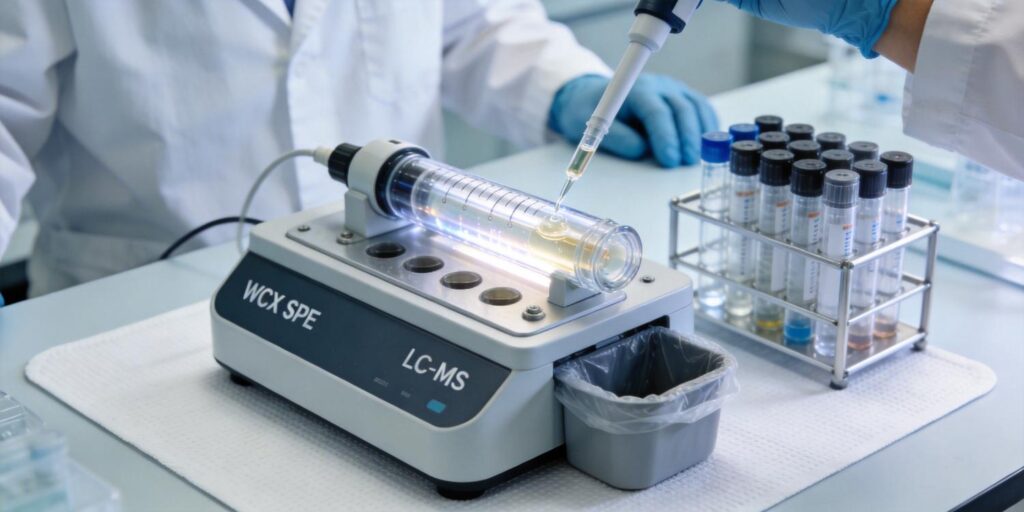
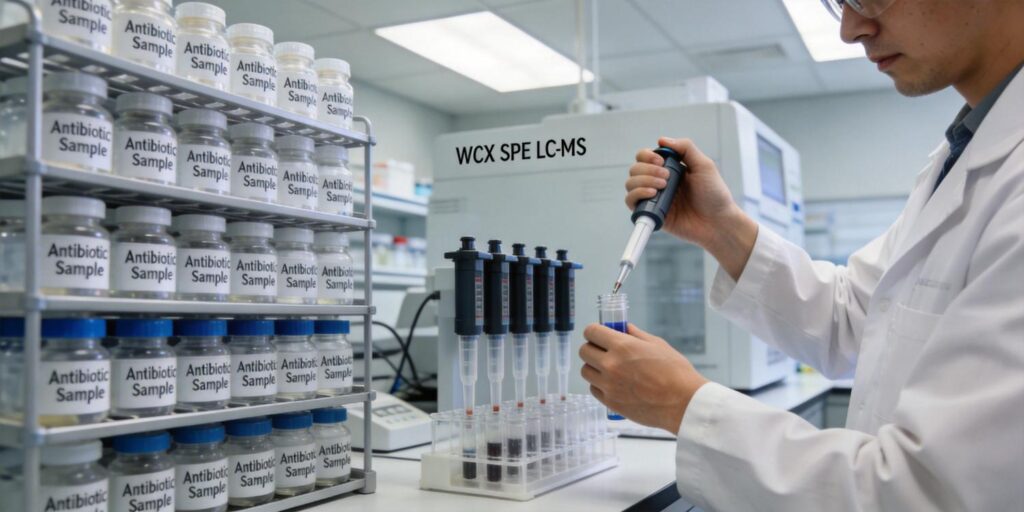
Weak cation exchange (WCX) solid-phase extraction represents one of the most sophisticated approaches for isolating amine-containing drug compounds from complex biological matrices. These compounds encompass a broad spectrum of therapeutic agents including amphetamines, methamphetamine, phenylethylamine derivatives, and numerous basic pharmaceuticals that contain primary, secondary, or tertiary amine functional groups. According to forensic toxicology literature, WCX sorbents provide superior retention for strong bases and quaternary amines through a mixed-mode mechanism combining both ion-exchange and reversed-phase interactions.
The chemical structures of these compounds typically feature nitrogen-containing functional groups that become protonated under acidic conditions, making them ideal candidates for weak cation exchange extraction. As noted in forensic applications, “The retention mechanism is mixed mode (both ion-exchange and reversed-phase), which improves retention for all types of basic analytes, especially strong bases.” This dual retention mechanism ensures high recovery rates even for highly polar amine compounds that might otherwise be challenging to extract using traditional reversed-phase methods.
Biological Matrix Preparation
Proper biological matrix preparation is critical for successful WCX SPE extraction of amines. The most common matrices include urine, plasma, serum, whole blood, and various tissue samples. Each matrix requires specific pretreatment protocols to ensure optimal extraction efficiency and minimize matrix interference.
For urine samples, typical preparation involves adding internal standards and appropriate buffer solutions. As documented in forensic protocols, “To 2 mL of urine add internal standard(s) and 1 mL of 0.1 M phosphate buffer, pH 6.0. Sample pH should be 6.0 ± 0.5. Adjust pH accordingly with 0.1 M monobasic or dibasic sodium phosphate.” This pH adjustment is crucial because it ensures the amine compounds are in their protonated form for optimal retention on the WCX sorbent.
For plasma and serum samples, protein precipitation is often required before SPE. Common approaches include using methanol, acetonitrile, or acidified organic solvents to denature and precipitate proteins. Whole blood samples present additional challenges due to their cellular components and may require hemolysis or enzymatic digestion before extraction. Tissue samples typically need homogenization followed by protein precipitation or enzymatic digestion to release bound analytes.
WCX Conditioning Procedure
The conditioning step is fundamental to WCX SPE performance, as it activates the sorbent and prepares it for optimal analyte retention. A typical conditioning protocol involves sequential solvent washes:
- Methanol Wash: 2-3 mL of methanol to wet the sorbent bed and remove any residual impurities from manufacturing
- Water Wash: 2-3 mL of deionized water to remove methanol and prepare the sorbent for aqueous sample loading
- Conditioning Buffer: 2-3 mL of buffer at pH 4-5 to protonate the carboxylic acid groups on the WCX sorbent
Proper conditioning ensures the carboxylic acid functional groups on the WCX sorbent are in their protonated form, ready to interact with protonated amine analytes through ionic interactions. The conditioning buffer pH is typically selected to be below the pKa of the carboxylic acid groups (approximately 4-5) to ensure they remain protonated during sample loading.
Sample Loading pH Optimization
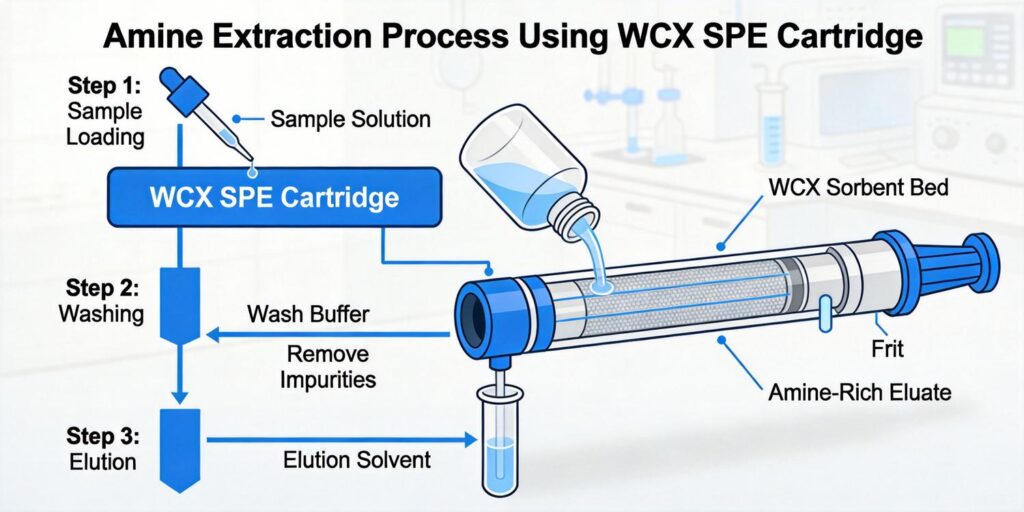
pH optimization during sample loading represents perhaps the most critical parameter in WCX SPE method development for amine extraction. The sample pH must be carefully controlled to ensure amine compounds are protonated while maintaining the WCX sorbent in its active form.
Research indicates optimal loading pH typically ranges from 4.0 to 6.0, depending on the specific amine compounds being extracted. For most basic drugs, a pH of 4.5-5.5 provides excellent retention while minimizing interference from neutral and acidic compounds. As noted in forensic applications, “At pH 4.5 (aqueous medium), the protonated chlorhexidine was retained by a PRS sorbent, while the uncharged excipients passed through the column.”
The buffer selection is equally important. Common buffers include phosphate buffers (pH 4.5-6.0), acetate buffers (pH 4.5-5.5), and formate buffers. These buffers provide adequate buffering capacity while maintaining ionic strength that supports efficient ion-exchange interactions. Sample volumes typically range from 1-5 mL for biological fluids, with flow rates controlled at 1-2 mL/min to ensure sufficient contact time between analytes and sorbent.
Washing to Remove Neutral Interferences
Effective washing protocols are essential for removing neutral and weakly acidic interferences while retaining target amine compounds on the WCX sorbent. The washing step typically employs solvents with moderate elution strength that can remove unwanted matrix components without eluting the retained amines.
Common washing protocols include:
- Water Wash: 2-3 mL of deionized water to remove water-soluble salts and polar interferences
- Buffer Wash: 2-3 mL of the same buffer used for sample loading (pH 4.5-5.5) to maintain ionic conditions
- Organic Wash: 1-2 mL of methanol or acetonitrile (often containing 5-10% water) to remove hydrophobic interferences
Some methods incorporate additional washing steps with specific solvent mixtures. For example, forensic protocols sometimes include “2 mL of hexane” or “2 mL of 0.1 N HCl” as washing steps to remove specific interferences. The key principle is to use solvents that disrupt hydrophobic interactions (for neutral compounds) without disrupting the ionic interactions between protonated amines and the WCX sorbent.
After washing, a drying step (typically 5 minutes under vacuum) is often employed to remove residual water and prepare the sorbent for efficient elution.
Elution Using Basic Organic Solvent
The elution step represents the final critical phase in WCX SPE extraction, where retained amine compounds are selectively released from the sorbent. Elution efficiency depends on disrupting the ionic interactions between protonated amines and the WCX sorbent while maintaining analyte stability.
The most effective elution solvents are basic organic mixtures that:
- Neutralize the protonated amine groups
- Disrupt ionic interactions with the WCX sorbent
- Provide sufficient organic content to elute hydrophobic compounds
Common elution solvents include:
- Ammonium hydroxide in organic solvents: Typically 2-5% ammonium hydroxide in methanol, acetonitrile, or ethyl acetate
- Basic buffer-organic mixtures: Such as “2% ammonium hydroxide in ethyl acetate” or “methylene chloride/isopropyl alcohol/ammonium hydroxide (78:20:2)”
- Triethylamine-containing solvents: For particularly strongly retained compounds
Elution volumes typically range from 2-4 mL, with collection in clean tubes or vials. The basic conditions during elution convert protonated amines back to their neutral forms, disrupting the ionic interactions with the WCX sorbent and allowing elution with the organic solvent.
Following elution, the collected fractions are often evaporated to dryness under gentle nitrogen stream at 40-50°C, then reconstituted in appropriate solvents for subsequent analysis by HPLC, GC-MS, or other analytical techniques. This concentration step enhances detection sensitivity while providing compatibility with analytical instrumentation.
The WCX SPE method for amine extraction offers significant advantages over traditional extraction methods, including higher recoveries, cleaner extracts, and better reproducibility. As noted in comprehensive reviews, “SPE offers faster sample prep, lower cost, greater recoveries, greater accuracy, powerful enrichment of analytes, and additional selectivity and specificity” compared to other sample preparation techniques.
For laboratories considering WCX SPE implementation, Poseidon Scientific’s WCX SPE cartridges provide reliable performance with consistent lot-to-lot reproducibility. For high-throughput applications, 96-well SPE plates offer automation compatibility and improved workflow efficiency.