1. Nature of Humic and Fulvic Acid Interference in LC-MS Analysis
Humic and fulvic acids constitute the primary components of dissolved organic matter (DOM) in environmental water samples, ranging from micrograms per liter in groundwater to milligrams per liter in surface freshwater. These complex macromolecular substances are amphiphilic in nature, containing both hydrophobic aromatic cores and hydrophilic functional groups including carboxyl, phenolic hydroxyl, alcoholic hydroxyl, and carbonyl moieties.
According to Standard Methods for the Examination of Water and Wastewater, dissolved organic carbon (DOC) is operationally defined as the fraction of total organic carbon that passes through a 0.45 μm filter. Humic acids are water-soluble at high pH (typically above their pKa of 5-6), while fulvic acids remain soluble across all pH ranges. These substances can form micellar structures that exhibit unexpected retention behavior on SPE sorbents, even when charged.
During LC-MS analysis, humic substances create multiple interference pathways: they can co-elute with target analytes, cause ion suppression through competitive ionization, and generate elevated baseline noise that compromises detection limits. The amphiphilic nature of these compounds means they can interact with both reversed-phase and ion-exchange mechanisms, making their removal particularly challenging.
2. Impact on Ion Suppression and Chromatographic Baseline Noise
Humic substances significantly impact LC-MS performance through two primary mechanisms: ion suppression and increased chromatographic baseline noise. Research by Nakamura et al. (1996) demonstrated that DOM can reduce analyte recovery, particularly for compounds with log Pow values above 4 when using alkyl-bonded silica sorbents, or above 3 when using polystyrene sorbents.
Ion suppression occurs when humic compounds compete with target analytes for ionization in the MS source, reducing signal intensity and compromising quantification accuracy. This matrix effect is particularly problematic in environmental analysis where target compounds are often present at trace levels (parts-per-trillion to parts-per-billion).
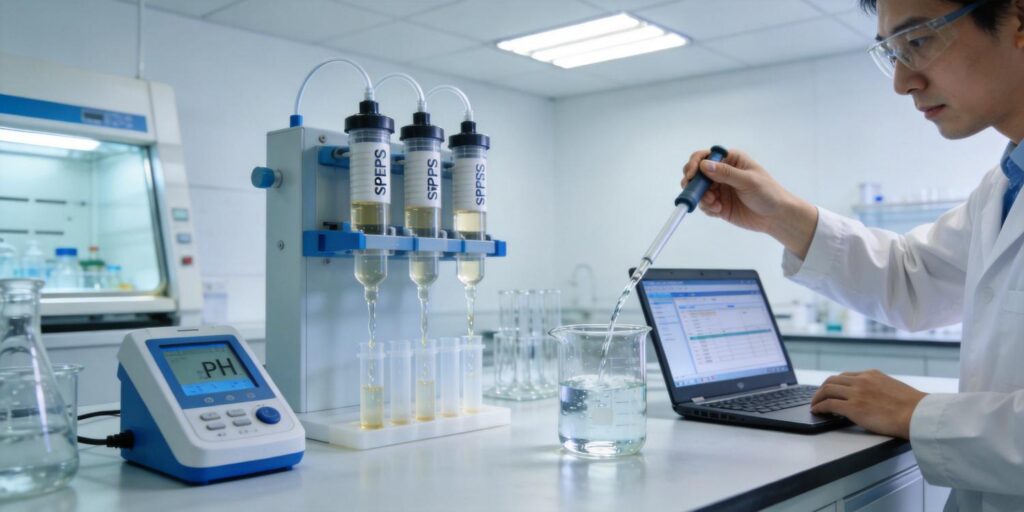
Chromatographic baseline noise increases due to the broad elution profile of humic substances, which can span multiple minutes of the chromatographic run. This elevated baseline reduces signal-to-noise ratios and can obscure low-level target peaks. The yellow-brown band often observed at the top of SPE columns during environmental extractions represents concentrated humic material that, if not properly removed, will transfer these interferences to the final extract.
3. Selection of HLB or WAX Sorbent for Humic Substance Removal
The choice between hydrophilic-lipophilic balanced (HLB) and weak anion exchange (WAX) sorbents depends on the specific analytical requirements and target analyte characteristics. Both sorbents offer distinct advantages for humic substance removal:
Oasis HLB Sorbent
HLB represents a breakthrough in SPE technology with its water-wettable copolymer that remains stable across pH 0-14. As the “gold standard” in SPE, HLB provides several advantages for humic removal:
- No conditioning or equilibration steps required due to inherent water-wettability
- High capacity for a wide range of compounds including acids, bases, and neutrals
- Elimination of silanol interactions that can complicate extractions
- Direct loading of aqueous samples without sacrificing recovery
Oasis WAX Sorbent
WAX sorbents offer mixed-mode functionality combining reversed-phase retention with weak anion exchange capabilities. These are particularly effective for:
- Strong acids with pKa < 1
- Selective retention of negatively charged humic substances at appropriate pH
- Orthogonal selectivity when combined with reversed-phase mechanisms
- Cleaner extracts through dual retention mechanisms
For general humic removal from environmental waters, HLB often provides the most versatile solution. However, when targeting specific acidic analytes or requiring maximum humic removal, WAX sorbents offer superior selectivity. The Oasis 2×4 strategy recommends using WAX for strong acids (pKa < 1) within a systematic approach to analyzing all compound types.
4. Pre-filtration Using 0.45 μm Membrane Filters
Pre-filtration represents a critical first step in environmental sample preparation. Standard Methods procedures recommend using glass-fiber filter discs (0.45 μm) without organic binders to remove particulate matter that could otherwise clog SPE devices and interfere with analysis.
Proper pre-filtration serves multiple purposes:
- Removes suspended solids that could physically block SPE sorbent pores
- Reduces variability in analytical results by standardizing sample composition
- Prevents fouling of SPE devices, particularly important for high-volume environmental samples
- Facilitates consistent flow rates during sample loading
Researchers including Durand and Barceló (1993) have successfully employed step-wise filtration through 0.7 μm followed by 0.45 μm glass-fiber filters for seawater analysis. It’s essential to test target analytes for potential adsorption to the selected filter material, though this is generally minimal for most environmental contaminants.
5. Cartridge Conditioning with Methanol and Ultrapure Water
While Oasis HLB sorbents are water-wettable and don’t require traditional conditioning, proper preparation remains important for optimal performance. For environmental applications involving humic-rich samples, we recommend the following conditioning protocol:
- Methanol Conditioning: Pass 2-3 mL of HPLC-grade methanol through the cartridge to ensure complete wetting of the sorbent bed
- Water Equilibration: Follow with 2-3 mL of ultrapure water (pH-adjusted if necessary) to prepare the sorbent for aqueous sample loading
- Flow Rate Control: Maintain a steady flow rate of 1-2 mL/min during conditioning to ensure uniform sorbent activation
For traditional silica-based sorbents, conditioning is absolutely essential to achieve proper retention. The water-wettable nature of Oasis sorbents eliminates this requirement, reducing solvent consumption by up to 70% and saving approximately 40% in sample preparation time compared to traditional SPE protocols.
6. Loading 100–500 mL Water Samples Under Low Vacuum
Environmental water samples typically require large volumes (100-500 mL) to achieve adequate concentration factors for trace-level analysis. Proper loading conditions are essential to maximize humic removal while retaining target analytes:
Optimal Loading Parameters
- Flow Rate: 5-10 mL/min under low vacuum (approximately 3-5 inches Hg)
- pH Adjustment: Adjust sample pH to 2-3 using hydrochloric or phosphoric acid to protonate humic acid carboxyl groups (pKa 5-6)
- Sorbent Capacity: Use 200-500 mg sorbent mass for 100-500 mL samples, following the guideline of approximately 1 g sorbent per liter of water
- Breakthrough Monitoring: Watch for the characteristic yellow-brown band at the top of the sorbent bed as an indicator of humic accumulation
Research by Pfaab and Jork (1994) established that 1 g of reversed-phase sorbent per liter of water prevents breakthrough for most environmental contaminants. For our standard protocol, we recommend 200 mg Oasis HLB for 100 mL samples or 500 mg for 500 mL samples, providing adequate capacity while maintaining reasonable flow rates.
7. Washing with 5% Methanol Solution to Remove Humic Fractions
The wash step represents the critical phase for humic substance removal while retaining target analytes. A 5% methanol in water solution provides optimal selectivity:
Wash Protocol Specifications
- Volume: 3-5 mL of 5% methanol/water (v/v)
- pH: Maintain acidic conditions (pH 2-3) to keep humic acids protonated and less retained
- Flow Rate: 1-2 mL/min to maximize contact time and washing efficiency
- Monitoring: Observe the eluate color – initial fractions may contain some humic material, but should clear substantially by the end of the wash
This wash selectively removes humic fractions while retaining most target analytes through stronger hydrophobic interactions. The 5% methanol concentration represents a compromise between sufficient elution strength to remove humics and weak enough to retain target compounds. For particularly challenging samples, increasing to 10% methanol may be necessary, though this requires verification that target analytes aren’t prematurely eluted.
8. Elution of Target Analytes Using Methanol
Following effective humic removal, target analytes are eluted using appropriate organic solvents. Methanol serves as an excellent general elution solvent for most environmental contaminants:
Elution Protocol
- Solvent: 2-5 mL of 100% HPLC-grade methanol
- Collection: Collect eluate in clean glass or polypropylene tubes
- Evaporation: Concentrate to 0.5-1.0 mL under gentle nitrogen stream at 30-40°C
- Reconstitution: Reconstitute in initial mobile phase composition for LC-MS analysis
For compounds requiring stronger elution conditions, alternative solvents include:
- Acetonitrile (medium polarity drugs)
- 90:10 Acetonitrile:Methanol mixture
- Ethyl acetate or methylene chloride (nonpolar compounds, GC-compatible)
When using solvents other than methanol, add 10-30% methanol to disrupt hydrogen bonding on the Oasis HLB sorbent. The Oasis generic SPE method provides elution solvent selection guidance based on analyte polarity and analytical requirements.
9. Evaluation of Matrix Removal by UV Absorbance Monitoring
Quantitative assessment of humic removal is essential for method validation and quality control. UV absorbance monitoring provides a simple, effective means of evaluating matrix removal efficiency:
UV Monitoring Protocol
- Wavelength: 254 nm for general organic matter detection
- Reference: Compare absorbance of final extract against original sample (appropriately diluted)
- Acceptance Criteria: >90% reduction in UV absorbance at 254 nm
- Additional Monitoring: 280 nm for aromatic humic components, 220 nm for general organic content
For more comprehensive evaluation, consider these additional assessment methods:
LC-MS Assessment
- Monitor characteristic humic substance ions in full-scan mode
- Compare matrix effect in post-extraction spiked samples vs pure standards
- Evaluate ion suppression using post-column infusion techniques
Recovery Studies
- Spike samples with target analytes at relevant concentrations
- Compare SPE recovery against alternative extraction methods (e.g., LLE)
- Validate with certified reference materials when available
Method Performance Metrics
- Signal-to-noise improvement in final extracts
- Reduction in chromatographic baseline drift and noise
- Improved peak shape and resolution for target compounds
Regular monitoring of humic removal efficiency ensures consistent analytical performance and reliable quantification of target environmental contaminants. By implementing this comprehensive SPE protocol, laboratories can achieve cleaner extracts, reduced matrix effects, and improved detection limits for LC-MS analysis of environmental water samples.
Conclusion
Effective removal of humic substances from environmental water samples requires a systematic approach combining proper sorbent selection, optimized conditioning and washing protocols, and rigorous quality assessment. The Oasis HLB and WAX sorbents provide robust platforms for humic removal, with HLB offering general-purpose capability and WAX providing enhanced selectivity for acidic compounds.
By following the detailed protocol outlined above – from pre-filtration through final elution and quality assessment – analytical laboratories can significantly improve LC-MS performance for environmental monitoring applications. The reduction in ion suppression and baseline noise translates directly to lower detection limits, improved quantification accuracy, and increased confidence in environmental data quality.
For laboratories processing large volumes of environmental samples, consider implementing 96-well SPE plate formats for higher throughput while maintaining the cleanup efficiency demonstrated in this protocol. Regular method validation against alternative extraction techniques and participation in proficiency testing programs will ensure ongoing method performance and regulatory compliance.