
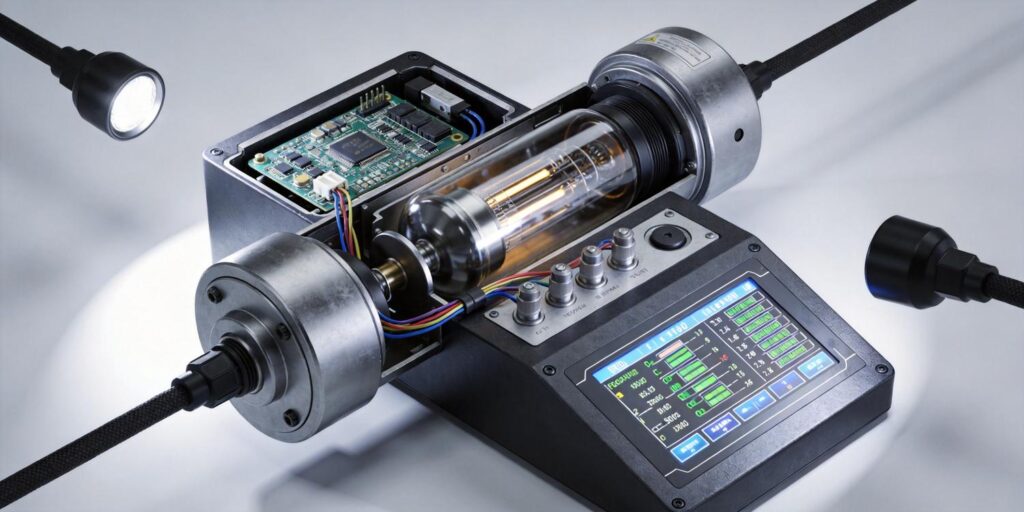
Cold Cathode Gauge Plasma Noise and Measurement Stability
In high-vacuum applications—PVD coating, analytical instruments, semiconductor processing, and UHV research—stable pressure readings below 10⁻³ Torr are essential for process repeatability and equipment protection. Cold-cathode ionization gauges, such as the Poseidon Scientific VG-SM225, deliver this capability without filaments, but users frequently ask about plasma-related noise and long-term drift. This article explains the physical origins of discharge fluctuations, their practical impact, and proven strategies to achieve repeatable measurements within ±20 % (typical) across 10⁻⁷–10⁻³ Torr.
The VG-SM225 employs an inverted-magnetron (Redhead-type) geometry with axial magnetic field (~1200 G) and high-voltage operation (−2500 V startup, −2000 V running). This design produces a stable, low-noise Penning discharge while remaining fully cleanable and compatible with PTR225N controllers.
Plasma Fluctuation Mechanisms
The Penning discharge relies on electrons trapped in crossed electric and magnetic fields, spiraling in long cycloidal paths before ionizing gas molecules. At pressures below ~10⁻⁴ Torr the electron space-charge density becomes high enough to support large-amplitude RF oscillations (typically 10–100 MHz). These oscillations arise from the long electron trapping times (several kilometers of path length) and cause periodic mode-jumping between different plasma states.
Consequences include:
- Step changes or “discontinuities” in the ion-current vs pressure curve
- Short-term fluctuations up to several percent of reading
- Occasional discharge extinction in conventional Penning cells (rare in inverted-magnetron designs)
Inverted-magnetron geometry confines electrons more efficiently than traditional “工”-shaped Penning cells, reducing oscillation amplitude and improving reproducibility. Poseidon’s VG-SM225 further minimizes these effects through precise electrode geometry, shielded magnet assembly, and internal space-charge stabilization. Contamination (carbon or oxide layers) alters surface field emission and can amplify instabilities—regular electrode cleaning restores baseline performance.
Power Supply Ripple Effect
Because the discharge current depends exponentially on anode voltage in the operating regime, even small ripple on the high-voltage rail translates directly into apparent pressure noise. A 1 % ripple at −2000 V can produce ±5–10 % fluctuations in ion current at 10⁻⁶ Torr.
The VG-SM225 contains an internal high-voltage converter powered by a stable 20–28 V DC supply. Its regulated converter limits ripple to <0.1 % under normal line conditions. When the gauge is fed from a noisy industrial 24 V rail, however, external filtering (ferrite bead + 100 µF low-ESR capacitor) or a dedicated linear supply is recommended. The gauge’s firmware also monitors supply voltage and automatically disables the high-voltage stage if it falls outside safe limits, protecting both the gauge and the chamber.
Signal Averaging Strategies
Digital averaging is the most effective and user-accessible method to suppress plasma noise. The VG-SM225 supports configurable averaging windows via its RS232 interface (default 1 s, selectable 0.1–10 s). Each reading represents the mean of 128–1024 internal samples taken at 1 kHz.
Practical guidelines:
- 10⁻⁶–10⁻⁴ Torr → 1–2 s averaging yields <±2 % peak-to-peak noise
- 10⁻⁷–10⁻⁶ Torr → 3–5 s averaging recommended for sub-±5 % stability
- For continuous monitoring, logarithmic 0–10 V analog output already incorporates internal low-pass filtering (<20 Ω source impedance)
Modern PLC/SCADA systems can apply additional moving-average or Kalman filtering on the digital stream with negligible latency. Custom firmware protocols allow users to request raw unaveraged samples for diagnostic purposes or to implement application-specific filters.
Environmental Shielding
External factors can modulate the internal magnetic field or couple electrical noise into the signal path:
Magnetic Interference
A transverse field of only 50 G at the flange can shift sensitivity by 5–15 %. The VG-SM225 magnet assembly is fully shielded; the external field drops to <5 G at 10 cm. Maintain ≥10 cm clearance from turbo pumps, motors, or permanent magnets.
Electrical Noise
RF plasma generators, VFDs, and ground loops introduce 50–200 mV ripple on the analog output—equivalent to nearly a decade of false pressure change at low 10⁻⁷ Torr. Use shielded twisted-pair cable, single-point grounding at the chamber, and the gauge’s low-impedance output to reject common-mode noise effectively.
Temperature
Electronics are compensated 0–50 °C with <±3 % variation in ion-current amplification. The discharge itself is almost temperature-independent.
Stability Validation Test
To quantify performance in your system:
- Install the VG-SM225 on a calibrated comparison chamber with a spinning-rotor or extractor reference gauge.
- Evacuate to base pressure (<10⁻⁷ Torr), record 24-hour continuous readings with 2 s averaging.
- Repeat after 3 months and after 12 months (typical calibration interval).
- Typical results with VG-SM225: long-term drift <9 % at 10⁻⁶ Torr, short-term noise <±2 % after averaging—consistent with published inverted-magnetron data.
Poseidon provides factory calibration certificates traceable to NIST-equivalent standards at multiple test points, plus optional annual re-calibration service with full report.
| Condition | Typical Noise (1 s avg) | After 2 s averaging | Long-term Drift (12 mo) |
|---|---|---|---|
| 10⁻⁴ Torr | ±4 % | ±1.5 % | <5 % |
| 10⁻⁶ Torr | ±8 % | ±2 % | <9 % |
| 10⁻⁷ Torr | ±12 % | ±4 % | <12 % |
Conclusion and Next Steps
The inverted-magnetron design of the VG-SM225, combined with low-ripple power conversion, configurable digital averaging, and robust environmental shielding, delivers the measurement stability required for modern high-vacuum processes. Plasma noise is real but predictable and readily tamed with straightforward engineering practices already implemented in the gauge.
Engineers and procurement teams seeking reliable high-vacuum monitoring down to 10⁻⁷ Torr now have a cost-effective, cleanable, and controller-compatible solution. Explore the VG-SM225 Cold Cathode Vacuum Gauge product page or request a 5–10 unit prototype kit with custom RS232 protocol and full calibration data package.
Need help integrating the gauge into your PLC or validating performance against your existing reference? Contact our applications team at sales@poseidon-scientific.com—we routinely support OEM chamber builders and end-user R&D labs with free system reviews and on-site stability demonstrations.
Stable vacuum is the foundation of repeatable results. Choose the gauge engineered to keep it that way.


