Packaging Vacuum Level Requirements
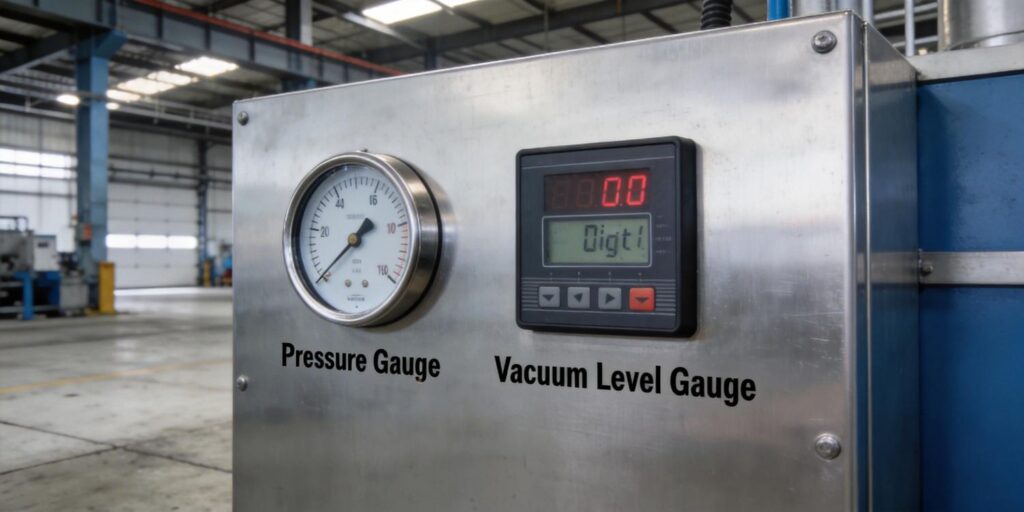
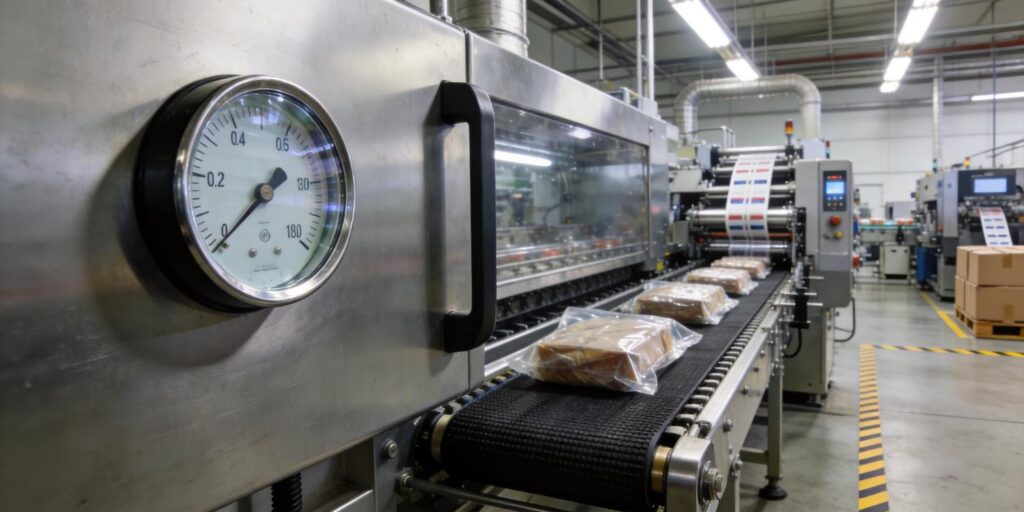
Vacuum packaging systems for food, pharmaceuticals, and electronics demand precise pressure control to extend shelf life, prevent oxidation, and ensure hermetic seals. Most commercial vacuum chamber machines operate in the rough-vacuum regime—atmospheric pressure down to 1–50 Torr (1.33–66.7 mbar). This range removes >99 % of air while remaining fast enough for high-throughput production lines running 10–60 cycles per minute.
Standard food vacuum packaging (meat, cheese, coffee) typically targets 10–20 Torr residual pressure. Modified atmosphere packaging (MAP) often stops at 50–100 Torr before back-filling with N₂/CO₂ mixes. Electronics and medical device blister packs may require deeper evacuation to 1–5 Torr to eliminate moisture and prevent arcing during sealing. These targets align directly with the measurement capabilities of thermal-conductivity gauges.
The Poseidon Scientific VG-SP205 Pirani Vacuum Transmitter covers the full required span: 760 Torr down to 10⁻³ Torr. Its linear response region (10–0.01 Torr) delivers the highest accuracy where sealing decisions are made, while the extended low end provides headroom for deeper-draw processes without switching sensors.
Fast Evacuation Monitoring
Production speed is everything in vacuum packaging. Pump-down times of 2–8 seconds per cycle require a gauge with millisecond-class response. The VG-SP205 uses a platinum filament maintained at constant temperature; any pressure drop instantly changes heat loss, producing a voltage shift detectable within <100 ms.
In practice, engineers set two critical thresholds:
- Evacuation complete (typically 15–25 Torr) → trigger seal jaws
- Leak-test window (hold at target pressure for 0.5–1 s) → confirm no rise before sealing
The gauge’s 0–10 V analog output (effective 2–8 V) or customizable RS232 stream updates every 50 ms, allowing PLCs to close the loop without lag. Because the sensor is mounted directly on the chamber (KF16/KF25 flange), there is zero tubing delay—unlike remote-mounted transducers. This direct mounting also eliminates virtual leaks that could falsify readings during rapid cycling.
For systems running gas mixtures, the VG-SP205 is factory-calibrated for air; minor offsets from CO₂ or argon are easily compensated in the PLC lookup table, preserving <±15 % accuracy across the critical sealing band.
Typical Pump-Down Profile with VG-SP205
| Time (s) | Chamber Pressure (Torr) | Action Triggered |
|---|---|---|
| 0 | 760 | Pump start |
| 1.5 | 200 | Coarse evacuation |
| 3.5 | 20 | Seal initiation (configurable) |
| 5.0 | 10 | Final hold & leak check |
Sensor Durability in Food Environments
Food packaging exposes sensors to water vapor, oils, acids, and occasional particulates. Traditional tungsten-filament Pirani gauges corrode rapidly in humid or fatty environments. The VG-SP205 solves this with a platinum filament—chemically inert, oxidation-resistant, and mechanically stable at operating temperatures.
Platinum’s large temperature coefficient of resistance gives cleaner signal-to-noise than tungsten or rhenium-tungsten alternatives. Single-gauge filament life reaches 3–5 years in typical food lines (tested at 15–50 °C ambient). The stainless-steel body and electropolished KF flange resist cleaning agents (alcohol, peroxide, alkaline foams) and meet FDA 21 CFR 177 indirect food-contact expectations.
Unlike cold-cathode gauges that accumulate carbon deposits, the VG-SP205 is completely maintenance-free. No high-voltage electrodes, no magnets, no disassembly required. Even after thousands of cycles with residual moisture, the platinum surface remains clean and the calibration curve stable.
Signal Integration with Sealing System
Modern vacuum packaging lines integrate the gauge directly into the machine’s safety and sequencing logic. The VG-SP205 offers three output options:
- 0–10 V analog (industry-standard for PLC analog inputs)
- RS232 digital (custom protocol available for 5–10 units)
- Optional RS485 (board-level change)
Engineers typically map the analog voltage to pressure via a simple linear or piecewise function in the PLC. When pressure falls below the programmable set-point (e.g., 15 Torr), a digital output or RS232 flag closes the seal jaws, starts gas flush, and initiates the heat-seal cycle. If pressure rises during the hold phase, the interlock aborts the cycle and triggers an alarm—preventing leaky packages from reaching the retail stream.
Custom protocol support lets OEMs embed gauge status (temperature-compensated reading, error flags, firmware version) into existing machine HMIs without additional gateways. RJ45 connector (field-convertible to DB9) simplifies wiring and reduces installation time on rotary or inline machines.
Maintenance Strategy
Zero scheduled maintenance is the key advantage of the VG-SP205 in 24/7 packaging environments. The platinum filament is sealed inside a stainless-steel envelope; contamination that would destroy tungsten filaments has negligible effect. Annual visual inspection of the flange seal and quick leak-rate check (helium or pressure-rise test) is sufficient for most users.
Factory calibration certificates ship with every unit, traceable to national standards at multiple points across 760–1 Torr. Because the gauge is non-repairable in the field, Poseidon offers a low-cost swap program: return the old unit and receive a freshly calibrated replacement within days—keeping downtime under one shift.
For extreme-duty lines (high-fat products or frequent wash-down), users can add an optional inline filter (10 µm sintered stainless) on the KF flange. This extends already long service life without affecting response time.
Comparison of Maintenance Requirements
| Gauge Type | Filament Life | Cleaning Interval | Calibration Frequency |
|---|---|---|---|
| VG-SP205 Pirani (Platinum) | 3–5 years | None | Annual (swap program) |
| Traditional Tungsten Pirani | 1–2 years | Monthly | Quarterly |
| Cold Cathode (for reference) | 1–3 years | Every 6 months | Annual |
Conclusion and Next Steps
The VG-SP205 Pirani Vacuum Transmitter delivers the exact combination of speed, accuracy, durability, and integration flexibility that vacuum packaging OEMs and end-users need. Its small footprint, low cost (3000–3500 RMB self-manufactured equivalent), and customizable communication protocol make it the first choice for new machine designs and retrofits alike.
Whether you run rotary chamber machines, inline tray sealers, or MAP snorkel systems, the VG-SP205 ensures every package meets target residual pressure—reducing leakers, extending shelf life, and protecting brand reputation.
Ready to upgrade your vacuum monitoring? Visit the VG-SP205 Pirani Vacuum Transmitter product page for full specifications, dimensional drawings, and sample RS232 protocol code. Procurement teams can request 5–10 unit custom-protocol prototypes with full calibration data packages at no extra charge.
Need help selecting flange size, output mapping, or integrating with your specific PLC brand? Contact our applications engineering team at sales@poseidon-scientific.com. We routinely support chamber builders and food processors with free system reviews, on-site response-time demonstrations, and validation support for HACCP or ISO 22000 documentation.
Stable, fast, maintenance-free vacuum measurement—engineered for the packaging line. Choose Poseidon and keep your lines running at peak efficiency.