Introduction to Water Contaminant Monitoring
Water quality monitoring has become increasingly critical in environmental protection, public health, and regulatory compliance. With growing concerns about industrial pollution, agricultural runoff, and emerging contaminants, analytical laboratories face the challenge of detecting trace-level pollutants in complex aqueous matrices. Solid Phase Extraction (SPE) has emerged as the cornerstone technology for water contaminant analysis, offering unparalleled capabilities for sample cleanup, concentration, and analyte isolation.
Common Water Contaminants Requiring SPE Analysis
Water monitoring programs target diverse contaminant classes, each presenting unique analytical challenges that SPE effectively addresses:
Pesticides and Herbicides
Agricultural runoff introduces numerous pesticides into water systems, including triazine herbicides like atrazine, organophosphorus compounds, and N-methylcarbamates. Research demonstrates that SPE enables detection of atrazine at sub-parts-per-trillion levels (Cai et al., 1993), far below conventional detection limits. These compounds often exist at trace concentrations requiring significant enrichment factors that SPE readily provides.
Industrial Chemicals and Priority Pollutants
Polychlorinated biphenyls (PCBs), polycyclic aromatic hydrocarbons (PAHs), and other persistent organic pollutants represent significant environmental threats. SPE methodologies have been developed for ultratrace determination of polychlorinated dibenzo-p-dioxins (Chang et al., 1992) and routine PCB analysis in waste automotive engine oils (Canals et al., 1993). The hydrophobic nature of these compounds makes reversed-phase SPE particularly effective.
Pharmaceuticals and Personal Care Products
Emerging contaminants including antibiotics, analgesics, and endocrine disruptors enter water systems through wastewater treatment plants. SPE techniques have been validated for compounds like warfarin in drinking water (Dalbacke et al., 1992) and various pharmaceuticals in surface waters, demonstrating the versatility of SPE across different chemical classes.
Heavy Metals and Inorganic Species
While traditionally analyzed by atomic spectroscopy, certain metal species benefit from SPE preconcentration. Methods exist for arsenic speciation using on-column formation of As(III)-trispyrrolidenedithiocarbamate (Van Elteren et al., 1990) and IMAC SPE for heavy metal cleanup prior to analysis (Dixon et al., 1996).
Trace Detection Requirements in Water Analysis
Modern water monitoring demands extraordinary sensitivity, often requiring detection at parts-per-trillion (ppt) or even parts-per-quadrillion (ppq) levels. Regulatory frameworks like the US EPA’s Clean Water Act and the EU Water Framework Directive establish stringent limits that necessitate advanced sample preparation techniques.
Sub-ppt Detection Capabilities
SPE enables detection capabilities far exceeding traditional methods. For instance, atrazine can be determined at low and sub-parts-per-trillion levels using SPE (Cai et al., 1993), while organophosphorus pesticides in fruits and surface waters achieve sensitive detection through HPLC following SPE enrichment (Carabias et al., 1992). These capabilities stem from SPE’s ability to concentrate analytes from large sample volumes (typically 100-1000 mL) into small elution volumes (1-5 mL), achieving enrichment factors of 100-1000×.
Matrix Complexity Challenges
Natural water samples contain humic acids, fulvic acids, suspended solids, and various dissolved organic matter that interfere with analytical detection. SPE provides selective retention mechanisms that separate target analytes from matrix interferences. Polymeric sorbents effectively remove humic and fulvic acid interferences while simultaneously extracting polar acidic, neutral, and basic pesticides (Pichon et al., 1996).
Method Validation Requirements
Regulatory compliance demands rigorous method validation including recovery studies, precision measurements, and detection limit determinations. SPE methods consistently demonstrate higher and more reproducible recoveries compared to liquid-liquid extraction, with typical recoveries of 80-120% for most target analytes. The technique’s reproducibility stems from controlled flow rates and standardized sorbent chemistries.
SPE Extraction Workflow for Water Analysis
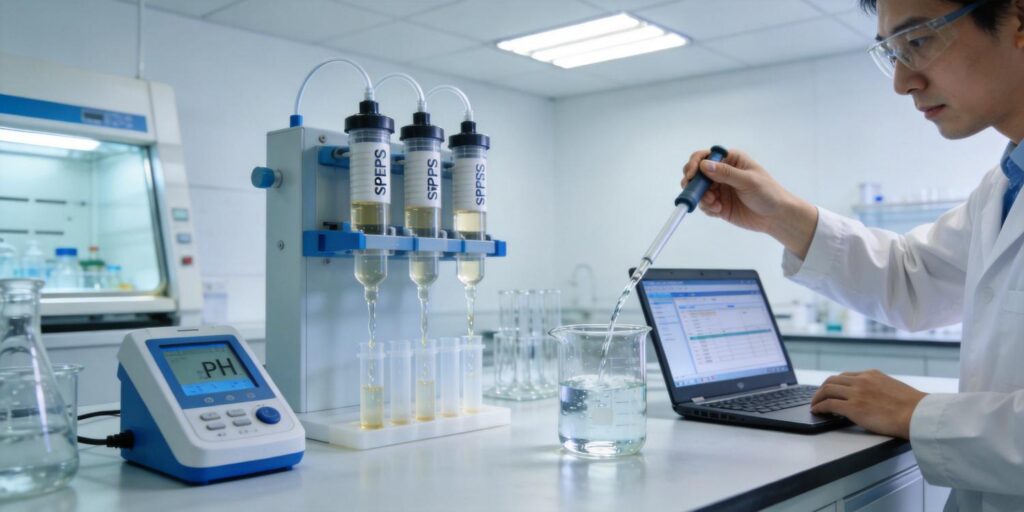
The SPE process for water contaminants follows a systematic five-step workflow optimized for maximum recovery and minimal interference.
Step 1: Sorbent Selection and Cartridge Conditioning
Choosing the appropriate SPE sorbent depends on analyte chemistry. For comprehensive water analysis, mixed-mode sorbents combining reversed-phase and ion-exchange mechanisms offer broad-spectrum coverage. The Oasis 2×4 strategy employs just two protocols and four sorbents to analyze acids, bases, and neutrals across all matrices. Cartridge conditioning typically involves sequential methanol and water/buffer steps to activate the sorbent and ensure proper wetting of hydrophobic phases.
Step 2: Sample Loading and Analyte Retention
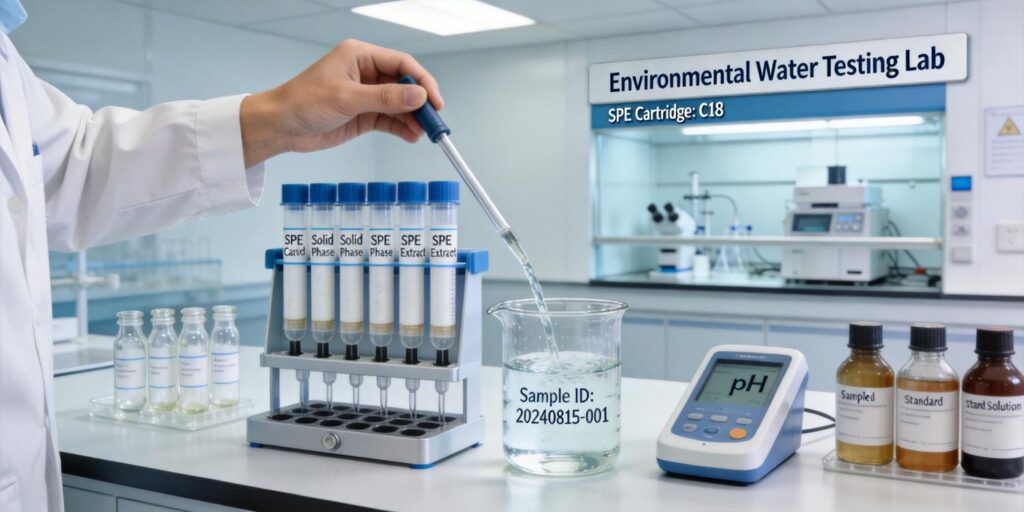
Water samples, often pre-filtered to remove particulates, are loaded onto conditioned SPE cartridges at controlled flow rates (1-10 mL/min). Optimal flow rates balance throughput with retention efficiency, as recovery is inversely proportional to flow rate. Large volume samples (up to 1000 mL) can be processed using disk formats or 96-well plates for high-throughput applications. The loading pH is frequently adjusted to optimize retention based on analyte pKa values.
Step 3: Interference Removal Through Washing
Selective washing removes matrix components while retaining target analytes. Wash solvents are carefully chosen based on their ability to elute interferences without displacing analytes. For reversed-phase extractions, aqueous washes with 5-20% methanol or acetonitrile effectively remove polar interferences. For mixed-mode extractions, pH-adjusted washes selectively remove compounds based on their ionization state.
Step 4: Analyte Elution and Concentration
Target analytes are eluted using minimal volumes of strong solvents (typically 1-5 mL). Common eluents include methanol, acetonitrile, or mixtures with acid/base modifiers for ion-exchange mechanisms. The small elution volumes facilitate subsequent concentration steps if required for ultra-trace analysis. Eluates are often evaporated under gentle nitrogen stream and reconstituted in mobile phase compatible solvents.
Step 5: Analysis and Quality Control
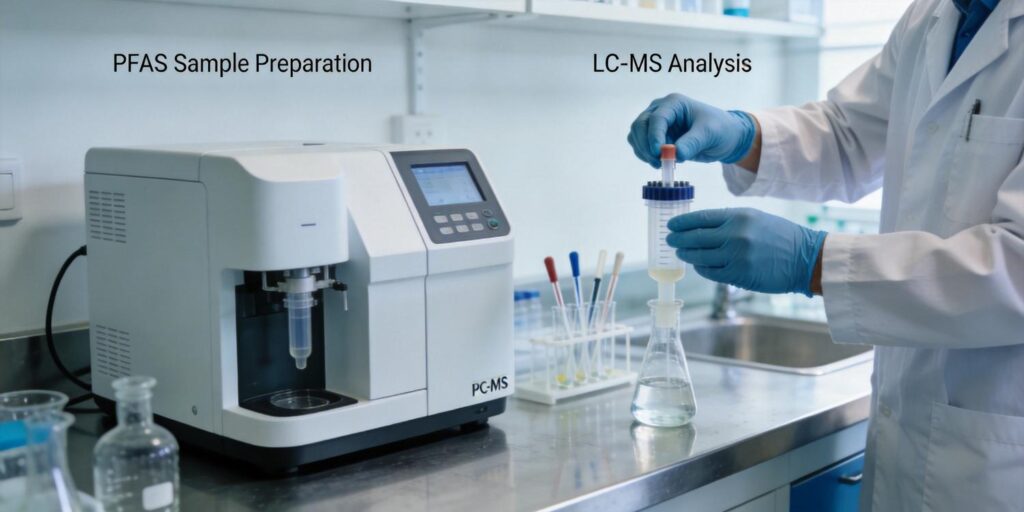
SPE extracts are analyzed by chromatographic techniques including GC-MS, LC-MS/MS, or HPLC-UV. Quality control measures include method blanks, matrix spikes, and internal standards to monitor extraction efficiency and matrix effects. Automated systems enable high-throughput processing with improved reproducibility compared to manual methods.
Advanced SPE Techniques for Water Monitoring
Beyond basic cartridge formats, several advanced SPE configurations enhance water analysis capabilities:
On-line SPE-LC/MS Systems
Fully automated systems integrate SPE directly with analytical instrumentation, enabling unattended operation and reduced sample handling. On-line SPE-HPLC systems achieve detection limits in the low-ppt range for pesticides in drinking water (Huen et al., 1994) and provide rapid analysis of micro-contaminants using atmospheric pressure chemical ionization tandem mass spectrometry (Hogenboom et al., 1997).
SPE Disk Technology
Extraction disks offer advantages for large volume samples and high particulate content. Their short bed height (0.5-2 mm) allows faster flow rates without compromising recovery. Membrane-based SPE has been successfully applied to organophosphorus pesticide determination in aqueous samples by on-line membrane disk extraction and capillary gas chromatography (Kwakman et al., 1992).
96-Well Plate Formats
High-throughput applications benefit from 96-well SPE plates compatible with automated liquid handlers. These systems enable simultaneous processing of 96 samples, dramatically increasing laboratory productivity for routine monitoring programs. Applications include high-throughput LC-MS/MS bioanalysis using 96-well disk solid phase extraction plates (Simpson et al., 1998).
Method Development Considerations
Successful SPE method development for water analysis requires systematic optimization:
Analyte Characterization
Understanding analyte properties—including structure, pKa, polarity, and functional groups—guides sorbent and solvent selection. The “educated approach” to method development emphasizes organized problem-solving based on chemical principles rather than trial-and-error screening.
Matrix Effects Evaluation
Natural organic matter, ionic strength, and pH variations affect extraction efficiency. Method development should include evaluation of matrix effects using representative water samples. Techniques like standard addition or isotope-labeled internal standards compensate for matrix-induced suppression or enhancement.
Breakthrough Volume Determination
For large volume sampling, determining breakthrough volumes ensures complete analyte retention. Theoretical prediction methods combined with experimental verification optimize sample loading volumes without compromising recovery.
Future Directions in SPE for Water Monitoring
The evolution of SPE technology continues to address emerging challenges in water analysis:
Novel Sorbent Materials
Advanced polymeric materials with enhanced selectivity and capacity are being developed. Hydrophilic-lipophilic balanced (HLB) sorbents provide exceptional retention for polar compounds while maintaining compatibility with pH 0-14. Molecularly imprinted polymers offer antibody-like specificity for target analyte classes.
Miniaturization and Automation
Micro-extraction techniques and lab-on-a-chip devices promise reduced solvent consumption and sample volumes while maintaining sensitivity. Automated systems with integrated SPE, concentration, and analysis streamline workflow and improve data quality.
Coupled Techniques
Integration of SPE with alternative extraction methods like supercritical fluid extraction (SFE) or microwave-assisted extraction expands application scope. SPE devices can trap analytes from SFE streams or be eluted using supercritical fluids, providing solvent-free alternatives for certain applications.
Conclusion
Solid Phase Extraction remains indispensable for water contaminant monitoring, offering the sensitivity, selectivity, and reproducibility required for modern environmental analysis. From pesticide detection at sub-ppt levels to comprehensive screening of emerging contaminants, SPE provides the foundation for reliable water quality assessment. As analytical demands evolve with new regulatory requirements and contaminant discoveries, SPE technology continues to advance, ensuring laboratories can meet tomorrow’s water monitoring challenges with confidence and precision.
For laboratories seeking optimized SPE solutions for water analysis, Poseidon Scientific offers a comprehensive range of HLB SPE cartridges, MAX SPE cartridges, MCX SPE cartridges, WAX SPE cartridges, WCX SPE cartridges, and 96-well SPE plates designed to meet the rigorous demands of environmental water analysis.