What Are Matrix Effects?
Matrix effects represent one of the most significant challenges in modern analytical chemistry, particularly in LC-MS workflows. These effects occur when co-extracted components from the sample matrix interfere with the ionization process of target analytes in the mass spectrometer. As noted in the literature, “An undesirable feature of atmospheric pressure ionization-MS analysis is suppression of ionization by co-extracted endogenous interferences from biofluids.” This phenomenon can lead to inaccurate quantification, reduced sensitivity, and compromised data quality.
Matrix effects are particularly problematic in complex biological and environmental samples where numerous endogenous compounds—proteins, lipids, salts, metabolites, and other matrix components—co-elute with target analytes. These interferences can compete for ionization in the MS source, alter droplet formation in electrospray ionization, or modify the chemical environment during analysis. The result is either ion suppression (reduced signal) or, less commonly, ion enhancement (increased signal), both of which compromise analytical accuracy.
Ion Suppression in LC-MS
The Mechanism of Ion Suppression
Ion suppression occurs when matrix components compete with target analytes for charge during the ionization process in LC-MS systems. As documented in SPE literature, “The sensitivity to quenching of the ion source or other disruption of the MS fragmentation/ionization process means that it is important to eliminate proteins during the SPE stage.” This competition can happen through several mechanisms:
- Competition for droplet surface: In electrospray ionization, non-volatile matrix components can occupy the droplet surface, preventing analytes from reaching optimal positions for ionization.
- Charge competition: Highly ionizable matrix components can consume available charges in the ionization source.
- Chemical interference: Matrix components can alter pH or chemical environment, affecting analyte ionization efficiency.
- Source contamination: Non-volatile compounds can deposit on MS interfaces, gradually reducing sensitivity over time.
Consequences of Ion Suppression
Ion suppression leads to several analytical challenges:
- Reduced sensitivity: Lower signal intensity for target analytes
- Poor quantification: Inaccurate concentration measurements
- Increased detection limits: Higher limits of detection and quantification
- Reduced method robustness: Variable results between different sample matrices
- Instrument maintenance issues: Increased frequency of source cleaning required
As noted in SPE applications, “Biological samples are notoriously dirty; injecting them with minimum cleanup onto very sensitive and expensive instruments makes very little sense. SPE has been shown to significantly increase gas (GC) and liquid chromatography (LC) column life while reducing the downtime on equipment like gas chromatography and liquid chromatography mass spectrometers (GCMS and LCMS) for source cleaning.”
Role of SPE Cleanup in Mitigating Matrix Effects
SPE as a Strategic Solution
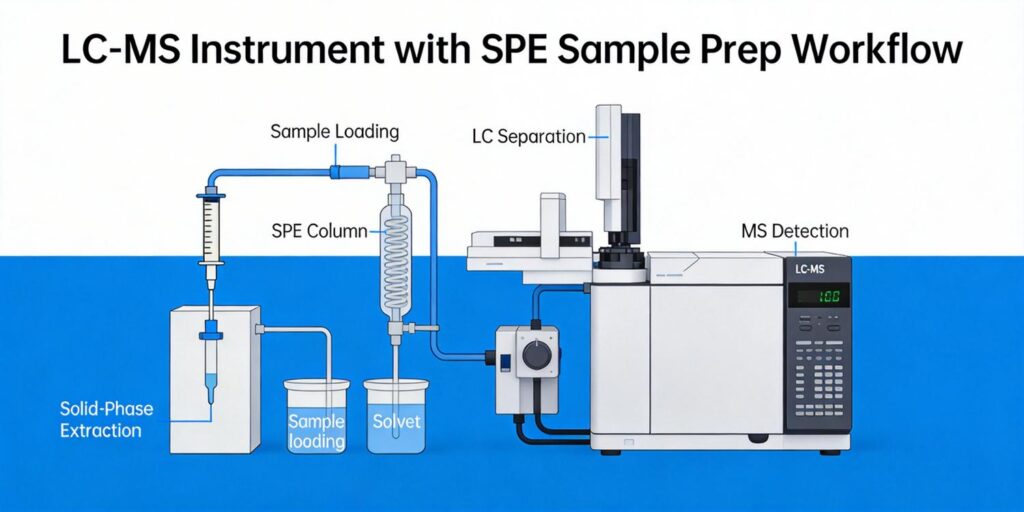
Solid Phase Extraction serves as a critical line of defense against matrix effects in LC-MS workflows. The fundamental purpose of SPE in this context is to selectively isolate target analytes while removing interfering matrix components. As described in SPE methodology, “The SPE strategy generally comprises the isolation (and concentration) of the analytes from a complex matrix by adsorption onto an appropriate sorbent, the removal of interfering impurities by washing with a suitable solvent system and then the selective recovery of the retained analytes.”
How SPE Reduces Matrix Effects
SPE addresses matrix effects through several mechanisms:
- Selective retention: Proper sorbent selection allows retention of target analytes while allowing matrix interferences to pass through during loading and washing steps.
- Matrix component removal: Washing steps eliminate polar and moderately polar interferences that could cause ion suppression.
- Concentration: SPE concentrates analytes, improving signal-to-noise ratios and compensating for any residual matrix effects.
- Solvent exchange: Transferring analytes to MS-compatible solvents minimizes ionization interference.
SPE Sorbent Selection for Matrix Effect Reduction
Different SPE chemistries offer varying degrees of matrix effect reduction:
- Reversed-phase SPE (HLB): Effective for removing non-polar interferences like lipids and hydrophobic compounds
- Mixed-mode SPE (MCX, MAX, WCX, WAX): Combines reversed-phase and ion-exchange mechanisms for superior cleanup of complex matrices
- Ion-exchange SPE: Specifically targets ionic interferences that can cause severe ion suppression
Modern SPE products like Oasis PRiME HLB are specifically designed to “reduce matrix effects with more than 95% of common matrix interferences removed,” according to product documentation. Mixed-mode sorbents are particularly effective, providing “the best reduction of matrix effects” and “highest sensitivity” through dual retention mechanisms.
Best Practices for Minimizing Matrix Effects in SPE-LC-MS Workflows
Method Development Strategies
Effective SPE method development begins with understanding both the analyte and matrix characteristics. As noted in SPE literature, “Research the problem—previous SPE and analysis conditions for the analyte and matrix? Characterize the analyte—structure, pKa, polarity, functional groups. Characterize the sample matrix—possible interferences, similar functional groups, pKa, etc.”
Key Optimization Parameters
- pH Control: Adjust sample pH to ensure analytes are in optimal form for retention while minimizing interference retention.
- Loading Conditions: Optimize sample dilution and loading flow rates to maximize analyte retention while allowing matrix components to pass through.
- Wash Optimization: Develop washing steps that remove matrix interferences without eluting target analytes.
- Elution Strategy: Use minimal elution volumes with appropriate solvent strength to maximize concentration while minimizing co-elution of residual interferences.
Practical Implementation Tips
- Matrix-matched calibration: Use calibration standards prepared in blank matrix to account for residual matrix effects
- Internal standards: Employ stable isotope-labeled internal standards that experience similar matrix effects as target analytes
- Standard addition: For particularly challenging matrices, use standard addition methods to correct for matrix effects
- Post-column infusion: Monitor matrix effects throughout chromatographic runs to identify problematic regions
- Regular method validation: Continuously assess matrix effects during method validation and routine analysis
Advanced Techniques
For particularly challenging applications, consider these advanced approaches:
- Dual SPE cleanup: Sequential SPE using different mechanisms for maximum cleanup
- On-line SPE-LC-MS: Automated systems that provide consistent cleanup with minimal manual intervention
- 96-well plate formats: High-throughput systems that maintain consistency across large sample batches
- Specialized sorbents: Use of molecularly imprinted polymers or other selective materials for specific interference removal
Quality Control Measures
Implement robust QC procedures to monitor matrix effects:
- Process blanks: Include blank samples processed through entire SPE workflow
- QC samples: Use quality control samples at multiple concentration levels
- System suitability: Regular testing of system performance with reference materials
- Carryover assessment: Monitor and minimize carryover between samples
Conclusion
Matrix effects represent a significant challenge in LC-MS analysis, but strategic implementation of SPE cleanup provides an effective solution. By understanding the mechanisms of ion suppression, selecting appropriate SPE chemistries, and implementing best practices in method development, analysts can significantly reduce matrix effects and improve analytical performance. As SPE technology continues to advance with products offering improved selectivity and cleaner extracts, the battle against matrix effects becomes increasingly manageable. The key lies in thoughtful method development, proper sorbent selection, and continuous monitoring of method performance to ensure reliable, accurate results in even the most challenging analytical scenarios.
For laboratories seeking to optimize their SPE-LC-MS workflows, Poseidon Scientific offers a comprehensive range of SPE products including HLB SPE cartridges, MAX SPE cartridges, MCX SPE cartridges, WAX SPE cartridges, WCX SPE cartridges, and 96-well SPE plates designed to address matrix effects across diverse applications.