The Critical Importance of Proper SPE Cartridge Conditioning
Solid Phase Extraction (SPE) cartridge conditioning is the foundational step that determines the success or failure of your entire extraction process. As Dr. Xu, product manager at Poseidon Scientific, I’ve seen firsthand how proper conditioning techniques can dramatically improve recovery rates, precision, and overall method reliability. SPE cartridges are shipped dry for stability and packaging reasons, but this dry state creates a fundamental challenge for effective extraction.
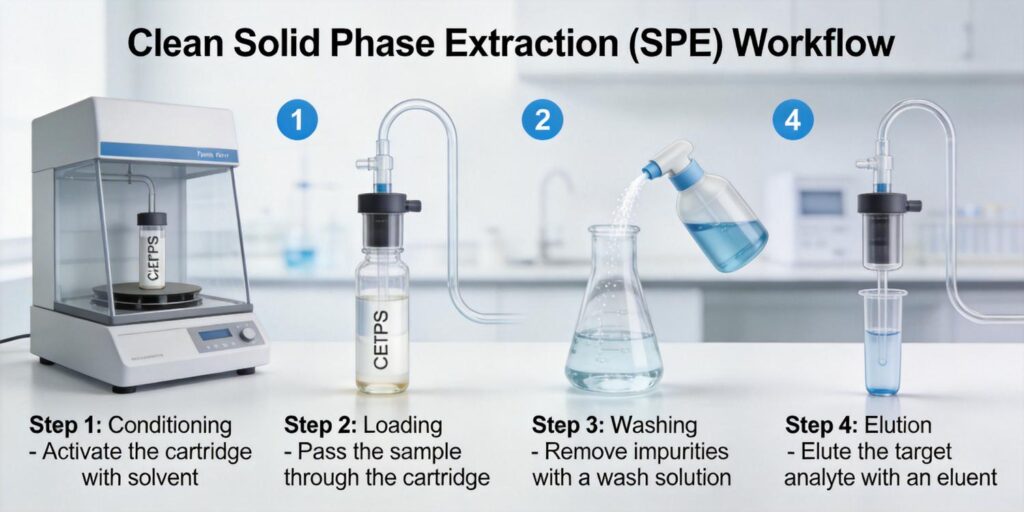
Conditioning serves three essential functions: it activates sorbent functional groups by expanding binding sites away from the solid surface, prepares the chemical environment for optimal analyte binding, and removes dust, fines, and residual impurities from the sorbent. Without proper conditioning, you’re essentially trying to extract analytes with a sorbent that’s not ready to receive them, leading to poor recovery and inconsistent results.
Recommended Solvent Sequences for Different SPE Mechanisms
Reversed Phase SPE (C18, C8, HLB, MAX, MCX)
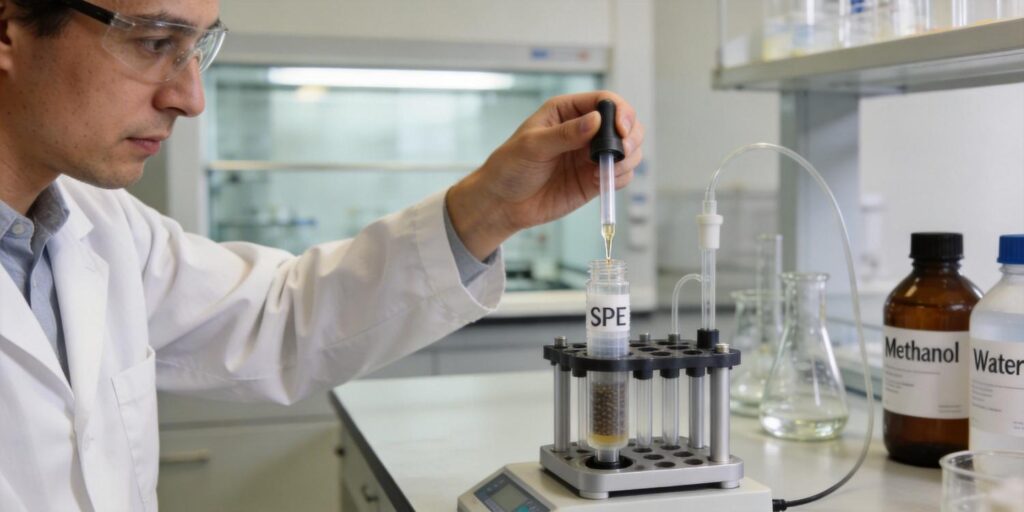
For reversed phase applications, methanol is the gold standard conditioning solvent because it meets all critical criteria: miscibility with aqueous matrices, easy diffusion into sorbent pores, high mass transfer of H-C bonds with sorbent alkyl chains, and universal elution of polar and nonpolar contaminants. The standard sequence is:
- Primary Conditioning: 1.5 mL of methanol per 100 mg of sorbent at low vacuum (approximately 3 in. Hg)
- Equilibration: 1 mL of deionized or distilled water per 100 mg of sorbent to remove excess methanol
- Optional Buffer Application: For ion-exchange mechanisms, apply 1 mL of appropriate buffer after flushing
For Poseidon Scientific’s HLB (Hydrophilic-Lipophilic Balance) cartridges, methanol effectively wets the surface and penetrates the bonded phase, allowing water molecules and analytes to diffuse into the bonded layer. After conditioning with methanol, water is passed to remove excess solvent prior to sample application.
Mixed-Mode SPE (WAX, WCX)
Mixed-mode cartridges require more specific conditioning sequences. For example, a typical protocol for Bond Elut Certify cartridges involves:
- 2 mL methanol
- 2 mL phosphate buffer (0.1 mol/L, pH 6.0)
The cartridge must not become dry before sample application. For Poseidon Scientific’s WAX (Weak Anion Exchange) and WCX (Weak Cation Exchange) cartridges, similar principles apply, with careful attention to pH optimization for the desired ionic interactions.
Normal Phase SPE
For normal phase applications, the conditioning sequence is reversed:
- Non-polar solvent (hexane, heptane, or methylene chloride)
- Sample in non-polar or slightly polar solvent
Avoiding Sorbent Drying: The Critical Window
One of the most common mistakes in SPE conditioning is allowing the sorbent to dry between steps. When silica particles are bonded with a hydrophobic phase, they become “waterproof” and must be conditioned to interact with aqueous samples. If the sorbent dries, several problems occur:
- Channeling: Excessive flow or redrying creates channels in the sorbent bed, reducing available surface area for sample contact
- Reduced Capacity: Only a portion of the sorbent is successfully solvated
- Poor Recovery: Successive liquid steps flow faster through channels, reducing contact time for effective mass transfer
At approximately 2.5 in. Hg vacuum, the column will resist air displacement (vacuum may be left on without drying the sorbent). If you’ve walked away from the manifold and feel too much time has passed between conditioning steps, simply start over to resolvate. However, if channels have formed due to high flows or excessive drying, reconditioning will not correct the problem.
Flow Rate Considerations
Generally, flow rates between 0.5 and 3.0 mL/min are acceptable to allow sufficient solvent-sorbent contact for solvation without causing channeling. During sample application, aim for approximately 1 mL/min. A momentary increase in vacuum may be needed to initiate sample flow, but maintain moderate rates throughout.
Troubleshooting Common Conditioning Problems
Problem 1: Low Recovery After Proper Conditioning
Possible Causes:
- Insufficient solvation volume
- Excessive flow rates during conditioning
- Sorbent bed channeling
- Improper pH conditions for the desired interactions
Solutions:
- Increase conditioning solvent volume (typically 1.5 mL per 100 mg sorbent minimum)
- Reduce flow rates to 0.5-1.0 mL/min during conditioning
- If channeling is suspected, discard cartridge and start fresh
- Verify sample and sorbent pH compatibility
Problem 2: Inconsistent Results Between Cartridges
Possible Causes:
- Variable conditioning times
- Inconsistent vacuum/pressure application
- Different drying times between steps
- Variations in solvent volumes
Solutions:
- Standardize timing for each conditioning step
- Use calibrated vacuum/pressure sources
- Maintain consistent drying protocols
- Use precise volumetric measurements for solvents
Problem 3: Excessive Background Noise in Final Analysis
Possible Causes:
- Inadequate washing of residual compounds during conditioning
- Contaminants from sorbent or hardware
- Incomplete removal of conditioning solvent
Solutions:
- Include a wash step with the strongest solvent that will be used in the extraction
- Use certified low-extractable cartridges like Poseidon Scientific’s premium lines
- Ensure complete water flush after methanol conditioning
Problem 4: Cartridge Blockage During Conditioning
Possible Causes:
- Particulate matter in solvents
- Improperly packed sorbent bed
- Excessive vacuum application
Solutions:
- Filter all solvents before use
- Use cartridges from reputable manufacturers with consistent packing quality
- Reduce vacuum and increase conditioning time
Advanced Conditioning Techniques
Drying Optimization
While avoiding sorbent drying between conditioning and sample application is crucial, controlled drying before elution can be beneficial. Drying is necessary when two immiscible reagents are used in sequence or when water from an aqueous wash step could contaminate an anhydrous eluent. Evaluate drying time by observing changes in recovery with drying time in a time-course experiment. Typically 3-5 minutes at elevated vacuum or pressure is sufficient.
You can gauge dryness by touching the cartridge around the sorbent bed; if it feels noticeably cooler than ambient temperature, then drying is not complete. In some instances, aqueous droplets may adhere to the walls of the cartridge. These can be removed with a twisted tissue or cotton tip applicator.
Conditioning for Special Applications
For large volume samples or samples containing high amounts of particulates, consider using SPE disks rather than cartridges. Disks are recommended when high flow rates are required during sampling. They’re conditioned with a water-miscible organic solvent such as methanol, followed by water or an aqueous buffer.
For polymer-based sorbents like those in Poseidon Scientific’s products, conditioning is particularly important because these materials don’t have the silanol issues of silica-based sorbents but still require proper solvation for optimal performance.
Best Practices Summary
- Always condition reversed phase sorbents with methanol (or acetonitrile) followed by water or buffer
- Never let the sorbent dry between conditioning and sample application
- Maintain moderate flow rates (0.5-3.0 mL/min) during all conditioning steps
- Use sufficient solvent volumes (typically 1.5 mL per 100 mg sorbent)
- Standardize timing for consistent results across multiple extractions
- Verify pH compatibility between conditioning solvents, sorbent, and sample
- Consider your specific sorbent type when developing conditioning protocols
Proper SPE cartridge conditioning isn’t just a procedural step—it’s the foundation upon which successful extractions are built. By following these best practices and troubleshooting guidelines, you’ll achieve more consistent, reliable results with higher recovery rates and cleaner extracts. Whether you’re using Poseidon Scientific’s HLB, MAX, MCX, WAX, or WCX cartridges, or any other SPE product, proper conditioning techniques will ensure you get the most from your solid phase extraction workflow.
For more detailed application notes and specific conditioning protocols for our products, visit our HLB SPE Cartridges, MAX SPE Cartridges, MCX SPE Cartridges, WAX SPE Cartridges, WCX SPE Cartridges, or our 96-well SPE plates.