
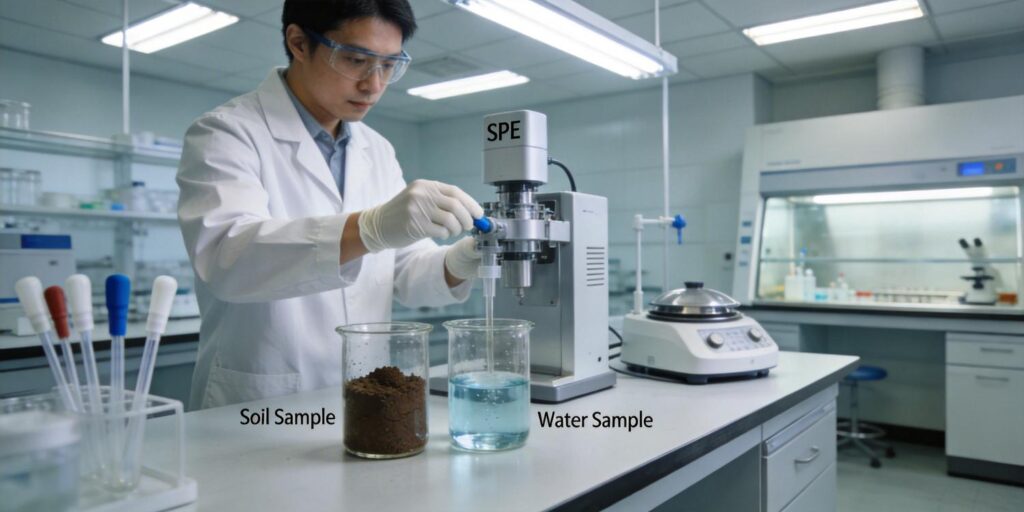
Overview of Environmental Sample Matrices
Environmental sample preparation presents unique challenges that distinguish it from clinical or pharmaceutical applications. As noted in the literature, environmental chemists routinely deal with large volume samples – often liters rather than milliliters – due to the trace-level concentrations of pollutants typically found at part-per-billion (ppb) or part-per-trillion (ppt) levels. This volume difference stems from the need to concentrate analytes sufficiently for detection while managing co-extracted interferences.
Environmental matrices can be broadly categorized into three main types:
1. Aqueous Samples
This category includes drinking water, surface water, groundwater, wastewater, and seawater. The trace enrichment aspect of SPE lends itself particularly well to clean aqueous samples like drinking water or groundwater. However, particulate-laden samples such as river water or wastewater present additional challenges that require careful handling strategies.
2. Solid Matrices
Soil, sludge, and sediment samples require liberation of analytes from solid matrices into liquid form before SPE can be applied. Traditional approaches include Soxhlet extraction, homogenization in extraction buffers, or other physical manipulations. Even with careful primary extraction, considerable additional clean-up is often required prior to analysis.
3. Air and Particulate Samples
While less common than aqueous and solid matrices, SPE has been successfully applied to air pollution monitoring and industrial hygiene applications, particularly for trapping volatile compounds from air streams.
Environmental analyses may present the analyst with some or all of the following challenges: large volume samples, non-homogeneous samples containing particulates and/or dissolved organic matter, and a wide range of analytes covering both hydrophilic to hydrophobic extremes.
Water vs Soil Extraction Challenges
Water Sample Challenges
Water samples present several specific challenges for SPE extraction:
- Particulate Content: River water and wastewater often contain high levels of particulates that can clog SPE cartridges or discs. For such samples, SPE disks are recommended as they can handle higher particulate loads and flow rates.
- Dissolved Organic Matter (DOM): Natural organic matter, including humic and fulvic acids, can interfere with analyte recovery and cause matrix effects.
- Salinity Effects: Seawater and brackish water samples present ionic strength challenges that can affect analyte retention and recovery.
- Breakthrough Volume Considerations: Large volume samples require careful consideration of breakthrough volumes to ensure complete analyte retention.
Soil Sample Challenges
Soil and sludge samples present fundamentally different challenges:
- Matrix Liberation: A prerequisite for successful extraction is liberation of analytes from solid matrices into liquid form. This often requires Soxhlet extraction, homogenization, or other physical manipulations.
- Co-extracted Interferences: Soil extracts are typically rich in humic and fulvic acids and may contain high levels of sulfurous compounds and other inorganics.
- Philosophical Dilemma: Environmental chemists must decide whether to measure total toxicant levels or only the portion that could leach into water supplies. This decision affects extraction strategy selection.
- Leaching Procedures: Approaches like the Toxicity Characteristic Leaching Procedure (TCLP) involve tumbling samples in aqueous media or passing water through samples, then extracting the resulting leachate using LLE or SPE.
As noted in environmental chemistry literature, “Standard SPE materials are primarily designed to accept aqueous or, at least, solubilized, fluid samples. Samples having too great a viscosity or that contain a moderate to heavy particulate content cannot be extracted by SPE without a dilution step, filtration, centrifugation, or some other manipulation.”
SPE Workflows for Environmental Testing
Fundamental SPE Steps
The basic SPE workflow consists of five fundamental steps that apply to environmental applications:
- Conditioning: The sorbent is conditioned with a water-miscible organic solvent such as methanol, followed by water or aqueous buffer. This step wets the surface and prepares the sorbent to accept the sample.
- Loading: The sample is applied to the conditioned sorbent. For environmental applications, this often involves large volumes that must be loaded at controlled flow rates (typically 1-3 drops/second for optimal recovery).
- Washing: Unwanted matrix components are removed using solvents that won’t elute the target analytes.
- Elution: Target analytes are recovered in the smallest possible volume of appropriate solvent.
- Reconditioning (optional): Some methods include a final conditioning step for sorbent reuse or stabilization.
SPE Modes for Environmental Applications
Analyte Adsorption Mode
This is the most common approach for environmental applications, where analytes are retained (k’ >> 1) while matrix components are unretained or strongly retained. This mode offers preconcentration advantages and cleaner extracts.
Matrix Adsorption Mode
Less commonly used in environmental work, this approach involves matrix retention while analytes pass through unretained. It offers no preconcentration advantage but can be useful for specific applications.
SPE Sorbent Selection for Environmental Applications
Proper sorbent selection is critical for environmental SPE applications:
- Reversed-Phase Sorbents (C18, C8, HLB): Ideal for non-polar to moderately polar compounds in aqueous matrices. HLB cartridges are particularly useful for a wide range of environmental pollutants due to their hydrophilic-lipophilic balance.
- Mixed-Mode Sorbents (MCX, WCX, MAX, WAX): Combine reversed-phase and ion-exchange mechanisms for selective extraction of ionizable compounds. MCX and WCX are cation-exchange sorbents, while MAX and WAX are anion-exchange sorbents.
- Normal-Phase Sorbents: Used for polar compounds in non-aqueous matrices, though less common in environmental work.
High-Throughput Environmental Analysis
For laboratories processing large numbers of environmental samples, 96-well SPE plates offer significant advantages in throughput and automation compatibility. These plates enable parallel processing of multiple samples, reducing solvent consumption and improving reproducibility.
Method Validation Considerations
Recovery Studies
Method validation for environmental SPE applications must include comprehensive recovery studies:
- Matrix Effects: Evaluate recovery in different environmental matrices (clean water, wastewater, soil extracts) to account for matrix-induced suppression or enhancement.
- Concentration Range: Validate across the expected concentration range, from detection limits to upper quantitation limits.
- Breakthrough Testing: For large volume samples, determine breakthrough volumes to ensure complete analyte retention.
Precision and Accuracy
Environmental method validation requires demonstration of both within-run and between-run precision:
- Repeatability: Multiple extractions of the same sample to assess method precision.
- Reproducibility: Different analysts, instruments, and days to assess method robustness.
- Accuracy Assessment: Comparison with reference methods or use of certified reference materials.
Specificity and Selectivity
Given the complex nature of environmental matrices, specificity testing is crucial:
- Interference Testing: Evaluate potential interferences from common environmental contaminants.
- Cross-Reactivity: For methods targeting specific compound classes, test for cross-reactivity with structurally similar compounds.
- Matrix Blank Evaluation: Analyze matrix blanks to ensure no interfering peaks at analyte retention times.
Stability Studies
Environmental samples and extracts may undergo stability testing:
- Sample Stability: Evaluate analyte stability in original sample matrices under storage conditions.
- Extract Stability: Assess stability of SPE eluents under analysis conditions.
- Processed Sample Stability: For automated systems, evaluate stability of processed samples in autosampler trays.
Quality Control Procedures
Implement robust QC procedures for environmental SPE methods:
- Method Blanks: Process blanks through entire method to monitor contamination.
- Matrix Spikes: Spike samples with known concentrations of analytes to monitor recovery.
- Duplicate Analyses: Analyze sample duplicates to assess precision.
- Control Charts: Maintain control charts for critical method parameters.
Regulatory Compliance
For environmental monitoring programs, method validation must address regulatory requirements:
- Method Detection Limits (MDLs): Determine according to EPA or other regulatory guidelines.
- Reporting Limits: Establish practical quantitation limits based on method performance.
- Documentation: Maintain comprehensive validation documentation for regulatory audits.
Environmental Considerations
As noted in environmental chemistry literature, “It is especially ironic that many of the older, officially sanctioned methods for conducting pollution or residue analysis generate more hazardous waste and pollution than they actually detect, monitor, or ameliorate.” Modern SPE methods should prioritize:
- Solvent Reduction: SPE typically uses 90% less solvent than traditional LLE methods.
- Waste Minimization: Reduced solvent consumption translates to less hazardous waste generation.
- Green Chemistry Principles: Align method development with green chemistry principles where possible.
Environmental sample preparation using SPE has evolved significantly since its introduction in the 1980s. Today, it represents a mature technology that offers environmental laboratories robust, reproducible, and environmentally friendly alternatives to traditional extraction methods. Proper method development and validation, combined with appropriate sorbent selection and workflow optimization, can deliver reliable results for even the most challenging environmental matrices.
For laboratories seeking to implement or optimize environmental SPE methods, Poseidon Scientific offers a comprehensive range of SPE products specifically designed for environmental applications, from individual cartridges to high-throughput 96-well plates.
