1. Importance of Elution Solvent Selection in SPE
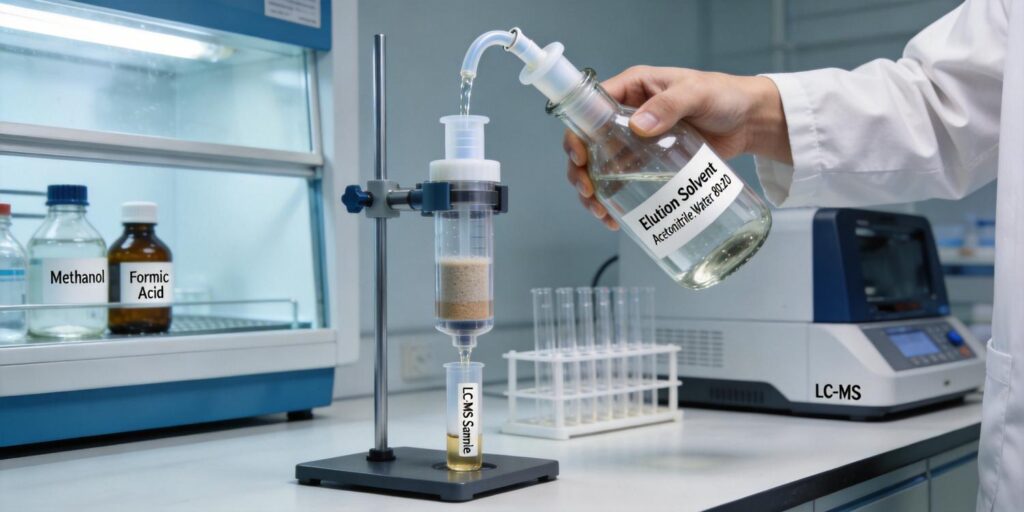
The elution step represents the culmination of solid-phase extraction (SPE) methodology, where careful solvent selection determines the success of your LC-MS sample preparation. As noted in SPE literature, “Elution is most successfully accomplished with a solvent having the highest eluotropic strength toward the sorbent being used, thereby minimizing the total elution volume and maximizing the concentration effect of SPE.” This critical step transforms the theoretical retention of analytes into practical recovery, directly impacting method sensitivity, reproducibility, and analytical throughput.
Proper elution solvent optimization addresses multiple analytical objectives simultaneously: achieving quantitative recovery (ideally exceeding 90%), minimizing co-elution of interfering compounds, ensuring compatibility with subsequent LC-MS analysis, and maintaining analyte stability throughout the process. The elution solvent serves as the bridge between sample preparation and instrumental analysis, making its optimization fundamental to method success.
2. Influence of Analyte Polarity and Sorbent Chemistry
The fundamental relationship between analyte properties and sorbent characteristics dictates elution strategy. According to SPE principles, “The physicochemical properties of the analyte and of the sorbent are of paramount importance to the retention of the analyte on a particular sorbent material.” This interaction determines the strength required for effective desorption.
Analyte Characteristics
Analyte polarity, functional groups, pKa values, and solubility profiles must be considered. Hydrophobic compounds with high log P values require stronger organic solvents for elution from reversed-phase sorbents, while polar compounds may need aqueous-organic mixtures. As demonstrated in research, “The hydrophilic nature of this analyte required that water be present in the eluting solvent for optimal recovery,” highlighting how analyte properties directly influence solvent composition.
Sorbent-Affinity Relationships
Different sorbent chemistries exhibit varying affinities for analytes. Reversed-phase materials (C18, C8, HLB) rely on hydrophobic interactions, while mixed-mode sorbents (MCX, WCX, WAX) combine hydrophobic and ionic mechanisms. The elution solvent must overcome these specific interactions effectively. For instance, ion-exchange sorbents require disruption of ionic bonds through pH modification or competitive displacement.
3. Organic Solvent Choices for Reversed-Phase SPE
Reversed-phase SPE represents the most common application mode, with solvent selection following established eluotropic series. Research indicates that “Many solvents have been reported as SPE eluents. In increasing order of expected eluotropic strength on reversed-phase sorbents, based simply on their polarity, these include: acetic acid, methanol, acetonitrile, acetone, ethyl acetate, diethyl ether, methyl ‘butyl ether, methylene chloride, benzene, and hexane.”
Primary Solvent Options
Methanol: Offers strong elution power with good solubility for many analytes. Its hydrogen-bonding capability makes it particularly effective for polar compounds. However, its high UV cutoff (205 nm) may limit UV detection applications.
Acetonitrile: Provides excellent elution strength with lower viscosity than methanol, often resulting in better chromatographic performance. Its intermediate polarity makes it suitable for a wide range of compounds.
Acetone: Strong eluent with good solvating properties but may cause issues with some LC-MS systems due to its reactivity and potential for adduct formation.
Solvent Mixtures and Optimization
Binary mixtures often provide superior performance. As noted in method development studies, “Miscible solvent mixtures can be used to achieve a hydrophilic-hydrophobic balance.” Common combinations include methanol-water, acetonitrile-water, and methanol-acetonitrile mixtures. The optimal ratio depends on analyte hydrophobicity, with more hydrophobic compounds requiring higher organic percentages.
4. Role of pH Modifiers in Mixed-Mode Cartridges
Mixed-mode SPE cartridges (MCX, WCX, WAX) combine reversed-phase and ion-exchange mechanisms, requiring sophisticated elution strategies. These sorbents “give the analyst the ability to extract a broad range of compounds with increased selectivity” but demand careful pH control during elution.
Acidic Modifiers for Basic Compounds
For mixed-mode cation exchange (MCX) cartridges retaining basic compounds, acidic modifiers disrupt ionic interactions. Formic acid (1-5%), acetic acid (2-10%), or hydrochloric acid (0.1-1%) in organic solvents effectively protonate basic analytes, neutralizing their positive charge and facilitating elution. Volatile acids like formic and acetic are preferred for LC-MS compatibility.
Basic Modifiers for Acidic Compounds
Mixed-mode anion exchange (WAX) and weak cation exchange (WCX) cartridges require basic conditions for elution of acidic compounds. Ammonium hydroxide (2-5%), triethylamine (1-5%), or ammonia in methanol effectively deprotonate acidic analytes. As research notes, “Remember to use volatile acids and bases for inclusion in the elution solvent if evaporation” is required for concentration steps.
Simultaneous Disruption Strategies
Effective elution from mixed-mode sorbents often requires simultaneous disruption of both hydrophobic and ionic interactions. This typically involves organic solvents containing appropriate pH modifiers. For example, “Elute by simultaneously disrupting ionic and hydrophobic interactions” represents the optimal approach for mixed-mode extractions.
5. Strategies for Maximizing Analyte Recovery
Optimizing recovery involves systematic evaluation of multiple parameters. The “educated approach” to SPE optimization “requires you to organize your attempt at method development, as well as review your objectives and as much preliminary information as you have on your analyses of interest.”
Volume Optimization
Elution volume significantly impacts recovery and concentration factor. Research demonstrates that “the volume of elution solvent used to desorb” analytes follows a saturation curve, where increasing volume improves recovery up to a plateau. Typically, 2-3 bed volumes (1-3 mL for standard cartridges) provide optimal recovery without excessive dilution.
Multiple Elution Fractions
Collecting eluate in multiple fractions (e.g., 0.5 mL increments) allows determination of the minimum volume required for complete elution. This approach minimizes dilution while ensuring quantitative recovery. Studies show that “eluting the analyte in smallest volume possible” maximizes concentration effects.
Solvent Strength Gradient
Gradual increase in solvent strength can improve recovery for complex analyte mixtures. Starting with weaker eluents followed by stronger solvents can fractionate compounds based on their retention characteristics. This approach has been used successfully for “selective desorption, used to fractionate components into hydrophilic and hydrophobic components.”
6. Preventing Co-elution of Interfering Compounds
Selective elution represents the final opportunity to remove interferences before LC-MS analysis. As SPE literature notes, “During the retention step, many compounds in our complex sample may have been retained on the solid surface at the same time as our compound of interest. Likewise, at elution it is likely that some of these co-retained compounds will be eluted with our compound of interest.”
Wash Step Optimization
Effective washing before elution removes weakly retained interferences. The wash solvent should have sufficient strength to remove impurities but insufficient strength to elute target analytes. Research recommends testing “the possibility of cutting down on the number of washing steps and on the volume of the washing solution” during optimization.
Selective Elution Strategies
Fractionated elution using solvents of increasing strength can separate target analytes from interferences. For example, using “acetic acid (25%) in water, followed by elution of the more hydrophobic herbicide with methanol” successfully separated compounds with different polarities.
pH-Selective Elution
For ionizable compounds, pH adjustment during elution can provide selectivity. By choosing pH conditions where target analytes are neutral while interferences remain charged (or vice versa), selective elution becomes possible. This approach is particularly effective with mixed-mode sorbents.
7. Validation Experiments for Solvent Optimization
Systematic validation ensures method robustness and reliability. According to optimization guidelines, “At a minimum, the following experiments should be considered: optimizing the elution procedure for the washing solvent; optimizing the volume and number of steps used for eluting the analyte.”
Reccovery Studies
Quantitative recovery assessment using spiked samples provides fundamental validation. Replicate assays (4-6) at multiple concentration levels establish method precision and accuracy. Recovery should ideally exceed 90% with RSD values below 10%.
Elution Profile Characterization
Novel approaches like gradient elution profiling provide valuable insights. One technique involves “injecting analytes onto a SPE cartridge through which a gradient mobile phase (100% aqueous at t = 0 to 100% methanol at the end of the run) is pumped. The elution profiles of the analytes are easily observed using this technique.”
Matrix Effect Evaluation
Comparing elution efficiency in pure solvent versus matrix-matched samples identifies potential matrix effects. Differences may indicate “that retention/elution is identical for purely aqueous samples and real-life samples such as plasma,” requiring method adjustment.
Stability Assessment
Analyte stability in elution solvents during processing and storage must be verified. Some compounds may degrade in certain solvents or under specific pH conditions, necessitating alternative solvent choices or immediate analysis after elution.
LC-MS Compatibility Testing
Final validation includes assessment of eluate compatibility with LC-MS systems. Solvent effects on ionization efficiency, chromatographic performance, and system maintenance must be evaluated. Often, “an eluting solvent may be suitable for direct injection into an HPLC column. In this case the evaporation and reconstitution steps are eliminated,” improving throughput and reducing potential losses.
Method Transfer Considerations
When transferring methods between laboratories or to automated systems, elution parameters may require adjustment. Flow rates, solvent delivery systems, and collection methods can affect elution efficiency and should be validated during transfer.
Effective elution solvent optimization represents both science and art in SPE methodology. By understanding the fundamental principles of analyte-sorbent interactions and systematically evaluating solvent options, analysts can develop robust, sensitive methods for LC-MS analysis. The investment in thorough optimization pays dividends in improved data quality, reduced instrument downtime, and increased analytical confidence.
For comprehensive SPE solutions including HLB, MAX, MCX, WCX, and WAX cartridges, as well as 96-well SPE plates, visit our SPE products page to explore options tailored to your specific application needs.