
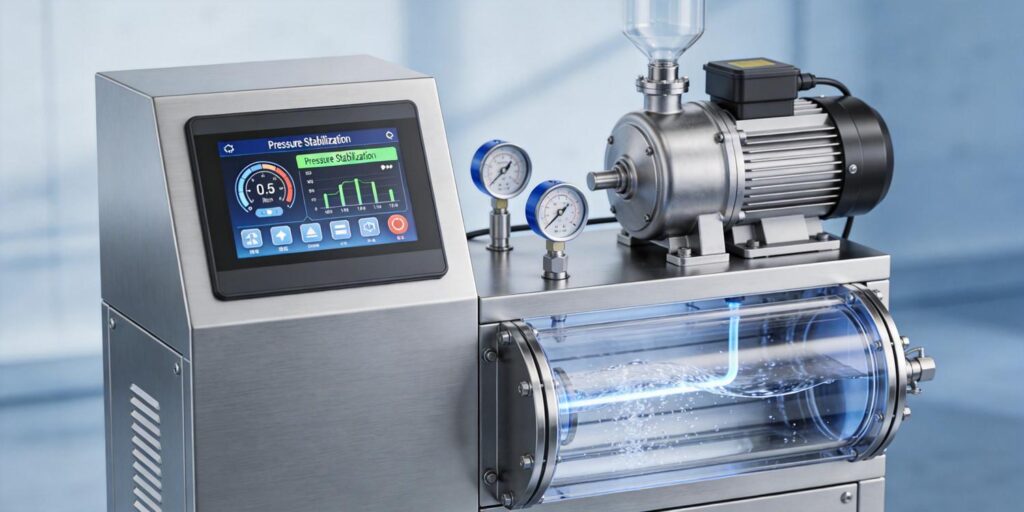
In vacuum systems used for semiconductor processing, thin-film deposition, and industrial heat treatment, precise pressure control is essential for process stability and product quality. A well-tuned PID control loop relies on fast, stable feedback from the vacuum gauge to adjust throttle valves, variable-speed pumps, or mass-flow controllers. At Poseidon Scientific, our VG-SP205 Pirani Vacuum Transmitter and VG-SM225 Cold Cathode Vacuum Gauge were engineered specifically to deliver the low-noise, repeatable analog signals that modern PID loops demand. With 0–10 V output (effective 2–8 V range) and optional RS232 digital protocol, these instruments minimize latency while maintaining the durability required in production environments.
This article explores how vacuum gauge performance directly affects control-loop behavior. Drawing on vacuum metrology principles and practical implementation data, we outline strategies to optimize response, reduce oscillation, and achieve sub-1 % pressure stability across a wide vacuum range.
Role of Vacuum Gauge in PID Loops
The vacuum gauge serves as the process variable (PV) sensor in a typical PID loop. Its output—whether analog voltage or digitized pressure value—feeds the controller, which compares PV against the set point (SP) and adjusts the manipulated variable (MV), such as valve position or pump speed. In the rough-vacuum regime (atmosphere to 10⁻³ Torr), the VG-SP205 Pirani provides continuous thermal-conductivity-based feedback with minimal dead time. In the high-vacuum regime (10⁻³ to 10⁻⁷ Torr), the VG-SM225 Cold Cathode uses Penning-discharge ion current, which scales linearly with pressure once the discharge is established.
Both gauges output a monotonic 0–10 V signal calibrated for air/nitrogen, enabling direct PLC scaling without complex lookup tables. This simplicity reduces programming overhead and improves loop reliability compared to gauges requiring gas-specific correction factors. As noted in standard vacuum texts, ionization gauges contribute negligible pumping speed (<0.01 L/s), so they do not disturb the very process they monitor.
Signal Latency Considerations
Latency in the feedback path introduces phase lag that can destabilize the loop. Analog 0–10 V output from Poseidon gauges exhibits <10 ms hardware latency—essentially instantaneous for most vacuum processes. RS232 digital output adds 50–200 ms depending on baud rate and polling interval, making it suitable for supervisory monitoring but less ideal for tight inner-loop control.
In high-speed applications such as reactive-ion etching, even 100 ms of latency can cause overshoot during rapid pump-down. The VG-SP205’s Pirani filament responds thermally within 200–500 ms to pressure steps, while the VG-SM225’s ion-current response is <50 ms once discharge is active. Engineers should therefore route the analog signal directly to the PID input and reserve digital comms for data logging or recipe changes.
Analog Filtering
Electrical noise from plasma, motors, or EMI can corrupt the gauge signal and amplify loop oscillations. A simple first-order RC low-pass filter (τ = 0.1–0.5 s) placed at the PLC analog input smooths noise without adding excessive phase lag. The VG-SM225’s internal electronics already incorporate temperature compensation and basic noise rejection; adding an external 10 kΩ series resistor and 0.1 µF capacitor to ground typically reduces peak-to-peak noise below 10 mV.
For digital implementations, software filtering via a moving-average or exponential filter (α = 0.05–0.2) achieves similar results. Avoid over-filtering: excessive lag turns a stable loop into a sluggish one, extending pump-down times by 20–30 %.
Response Time Comparison
Response time varies by gauge type and pressure regime. The VG-SP205 Pirani exhibits a 90 % response time of approximately 300 ms in the 1–10⁻² Torr linear region, slowing slightly at atmospheric pressure due to thermal mass. The VG-SM225 Cold Cathode, operating on Penning discharge, shows ion-current response <100 ms in the 10⁻⁴–10⁻⁶ Torr range once the discharge has started. However, initial startup at <10⁻⁶ Torr can require 5–30 minutes depending on voltage ramp and residual gas; this is mitigated by software interlocks that inhibit PID action until the gauge LED indicates stable operation.
Comparative vacuum literature (Peacock et al., 1991) confirms cold-cathode gauges generally match or exceed hot-cathode response in clean high-vacuum environments while eliminating filament-related drift. Poseidon’s positive-magnetron geometry further reduces startup variability compared to inverted-magnetron designs, delivering more predictable loop behavior.
Avoiding Oscillation
Oscillation typically arises from excessive proportional gain, integral windup during pump-down, or unfiltered derivative action on noisy signals. Vacuum systems exhibit long transport delays (chamber volume / pumping speed) and non-linear conductance, so aggressive tuning often produces 10–20 % pressure hunting.
Key practices include:
- Set derivative term to zero or very low values unless fast transients are present.
- Use anti-windup logic during initial evacuation when the gauge is out of range.
- Implement pressure-dependent gain scheduling: higher gain in the linear Pirani region, reduced gain in the cold-cathode regime to compensate for any residual non-linearity.
The VG-SM225’s linear ion-current output in its operating band simplifies gain scheduling and reduces the risk of limit-cycle oscillation seen in some legacy gauges with pronounced slope changes at 10⁻⁹ Torr.
PLC Tuning Recommendations
For most vacuum control applications, start with the following conservative parameters on a standard PLC PID block:
- Proportional band (PB): 50–100 % of full scale (e.g., 5 V span for 10⁻³–10⁻⁷ Torr range).
- Integral time (Ti): 30–120 s, scaled to chamber time constant.
- Derivative time (Td): 0–5 s maximum.
Apply the Ziegler-Nichols closed-loop method only after establishing stable open-loop response: increase PB until sustained oscillation, then halve it and set Ti = 0.5 × ultimate period. In practice, vacuum engineers achieve better results with manual fine-tuning guided by trend plots of PV, SP, and MV.
Both Poseidon gauges support direct 0–10 V connection to PLC analog inputs (4–20 mA conversion optional via external module). For RS232 integration, limit polling to 1 Hz or less to avoid adding artificial latency. Temperature compensation in both instruments keeps output drift <0.5 %/°C across 15–50 °C, eliminating the need for additional ambient compensation in the PID algorithm.
Industrial Example
A European vacuum heat-treatment facility retrofitted aging Pirani/cold-cathode pairs on eight retort furnaces. Previous loops exhibited ±15 % pressure oscillation during the critical 10⁻³–10⁻⁴ Torr transition, causing inconsistent case-hardening depths and 8 % scrap rates. After installing VG-SP205 units for roughing and VG-SM225 units for high-vacuum control, engineers applied the tuning guidelines above. Oscillation dropped to <2 %, pump-down time shortened by 22 %, and batch uniformity improved to ±3 % hardness variation. Maintenance logs show zero unplanned gauge replacements after 18 months, validating the low-cost, high-durability design.
Implementation Checklist
- Hardware selection: Match VG-SP205 for <10⁻³ Torr loops; use VG-SM225 for high-vacuum segments. Install gauges at representative chamber locations (avoid pump inlets where flow conductance distorts readings).
- Wiring and filtering: Use shielded twisted-pair cable for analog signals; add RC filter at PLC input.
- Startup sequence: Program interlock to hold PID in manual mode until cold-cathode discharge stabilizes (monitor status LED or digital flag).
- Initial tuning: Begin with PB = 80 %, Ti = 60 s, Td = 0. Ramp set point gradually and observe PV trend.
- Validation: Log 30-minute steady-state data at target pressure; confirm deviation <±1 % of set point.
- Maintenance: Quarterly zero-check for Pirani at atmosphere; annual electrode inspection/cleaning for cold-cathode (500-mesh sanding restores full sensitivity in <15 min).
- Documentation: Record final PID parameters and gauge serial numbers in the process recipe for future reproducibility.
Following this checklist typically yields first-pass stability within a single shift of commissioning.
Stable pressure feedback is the cornerstone of reliable vacuum control. By pairing Poseidon’s low-latency, low-maintenance gauges with disciplined PID practices, engineers achieve tighter process windows, higher throughput, and lower total cost of ownership. For detailed specifications and customization options—including protocol tailoring for existing PLC ecosystems—visit the VG-SP205 Pirani Vacuum Transmitter and VG-SM225 Cold Cathode Vacuum Gauge product pages.
Whether optimizing an existing line or specifying new equipment, the right gauge and loop configuration convert vacuum measurement from a passive sensor into an active driver of process excellence.


