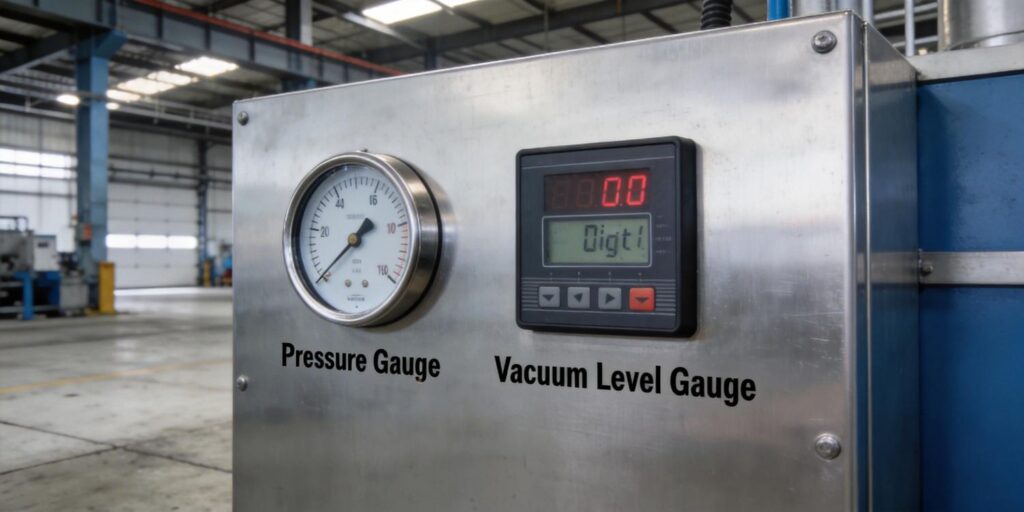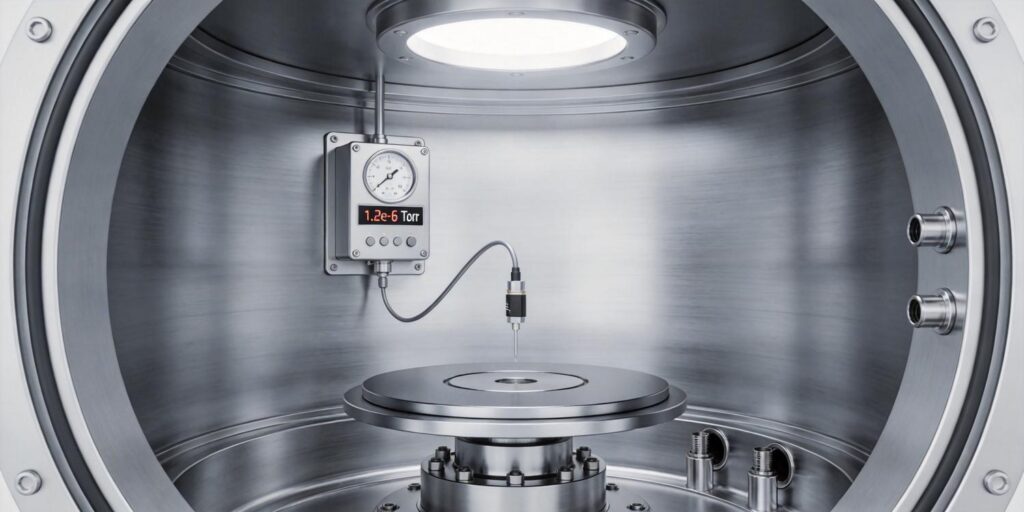
In thin film deposition processes such as physical vapor deposition (PVD), sputtering, and chemical vapor deposition (CVD), vacuum pressure is a fundamental process parameter. Accurate vacuum measurement directly determines film thickness uniformity, adhesion strength, microstructure, and overall coating performance. Engineers and procurement teams who specify vacuum gauges understand that even small deviations in pressure reading can cascade into costly defects. At Poseidon Scientific, we designed the VG-SP205 Pirani Vacuum Transmitter for rough vacuum monitoring (atmosphere to 10⁻³ Torr) and the VG-SM225 Cold Cathode Vacuum Gauge for high-vacuum regimes (10⁻³ to 10⁻⁷ Torr) precisely to deliver the reliability required in these demanding applications.
This article examines how vacuum gauge accuracy influences thin film quality across eight critical dimensions. Drawing from established vacuum science principles and real-world deposition experience, we provide actionable insights for process engineers seeking repeatable, high-yield results.
Pressure Influence on Film Uniformity
Deposition uniformity depends on the mean free path of vapor atoms or ions, which varies inversely with chamber pressure. At pressures above 10⁻³ Torr, frequent gas-phase collisions scatter depositing species, producing thicker films at the substrate center and thinner edges. Below 10⁻⁴ Torr, the mean free path lengthens, enabling line-of-sight transport and improved uniformity.
In magnetron sputtering, for example, operating at 5 × 10⁻³ Torr versus 2 × 10⁻³ Torr can shift film thickness variation from ±2 % to ±8 % across a 300 mm wafer. The VG-SP205 Pirani gauge excels here by providing stable 0–10 V analog output in the roughing stage, while the VG-SM225 Cold Cathode gauge maintains precision in the high-vacuum transition where uniformity is finalized. Literature in Foundations of Vacuum Science and Technology (Lafferty, 1998) confirms that pressure deviations of even 20 % in the 10⁻³–10⁻⁴ Torr range alter arrival angles enough to degrade step coverage in high-aspect-ratio features.
Plasma Density Variation
Plasma-based processes rely on controlled ionization. Pressure governs the balance between electron mean free path and collision frequency. Too high a pressure increases neutral density, damping plasma density and reducing ion flux; too low reduces ionization efficiency, leading to arcing or unstable discharge.
Cold cathode gauges like the VG-SM225 use Penning discharge principles to track these subtle shifts. Their positive ion current scales linearly with pressure in the 10⁻³–10⁻⁷ Torr range, delivering the resolution needed to hold plasma density within 5 % of target. In contrast, hot-cathode gauges suffer outgassing and X-ray limits that mask true plasma conditions. Comparative studies (Peacock et al., 1991) show cold-cathode instruments maintain ±10 % ion-current stability where hot-cathode types drift by 30 % due to filament contamination.
Reproducibility in Coating Batches
Batch-to-batch repeatability separates profitable production from scrap. Vacuum gauges must eliminate drift so that the same set-point pressure yields identical film properties run after run. The VG-SM225’s positive magnetron geometry and temperature-compensated electronics limit long-term drift to <1 % per 1000 hours in clean environments. This stability directly translates to consistent refractive index in optical coatings and sheet resistance in metallic films.
Without reliable gauges, engineers compensate by extending pump-down times or adjusting power—both increasing cycle time and energy costs. Poseidon’s gauges support RS232 digital output with customizable protocols, allowing direct integration into recipe-driven PLC systems for closed-loop pressure control.
Gauge Resolution Importance
Resolution becomes critical below 10⁻⁴ Torr, where small absolute changes represent large relative variations. A gauge with 0.1 % full-scale resolution at 10⁻⁶ Torr can distinguish 10⁻⁸ Torr differences—enough to separate acceptable from defective dielectric layers. The VG-SM225 achieves effective resolution of 0.01 % in its operating band through logarithmic current conversion and 16-bit internal processing, far surpassing typical analog cold-cathode transmitters.
Calibration Frequency
Calibration frequency depends on process gas, contamination level, and operating hours. In clean vacuum environments (e.g., optical coating), the VG-SM225 requires factory recalibration every 12–18 months. In reactive processes involving oxygen or fluorine, annual verification plus in-situ electrode cleaning extends life while preserving accuracy.
The VG-SP205 Pirani, being filament-based, is virtually maintenance-free but benefits from quarterly zero-checks at atmosphere. Poseidon’s design philosophy—emphasizing durability over ultra-high precision—aligns with production realities where gauges must survive repeated venting and occasional contamination without frequent downtime.
Real-World Case Example
A mid-volume optics manufacturer coating anti-reflective layers on smartphone lenses experienced 18 % batch rejection due to haze and non-uniformity. Root-cause analysis revealed their existing cold-cathode gauge had drifted 40 % low after 14 months in a fluorine-containing process. Replacement with the VG-SM225 restored pressure readings to within ±5 % of a certified reference gauge. Within two weeks, rejection rates dropped below 2 %, saving $47,000 per month in scrap and rework. The gauge’s removable electrode design allowed on-site cleaning in under 15 minutes, eliminating the previous two-day calibration cycle.
Cost of Inaccurate Measurement
Inaccurate vacuum readings impose direct and indirect costs:
- Material scrap: Defective films on high-value substrates (e.g., 200 mm silicon wafers at $800 each).
- Energy waste: Extended pump-down or power ramping to compensate for false readings.
- Equipment wear: Uncontrolled plasma accelerates target erosion and chamber contamination.
- Yield loss: Non-repeatable processes delay qualification and reduce throughput.
Industry benchmarks indicate that a 1 % improvement in pressure control can increase overall equipment effectiveness (OEE) by 3–5 % in PVD tools. Poseidon’s gauges, with self-diagnostic LED indicators and low-maintenance construction, minimize these hidden costs while keeping acquisition prices 40–60 % below legacy imported alternatives.
Process Optimization Tips
To maximize thin-film quality through better vacuum measurement:
- Match gauge to regime: Use the VG-SP205 Pirani for roughing and transition monitoring; switch to the VG-SM225 Cold Cathode for high-vacuum deposition where plasma and uniformity are most sensitive.
- Implement dual-gauge redundancy: Place one gauge at the chamber wall and one near the substrate for differential pressure verification, catching flow-conductance effects early.
- Automate calibration tracking: Leverage the digital RS232 output to log pressure versus time; set software alerts at 0.5 % deviation thresholds.
- Schedule electrode maintenance proactively: For the VG-SM225, inspect the removable sensor every 2000 hours or upon startup delay—500-mesh sanding restores full sensitivity in minutes.
- Validate gas-specific response: Although both gauges are calibrated for air/nitrogen, reactive processes benefit from periodic cross-check against a capacitance manometer.
- Integrate with recipe control: Use the 0–10 V analog output for direct PLC feedback; customize digital protocols (available at 5–10 unit minimum) to match existing SCADA systems.
These practices, grounded in both vacuum physics and practical production data, consistently deliver higher yields and lower total cost of ownership.
Engineers and procurement specialists evaluating vacuum instrumentation for thin-film deposition are invited to review the VG-SM225 Cold Cathode Vacuum Gauge and VG-SP205 Pirani Vacuum Transmitter specifications. Both instruments are engineered for the exact balance of accuracy, durability, and affordability that modern coating lines demand.
Accurate vacuum measurement is not a cost center—it is the foundation of consistent, high-quality thin films. By selecting the right gauge and following disciplined maintenance, process teams convert measurement precision into tangible competitive advantage.