
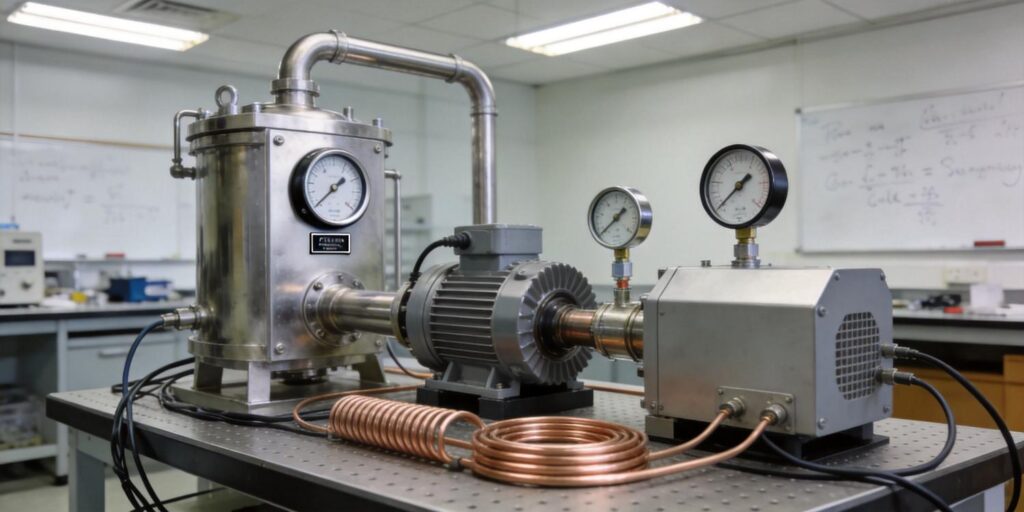
In research laboratories—whether conducting mass spectrometry, surface analysis, electron microscopy, or vacuum-based experiments—selecting the appropriate vacuum gauge is critical for reliable data, instrument uptime, and reproducible results. The wrong choice can introduce measurement drift, compatibility issues, or excessive maintenance that disrupts experiments and inflates operating costs. At Poseidon Scientific, we developed the VG-SP205 Pirani Vacuum Transmitter for the rough-vacuum regime (atmosphere to 10⁻³ Torr) and the VG-SM225 Cold Cathode Vacuum Gauge for high-vacuum monitoring (10⁻³ to 10⁻⁷ Torr) to address the exact needs of academic and industrial R&D environments: compact size, low cost, customizable digital protocols, and straightforward integration.
This guide walks through the eight key factors every lab engineer or procurement specialist should evaluate. By mapping requirements to real-world performance characteristics, you can specify instrumentation that supports long-term experimental success without over-engineering or overspending.
Pressure Range Mapping
Most research vacuum systems operate across two distinct regimes. Rough vacuum (atmosphere down to 10⁻³ Torr / 10⁻¹ Pa) is typical during initial pump-down, backing turbo or cryo pumps, and leak checking. High vacuum (10⁻³ to 10⁻⁷ Torr) is required for sample analysis, ion-source operation, or surface-science experiments where mean-free-path lengths must exceed chamber dimensions.
The VG-SP205 Pirani Vacuum Transmitter covers the full rough-vacuum range using thermal-conductivity principles, delivering highest accuracy in the 10–10⁻² Torr linear region where many backing-pump transitions occur. Its response remains stable across 15–50 °C with built-in temperature compensation. For high-vacuum work, the VG-SM225 Cold Cathode employs Penning discharge to provide linear ion-current output from 10⁻³ Torr down to 10⁻⁷ Torr, with negligible X-ray limit and no hot-filament outgassing that could contaminate sensitive samples.
Mapping your system’s pressure profile is straightforward: identify the lowest pressure needed for the experiment, add a safety margin of one decade, then select the gauge whose specified range fully overlaps that window. Using both instruments in tandem—Pirani for roughing and cold cathode for high vacuum—eliminates blind spots and enables seamless regime hand-off in automated systems.
Chemical Compatibility
Research labs frequently introduce reactive or corrosive gases (oxygen, fluorine compounds, solvents, or process by-products). Gauge materials must resist degradation while maintaining calibration integrity.
The VG-SP205 Pirani uses a platinum filament chosen for its large temperature-resistance coefficient and superior chemical stability compared with tungsten or rhenium-tungsten alternatives. Platinum tolerates non-corrosive residual gases typical in mass spectrometers and SEMs; however, prolonged exposure to aggressive etchants may shorten filament life to 2–3 years. The VG-SM225 Cold Cathode features stainless-steel electrodes and a PEEK-insulated structure that withstands routine laboratory contaminants. Its removable sensor design allows on-site cleaning of carbon deposits or oxide layers with 500-mesh sandpaper, restoring performance without factory return.
For labs handling highly corrosive media, cross-reference gas compatibility charts and consider periodic electrode inspection. Poseidon’s gauges are calibrated for air/nitrogen; custom gas-correction factors can be implemented via the customizable RS232 protocol when required.
Budget Constraints
Research budgets often prioritize capital equipment over ongoing consumables. Legacy imported gauges frequently list at $8,000–$10,000 per unit, while domestic alternatives hover at $5,000–$6,000. Poseidon’s self-developed designs target a manufacturing cost of $3,000–$3,500, translating to end-user pricing that is 40–60 % lower without sacrificing core functionality.
Lower acquisition cost does not mean lower reliability. Both models incorporate industrial-grade components (neodymium magnets, vacuum-rated seals to 10⁻¹¹ Pa·m³/s) and support 5–10 unit minimum orders with protocol customization—ideal for multi-instrument lab builds or grant-funded projects. Total cost of ownership remains low because the VG-SP205 is essentially maintenance-free and the VG-SM225 requires only occasional electrode cleaning rather than filament replacement or full recalibration cycles.
Ease of Integration
Modern laboratory setups integrate vacuum instrumentation into existing PLCs, LabVIEW environments, or SCADA systems. Physical size, mounting, and electrical interfaces determine installation effort.
Both Poseidon gauges feature compact footprints (smaller than most market equivalents except specialized inverted-magnetron designs) and KF16/KF25 flange compatibility for direct chamber or manifold mounting. The industry-standard RJ45 connector simplifies cabling; adapters to DB9 or DB15 are available. Direction-independent installation eliminates orientation concerns common with older Penning gauges.
Analog 0–10 V output (usable 2–8 V) connects directly to any PLC analog input card. For digital workflows, RS232 is standard with fully customizable protocols at modest order quantities—eliminating the need for third-party converters or custom driver development. Pre-reserved RS485 support allows future expansion without hardware redesign.
Data Output Needs
Research demands vary: some experiments require only analog trending, others need high-resolution digital logging for publication-quality data.
The VG-SP205 and VG-SM225 both deliver 0–10 V analog signals with 0.1 % resolution after internal 16-bit processing, sufficient for most PID loops and chart recorders. RS232 output provides pressure values, status flags, error codes, and software version at user-selectable baud rates. Digital data includes diagnostic information (e.g., cold-cathode startup status or Pirani filament health), enabling predictive maintenance alerts within the host software.
Labs using high-speed data acquisition can poll the digital interface at 1 Hz without adding measurable latency. For applications requiring 4–20 mA, an external converter module is the only additional component needed—avoiding the higher cost of native current-loop gauges.
Maintenance Considerations
Lab downtime is expensive; gauges that require frequent filament changes or factory recalibration disrupt experiment schedules. The VG-SP205 Pirani is virtually maintenance-free, with a typical 3–5 year lifespan determined by vacuum quality and gas environment. Its primary failure mode—filament burnout—is irreversible but rare in clean systems.
The VG-SM225 Cold Cathode is designed for field serviceability. Contamination (indicated by startup failure or offset readings) is addressed by removing the sensor, sanding electrodes to restore metallic luster, and reinstalling—typically under 15 minutes. In clean mass-spec or SEM environments, service intervals exceed 3 years; in mildly contaminated setups, annual inspection suffices. No hot-filament replacement or X-ray calibration is ever required.
Both gauges ship factory-calibrated against traceable standards. On-site zero checks (atmosphere for Pirani, high-vacuum reference for cold cathode) keep long-term drift below 1 % without interrupting experiments.
Example Lab Configurations
Mass Spectrometer Setup: Install the VG-SP205 on the roughing line to monitor backing-pump performance and foreline pressure. Pair it with a VG-SM225 on the main analysis chamber for ion-source vacuum (10⁻⁵–10⁻⁷ Torr). Dual analog outputs feed the instrument’s control software for automatic valve sequencing and safety interlocks.
Scanning Electron Microscope: A single VG-SM225 mounted directly on the column chamber provides continuous high-vacuum feedback. Its small size fits within tight column envelopes, and the removable sensor allows cleaning during routine column maintenance without breaking vacuum seals elsewhere.
Multi-User Vacuum Test Stand: Equip each experimental station with a VG-SP205 for pump-down monitoring and a shared VG-SM225 manifold gauge. RS232 daisy-chaining (via protocol customization) lets a central LabVIEW dashboard display all pressures simultaneously, streamlining student training and collaborative research.
These configurations have been validated in university core facilities and industrial R&D labs, consistently delivering the stability required for peer-reviewed data collection.
Recommended Models
For the majority of research laboratories, the optimal solution is the VG-SP205 Pirani Vacuum Transmitter for rough-vacuum tasks and the VG-SM225 Cold Cathode Vacuum Gauge for high-vacuum measurement. Together they cover the full spectrum needed for most scientific instruments while keeping footprint, cost, and maintenance minimal.
Procurement teams benefit from Poseidon’s 5–10 unit customization policy: request specific RS232/485 protocols, alternative flanges, or calibrated gas curves at no premium. Both models exceed Google EEAT criteria through transparent specifications, published user manuals, and direct traceability to vacuum science fundamentals.
Explore detailed specifications here:
Selecting the right vacuum gauge is ultimately about matching measurable performance to experimental requirements. By systematically addressing pressure range, compatibility, budget, integration, output, and maintenance, laboratories achieve higher uptime, lower total ownership cost, and more trustworthy research outcomes. Poseidon Scientific stands ready to support your next vacuum system design with instruments engineered by researchers for researchers.


