The Critical Role of Controlled Flow Rate in SPE Sample Loading
Flow rate control during sample loading represents one of the most fundamental yet often overlooked parameters in solid-phase extraction optimization. As research from Simpson’s comprehensive SPE text demonstrates, “SPE applications may be very sensitive to flow rates. Symptoms may include lower recoveries at higher flow rates or a decrease in reproducibility.” This sensitivity is particularly pronounced in ion exchange extractions, which generally show greater flow rate dependence than polar or non-polar extractions.
The mechanism behind this sensitivity relates to mass transfer kinetics. When samples are loaded too quickly, analytes may not have sufficient time to diffuse into the sorbent pores and establish proper interactions with the stationary phase. This phenomenon is especially critical for automated SPE workstations, where flow rates must be carefully calibrated for each method step. Studies show that load and elute steps typically demonstrate the highest sensitivity to flow rate variations, while conditioning and rinse steps may be less affected.
Practical Flow Rate Considerations
For manual SPE operations using vacuum manifolds, the pressure remains constant while flow rates through the SPE cartridge bed may vary depending on viscosity, packing material, and cartridge format. This variability can introduce significant method inconsistencies. In contrast, automated systems using positive pressure displacement (pumps or syringes) provide more stable flow control, though they require careful optimization of flow rates for each method step.
Research by Pichon and Hennion (1994) investigated flow rates of 5, 10, 15, and 20 mL/minute for on-line SPE applications, finding that satisfactory results could be obtained up to 15 mL/minute, but exceeding this threshold resulted in variable recoveries and lower overall recovery rates. For standard 2 mm internal diameter cartridges, practical flow rates typically range from 2-3 mL/minute for environmental analytes.
Optimizing Sample Solvent Strength for Maximum Retention
The solvent strength of your sample matrix directly impacts analyte retention on SPE sorbents. As Poole and Poole’s research demonstrates, “The selective sorption of the organic solvent by the sorbent changes the stationary-phase volume and system selectivity.” This phenomenon can result in changes of up to an order of magnitude in breakthrough volume when organic modifiers like methanol, propan-1-ol, tetrahydrofuran, or acetonitrile are added at the 1% (v/v) level.
Understanding Solvent-Sorbent Interactions
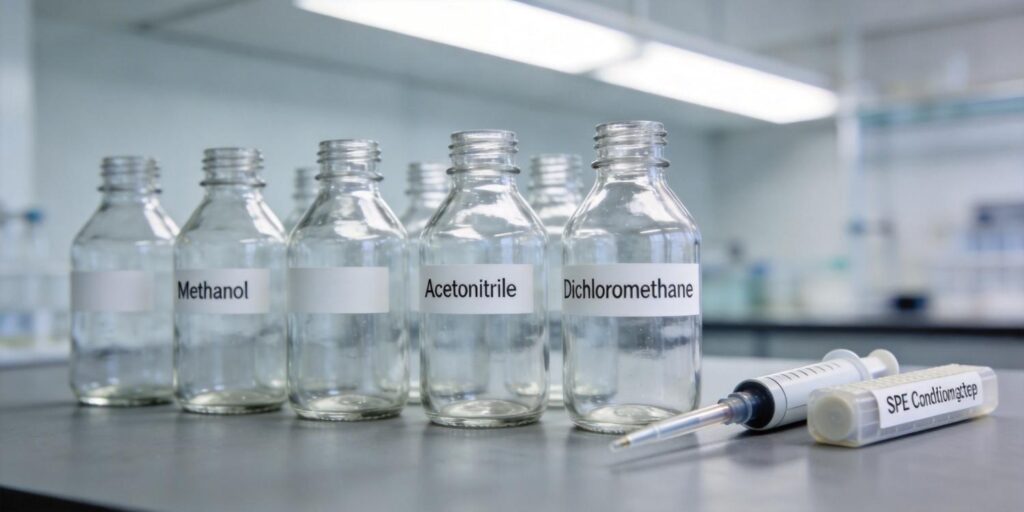
The eluotropic series provides a valuable framework for understanding solvent strength. Common solvents arranged in increasing order of eluting strength on reversed-phase sorbents include: acetic acid, methanol, acetonitrile, acetone, ethyl acetate, diethyl ether, methyl tert-butyl ether, methylene chloride, benzene, and hexane. However, as Wells (1985) notes, “a strong, nonpolar solvent such as hexane may not effect elution at all if a layer of adsorbed water exists on the SPE sorbent surface.”
Marko and Radova (1991) demonstrated remarkable differences in elution capabilities between methanol and acetonitrile for tertiary nitrogen bases. While methanol provided recoveries up to 98%, acetonitrile showed virtually no elution power under the same conditions, highlighting the importance of matching solvent properties to both analyte characteristics and sorbent surface chemistry.
Breakthrough Volume: The Critical Capacity Parameter
Breakthrough volume (Vb) represents “the volume of sample, assumed to have a constant concentration, that can be passed through the SPE device before the concentration of the analyte at the outlet of the device reaches a certain fraction of the concentration of the analyte at the inlet” (Larrivee and Poole, 1994). This parameter is typically defined at the point where 1% of the analyte concentration appears in the effluent.
Factors Influencing Breakthrough Volume
Several key factors determine breakthrough volume:
- Analyte-Sorbent Interaction Strength: Compounds with higher capacity factors (k’) exhibit larger breakthrough volumes
- Sorbent Mass and Bed Geometry: Larger sorbent masses and wider bed diameters increase breakthrough volumes
- Flow Rate: Higher flow rates decrease breakthrough volume due to band-broadening effects
- Sample Solvent Composition: Organic modifiers can dramatically reduce breakthrough volumes
Bidlingmeyer’s (1984) theoretical breakthrough volume profiles demonstrate that for compounds with capacity factors of 10 and 30, recovery remains theoretically 100% up to loading volumes of 11 mL and 31 mL respectively (assuming a 1.0 mL column volume). Beyond these points, recovery efficiency drops nonlinearly.
Practical Breakthrough Volume Considerations
Nakamura et al. (1996) established important guidelines for reversed-phase SPE, finding that for chemicals with log Pow values above approximately 3.5, there was no breakthrough from alkyl-bonded silica sorbents up to sample volumes of one liter. This relationship between hydrophobicity and breakthrough behavior provides valuable predictive capability during method development.
Mayer and Poole (1994) demonstrated that “the recovery of analytes by SPE shows significant flow-rate dependence when the sample volume exceeds the breakthrough volume of the analyte.” This highlights the interconnected nature of flow rate and breakthrough volume optimization.
Matrix Considerations: Navigating Complex Sample Environments
Sample matrix composition represents one of the most challenging aspects of SPE optimization. Environmental and biological matrices introduce numerous potential interferences that can affect extraction efficiency through various mechanisms.
Common Matrix Challenges
Particulates and Viscous Samples: Samples containing high levels of particulates, fibrin, mucus, proteins, or cellular components can clog frits and sorbent pores. The Forensic and Clinical Applications text recommends several approaches: “diluting, filtering, centrifuging, and sonicating the sample, or by precipitating proteins.” Alternatively, column characteristics can be modified by using larger sorbent particles, increasing pore size, using larger diameter columns, decreasing bed depth, or increasing frit pore diameter.
Natural Organic Matter: Environmental samples often contain dissolved organic matter that can compete with analytes for sorbent binding sites. This competition can significantly reduce effective sorbent capacity and lead to premature breakthrough.
Protein Binding: In biological samples, protein-bound analytes may not be available for extraction unless appropriate sample pretreatment (such as protein precipitation or pH adjustment) is employed.
Matrix Effects on Sorbent Capacity
The sample matrix can dramatically affect sorbent capacity through competitive interactions. As noted in forensic applications, “The sample matrix can compete with the analyte. Therefore, a sample matrix that contains a large number of compounds or a high level of a specific compound that interacts with the sorbent in a fashion similar to your analyte may reduce the capacity due to competitive interaction.”
Four primary strategies address matrix-related capacity issues:
- Increase bed size to overcome competitive interactions
- Change sorbent nature (e.g., from monomeric C18 to higher-loaded polymeric phases)
- Change extraction mechanism (e.g., from reversed-phase to ion exchange)
- Use coupled columns to filter out interfering material
Integrated Optimization Strategy
Successful SPE method development requires systematic optimization of all four parameters discussed. The following integrated approach ensures robust method performance:
Stepwise Optimization Protocol
- Initial Flow Rate Determination: Begin with conservative flow rates (typically 1-3 mL/min for cartridges) and systematically increase while monitoring recovery
- Solvent Strength Assessment: Evaluate sample dilution requirements to optimize retention while maintaining reasonable flow characteristics
- Breakthrough Volume Testing: Determine maximum sample volumes for your specific analyte-sorbent combination
- Matrix Compatibility Evaluation: Test method performance with actual sample matrices rather than simple aqueous standards
- Final Parameter Refinement: Fine-tune all parameters based on comprehensive recovery and reproducibility data
Automation Considerations
For automated SPE systems, additional factors must be considered. As demonstrated in automated method development, “Load and elute flow rates and cartridge drying steps are often the most time consuming steps in any automated SPE method. Because a slow flow rate for load and elute steps often gives the highest recoveries, these steps can be time consuming.” The balance between throughput and recovery must be carefully managed, with verification that recovery and carryover are not adversely affected by throughput optimization.
Conclusion
Optimizing sample loading in SPE methods requires careful consideration of four interrelated parameters: controlled flow rate, sample solvent strength, breakthrough volume, and matrix effects. Each parameter significantly impacts extraction efficiency, and optimal conditions must be determined empirically for each analyte-sorbent-matrix combination.
The most successful SPE methods emerge from systematic optimization that recognizes the interconnected nature of these parameters. By understanding the theoretical foundations of each factor and applying practical optimization strategies, analysts can develop robust, reproducible SPE methods suitable for both manual and automated applications across diverse sample types.
For laboratories seeking to implement or optimize SPE methods, Poseidon Scientific offers a comprehensive range of HLB SPE cartridges, MAX SPE cartridges, MCX SPE cartridges, WAX SPE cartridges, WCX SPE cartridges, and 96-well SPE plates designed to address diverse extraction challenges.