
Introduction
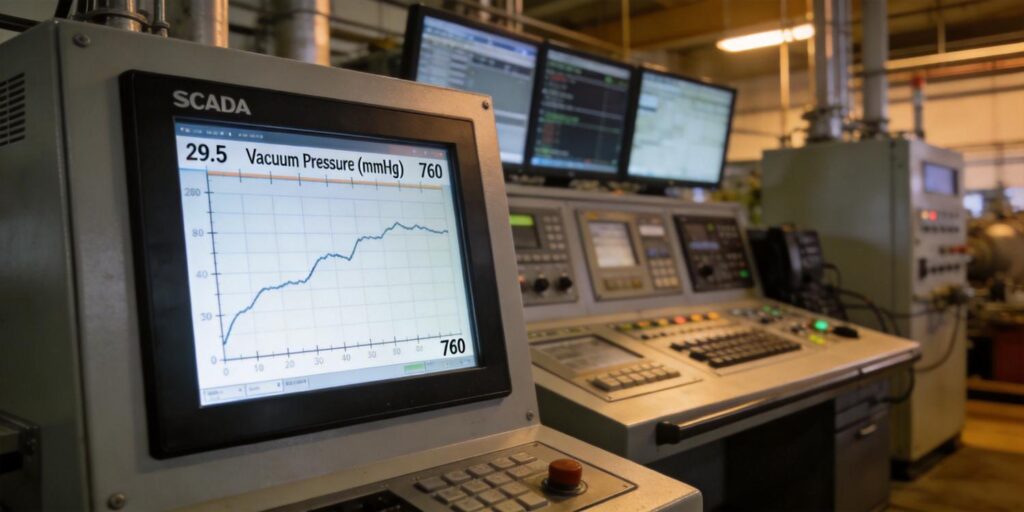
SCADA systems have become the central nervous system of modern industrial vacuum processes. In semiconductor fabrication, PVD coating lines, vacuum furnaces, and pharmaceutical drying equipment, SCADA platforms collect, visualize, and act on pressure data in real time—driving automated sequences, triggering interlocks, and generating compliance reports. Without reliable integration of vacuum gauges into the SCADA environment, operators lose visibility, control suffers, and small pressure excursions can cascade into scrap or equipment damage.
At Poseidon Scientific, we designed the VG-SP205 Pirani Vacuum Transmitter and VG-SM225 Cold Cathode Vacuum Gauge to integrate seamlessly with today’s SCADA architectures. The VG-SP205 delivers native RS232 digital output for precise roughing and medium-vacuum data, while the VG-SM225 provides a clean logarithmic 0–10 V analog signal for high-vacuum monitoring. Together they deliver continuous coverage from atmosphere to 10−7 Torr with unified spare parts and simple configuration. This article explains the role of SCADA in vacuum monitoring, the data acquisition flow, the trade-offs between analog and digital transmission, alarm configuration best practices, a real industrial example, and how the Poseidon pair makes integration fast and future-proof.
The Role of SCADA in Vacuum Monitoring
SCADA systems do far more than display numbers. They unify disparate sensors into a single operational picture, enforce process recipes, log every pressure event for traceability, and execute safety interlocks faster than any human operator. In vacuum applications, SCADA performs three critical functions:
- Real-time process supervision: Continuous trending of foreline and chamber pressure ensures the system stays within recipe limits.
- Automated sequencing and interlocks: Pump startup, valve actuation, and plasma ignition occur only when pressure confirms safe conditions.
- Historical analysis and compliance: Every pump-down curve, base-pressure hold, and alarm is archived for quality audits and continuous improvement.
The Poseidon gauges were built for exactly this environment. The VG-SP205’s RS232 output streams pressure already scaled in engineering units plus status bytes, while the VG-SM225’s logarithmic analog signal (1.33 V per decade) maps directly to decades of vacuum on any SCADA trend display. When both transmitters are used together, the SCADA receives one seamless pressure variable across six decades—eliminating the data gaps and scaling headaches common with mixed-vendor installations.
Data Acquisition Flow
A typical vacuum SCADA data flow follows a clear, repeatable path that the Poseidon pair simplifies:
- Sensor level: The VG-SP205 samples filament resistance and converts it to pressure via its constant-temperature bridge. The VG-SM225 measures ion current and converts it to voltage via logarithmic amplification.
- Transmission: RS232 packets from the Pirani or 0–10 V analog from the cold cathode travel over shielded cable to the PLC or remote I/O rack.
- Controller level: The PLC applies scaling (direct for RS232, logarithmic formula for analog), blends signals at the 10−3 Torr crossover, and publishes the unified pressure tag to the SCADA server.
- SCADA level: The historian logs every value, the HMI displays live trends, and alarm logic compares the pressure tag against recipe setpoints.
This flow requires no additional signal conditioners or protocol converters. The VG-SP205’s ASCII frames and the VG-SM225’s low-impedance analog output plug directly into standard PLC analog and serial modules, reducing cabinet space and commissioning time. Engineers report full system integration in under a day when using the Poseidon pair.
Analog vs Digital Transmission
Both transmission methods have strengths, and the Poseidon gauges give you the best of each:
Analog (VG-SM225 Cold Cathode)
The 0–10 V logarithmic signal offers simplicity and speed. It connects directly to any analog input card, requires no protocol configuration, and updates continuously. The fixed 1.33 V/decade scaling ensures uniform resolution on SCADA trend charts. Drawback: any noise on the line appears as pressure fluctuation, so shielded cable and differential inputs are essential.
Digital (VG-SP205 Pirani)
RS232 delivers pressure already scaled in Torr, Pa, or mbar, plus status and error codes. The controller receives clean engineering units with no scaling math required. Digital transmission also includes built-in diagnostics that analog cannot match. The trade-off is slightly slower update rates (typically 10 Hz) and the need for a serial port or converter.
Best practice in most systems: use the VG-SP205 RS232 for roughing and load-lock monitoring where precise digital values and status flags are valuable, and the VG-SM225 analog for high-vacuum trending where continuous resolution matters most. The SCADA historian logs both signals, giving operators complete visibility across the full vacuum range.
Alarm Configuration Best Practices
Well-configured alarms turn raw pressure data into proactive protection. Recommended SCADA alarm setpoints for a typical full-range system include:
- Foreline pressure >10 Torr while turbo is running (immediate pump protection interlock)
- Chamber base pressure >5 × 10⁻⁶ Torr for >30 seconds (prevent process start)
- Pressure rise rate >0.5 Torr/min during isolated hold test (leak detection)
- VG-SM225 analog voltage <2.0 V after high-voltage enable (discharge failure alarm)
The VG-SP205’s explicit RS232 error codes and the VG-SM225’s analog voltage thresholds feed directly into these alarms with no additional logic. Most users configure two severity levels—warning (yellow) for early drift and critical (red) for immediate interlock. Trending the time between alarms also provides early warning of developing issues such as valve wear or filter loading. This layered alarm strategy has been proven to reduce unplanned downtime by 60–70 % in production vacuum tools.
Industrial Example: Semiconductor Cluster Tool Integration
A major semiconductor foundry upgraded six cluster tools with the Poseidon pair. Previously, mixed-vendor gauges required separate analog conditioning cards, custom scaling blocks, and frequent manual range switching. After installation:
- One VG-SP205 on each load lock and one VG-SM225 on each process chamber
- RS232 from the Pirani and 0–10 V from the cold cathode fed directly into the existing Siemens SCADA via standard I/O modules
- Automatic crossover logic at 10−3 Torr produced a single continuous pressure tag for all HMIs and historians
Results after three months:
- Pump-down time reduced 18 %
- False interlock trips eliminated
- Calibration frequency dropped from quarterly to annual
- SCADA alarm response time improved from minutes to seconds
The same architecture now runs on 24 additional tools with zero software changes. The unified spare-parts kit and identical mounting dimensions simplified inventory and training across the entire fab.
Conclusion
Integrating vacuum gauges with SCADA systems transforms raw pressure signals into actionable intelligence that drives automation, protects equipment, and ensures compliance. The Poseidon VG-SP205 Pirani and VG-SM225 Cold Cathode Vacuum Gauge were purpose-built for this environment—delivering clean RS232 digital and logarithmic analog outputs that connect directly to today’s SCADA platforms with minimal engineering overhead.
Whether you are commissioning a new tool or modernizing an existing line, the combination of full-range coverage, simple data acquisition, flexible alarm configuration, and proven industrial performance makes the Poseidon pair the practical choice for reliable vacuum monitoring.
Ready to integrate high-performance vacuum gauges into your SCADA system? Our applications team specializes in semiconductor, PVD, furnace, and analytical installations. We offer free technical reviews, sample PLC function blocks, wiring diagrams, and rapid quotations. Contact us today for a no-obligation consultation—simply visit the product pages below or reply to this article.
VG-SP205 Pirani Vacuum Transmitter – RS232 for SCADA Integration
VG-SM225 Cold Cathode Vacuum Gauge – Logarithmic Analog for SCADA Trending
At Poseidon Scientific we design vacuum instrumentation that speaks your SCADA’s language—delivering the clean data, fast response, and integration simplicity your processes demand.


