Common Artificial Dyes in Confectionery Products
Artificial food dyes are widely used in the candy industry to achieve vibrant colors. Common examples include Tartrazine (E102, Yellow #5), Sunset Yellow (E110, Yellow #6), Allura Red (E129, Red #40), Brilliant Blue (E133, Blue #1), Indigo Carmine (E132, Blue #2), and Ponceau 4R (E124, Red #4). These synthetic colorants are preferred for their stability, cost-effectiveness, and intense coloring power. However, regulatory agencies such as the FDA and EFSA strictly monitor their levels due to potential health concerns, especially in children.
Sample Extraction from Candy Matrices
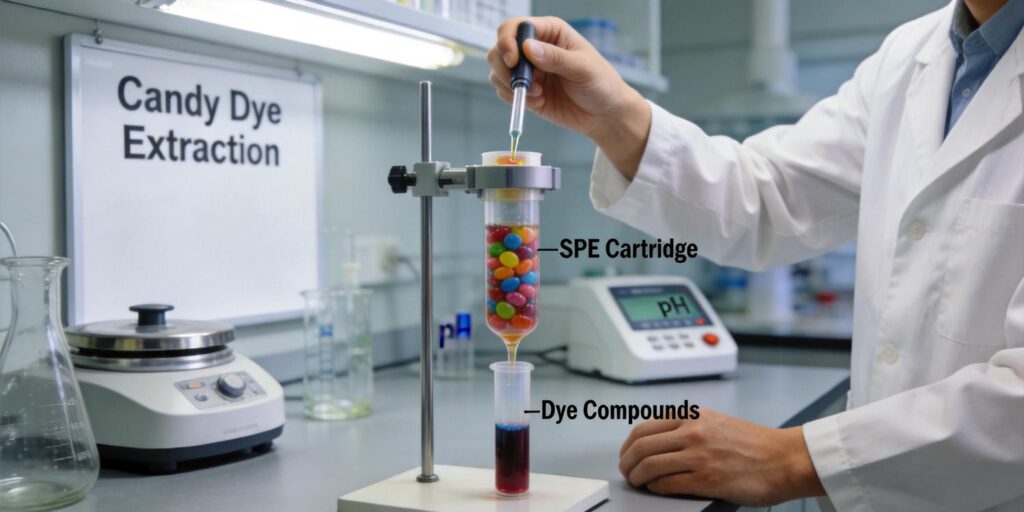
Candy matrices—ranging from hard candies and gummies to chocolates and marshmallows—pose unique extraction challenges due to high sugar content, fats, and gelatin. The first step typically involves grinding or crushing the sample, followed by dissolution in a suitable aqueous solvent (e.g., water or dilute acid). For fatty candies like chocolate, a defatting step with hexane or petroleum ether is recommended. The extract is then centrifuged and filtered to remove particulate matter before solid-phase extraction (SPE).
SPE Sorbent Selection for Dye Compounds
Artificial food dyes are polar, anionic compounds, making strong anion exchange (SAX) sorbents like MAX (mixed-mode strong anion exchange) an ideal choice. Alternatively, WAX (weak anion exchange) can be used when pH adjustment is preferred. For multi-dye analysis, polymeric reversed-phase sorbents (e.g., HLB) offer broad retention. Learn more about our HLB SPE cartridges and MAX SPE cartridges for optimal dye extraction.
Conditioning and Loading Procedures
For MAX sorbents, condition with 3 mL of methanol followed by 3 mL of deionized water. The sample (adjusted to pH ~7–8) is loaded at a slow flow rate (1–2 mL/min) to ensure quantitative binding. For WAX, condition with methanol and water at pH ~6. For HLB, condition with methanol and water without pH adjustment. After loading, the cartridge is washed to remove interferences.
Washing Steps Removing Sugars and Gelatin
Sugars and gelatin are common interferences in candy samples. A wash with 5% methanol in water (2–3 mL) effectively removes sugars without eluting dyes. For gelatin removal, a slightly alkaline wash (pH 8–9 with ammonium hydroxide) helps break hydrogen bonds. If using MAX or WAX, a wash with 100% methanol can remove neutral hydrophobic compounds. For comprehensive washing, our WAX SPE cartridges provide excellent selectivity.
Elution Solvents for Dye Analysis
For MAX, elute dyes using 2–3 mL of 2% formic acid in methanol (or acetonitrile). For WAX, use 5% ammonium hydroxide in methanol. For HLB, elute with methanol containing 0.1% HCl. The eluate is evaporated under nitrogen and reconstituted in mobile phase for HPLC analysis. When using WCX SPE cartridges, elution with acidic methanol is also effective for cationic dyes.
HPLC Detection Methods
High-performance liquid chromatography (HPLC) coupled with diode array detection (DAD) is the gold standard for artificial dye quantification. A C18 reversed-phase column (e.g., 250 × 4.6 mm, 5 µm) with a mobile phase of ammonium acetate buffer (pH 4–5) and acetonitrile/methanol gradient provides excellent separation. Detection wavelengths are set at 420 nm (yellow dyes), 520 nm (red dyes), and 620 nm (blue dyes). Mass spectrometry (LC-MS/MS) can be used for confirmatory analysis.
Regulatory Monitoring Applications
SPE extraction of artificial dyes from candy samples is critical for regulatory compliance. The FDA mandates that certified colors be listed on ingredient labels, while the EU requires maximum limits (e.g., Tartrazine ≤ 300 mg/kg in confectionery). This SPE protocol enables precise quantification for quality control and safety monitoring. For high-throughput applications, our 96-well SPE plates streamline the process. For alternative sorbents, see our MCX SPE cartridges for mixed-mode cation exchange applications.