Chemical Complexity of Coffee Extracts
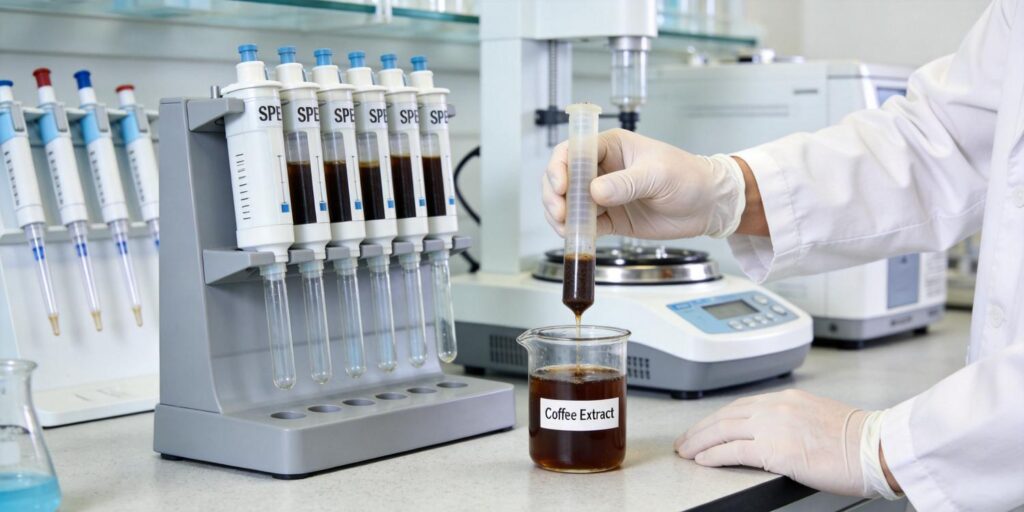
Coffee is one of the most chemically complex beverages consumed globally, containing over 1,000 volatile and non-volatile compounds. The major classes include chlorogenic acids, caffeine, diterpenes (cafestol, kahweol), melanoidins (Maillard reaction products), lipids (triglycerides, sterols), and polysaccharides. This complexity poses significant challenges for targeted contaminant analysis, as matrix components can interfere with extraction efficiency, chromatography, and mass spectrometry ionization. Efficient cleanup is essential to isolate trace-level pesticides (<10–100 ng/g) from the abundant matrix while maintaining high recovery and reproducibility.
Extraction Methods for Contaminants
Pesticide residues in green and roasted coffee beans originate from agricultural practices and post-harvest handling. Common extraction methods prior to SPE include QuEChERS (acetonitrile-based salting-out extraction) and pressurized liquid extraction (PLE). For roasted coffee, QuEChERS with acetate buffer (AOAC 2007.01) is recommended, as it provides high recoveries for both polar and non-polar pesticides. The extract is centrifuged and an aliquot of the acetonitrile layer is subjected to SPE cleanup. For lipid-rich samples, dispersive SPE with C18 and PSA may precede cartridge-based purification.
SPE Sorbent Selection for Matrix Cleanup
Choosing the right SPE sorbent is critical for retaining interfering compounds while allowing target analytes to pass through or be selectively eluted. For coffee extracts, mixed-mode sorbents are highly effective. HLB (Hydrophilic-Lipophilic Balance) cartridges retain a broad range of polar and non-polar compounds, suitable for capturing pesticides while washing away pigments. C18 sorbents are preferred for non-polar analytes but may co-retain lipids. For acidic pesticides, MAX (Mixed-mode Anion eXchange) provides strong anion exchange capacity. Cationic contaminants (e.g., some fungicides) benefit from MCX (Mixed-mode Cation eXchange). Neutral pesticides are well-handled by WAX (Weak Anion eXchange) or WCX (Weak Cation eXchange) depending on pH. For high-throughput applications, 96-well SPE plates offer parallel processing of multiple samples.
Conditioning and Loading Coffee Extracts
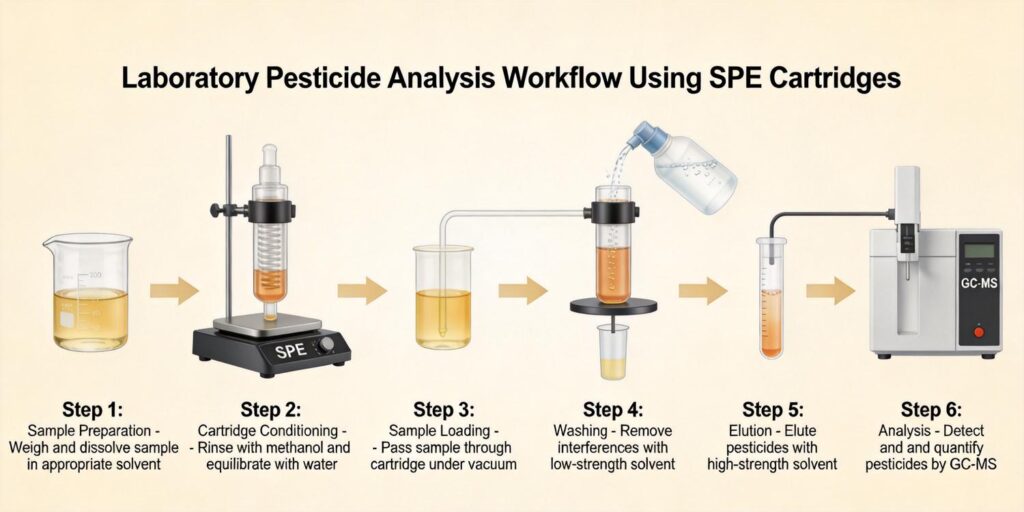
Proper conditioning equilibriates the sorbent bed and ensures reproducible retention. For HLB cartridges, condition with 1 mL methanol followed by 1 mL water. Load the acetonitrile extract (typically 1–2 mL) after dilution with water to reduce organic solvent content below 10% (v/v). This step ensures that pesticides adsorb onto the sorbent while matrix components with low affinity pass through. A slow flow rate (≤1 mL/min) enhances binding efficiency. For high-fat extracts, centrifugation or filtration (0.45 µm PTFE) is recommended before loading to prevent clogging.
Washing Steps Removing Pigments and Oils
After loading, a wash step removes hydrophilic interferences. A mixture of 5% methanol in water (v/v) effectively elutes sugars, organic acids, and phenolic compounds without displacing target analytes. For lipid removal, a second wash with hexane or dichloromethane may be used, especially when using C18 sorbents. Some protocols incorporate a 5% ammonia solution in methanol for MAX cartridges to remove acidic pigments. The wash volume should be 1–2 bed volumes to balance cleanup and retention.
Elution Solvent Optimization
Elution solvent composition and volume directly impact recovery and selectivity. For HLB and C18, methanol or acetonitrile with 0.1% formic acid typically elutes neutral and basic pesticides. For mixed-mode sorbents, elution requires both organic solvent and ionic modifiers: e.g., 5% ammonium hydroxide in methanol for MAX (elutes acidic compounds), or 5% formic acid in methanol for MCX (elutes basic compounds). Gradient elution (stepwise increase in elution strength) can further fractionate analytes. Typically, 1–2 mL of elution solvent is sufficient; higher volumes may dilute the sample and reduce sensitivity.
LC-MS Analysis of Contaminants
SPE eluates are evaporated under nitrogen and reconstituted in a solvent compatible with LC-MS (e.g., 80:20 water:methanol with 0.1% formic acid). Reversed-phase LC using C18 columns with a water-methanol gradient is standard. Mass spectrometry detection in positive/negative ESI mode with multiple reaction monitoring (MRM) provides high specificity and sensitivity. Matrix effects must be assessed by spiking experiments; isotope-labeled internal standards correct for ion suppression or enhancement. LOQs typically range from 1–10 ng/g for pesticides in coffee, meeting EU and FDA regulations.
Food Safety Quality Control
Rigorous quality control (QC) is mandatory for regulatory compliance. QC samples include blank matrix, spiked samples at three concentration levels (e.g., 10, 50, 200 ng/g), and solvent blanks to monitor carryover. Recovery should be within 70–120% with RSD ≤20%. Batch-to-batch SPE cartridge verification (e.g., using Poseidon HLB SPE cartridges) ensures consistent performance. Regular proficiency testing and method validation per SANTE/11312/2021 guidelines are recommended. Automation with 96-well plates (96-well SPE plates) improves throughput and reduces human error.