Environmental Presence of Flame Retardants in Indoor Dust
Flame retardants, particularly brominated flame retardants (BFRs) such as polybrominated diphenyl ethers (PBDEs) and hexabromocyclododecane (HBCD), are ubiquitous in indoor environments. These compounds are added to consumer products like furniture, electronics, and textiles to meet fire safety standards. Over time, they leach out and accumulate in indoor dust, posing a chronic exposure risk to occupants, especially young children who have higher hand-to-mouth activity. Studies have detected PBDEs in household dust at concentrations ranging from ng/g to µg/g, with higher levels in homes with older foam-containing products. The persistence and bioaccumulation potential of these compounds necessitate robust analytical methods for monitoring their presence.
Dust Sample Collection and Solvent Extraction
Dust samples are typically collected using a vacuum cleaner equipped with a cellulose extraction thimble or by wiping surfaces with pre-cleaned cotton wipes. For representative sampling, multiple rooms within a building are sampled, and the dust is sieved through a 500 µm mesh to remove debris. A common extraction protocol involves sonication or accelerated solvent extraction (ASE) with a mixture of hexane and acetone (1:1, v/v). For example, 1–2 g of sieved dust is extracted with 10–20 mL of solvent for 15 minutes, repeated twice. The combined extracts are then concentrated to ~1 mL under a gentle nitrogen stream before SPE cleanup.
SPE Cartridge Selection for Brominated Flame Retardants
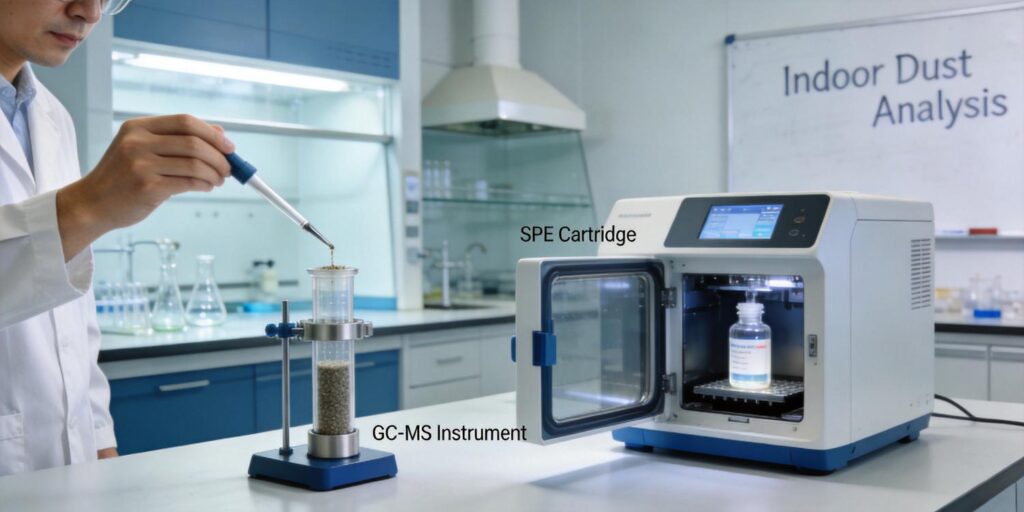
For BFRs, the HLB SPE cartridges (hydrophilic-lipophilic balanced) or silica gel SPE cartridges are recommended. HLB cartridges offer a wide pH stability and retain both polar and non-polar analytes, making them suitable for multi-residue methods. Alternatively, Florisil or alumina cartridges can be used for fractionation. The choice depends on the target analytes; for PBDEs, non-polar interactions dominate, so a reversed-phase sorbent like C18 may also be considered.
Recommended Sorbent for BFRs
For optimal recovery of tri- to deca-BDE congeners, a dual-layer cartridge combining silica gel and Florisil has shown superior cleanup efficiency. However, for routine analysis, a single HLB cartridge (200 mg, 6 mL) suffices when combined with selective elution.
Conditioning and Loading Extracts
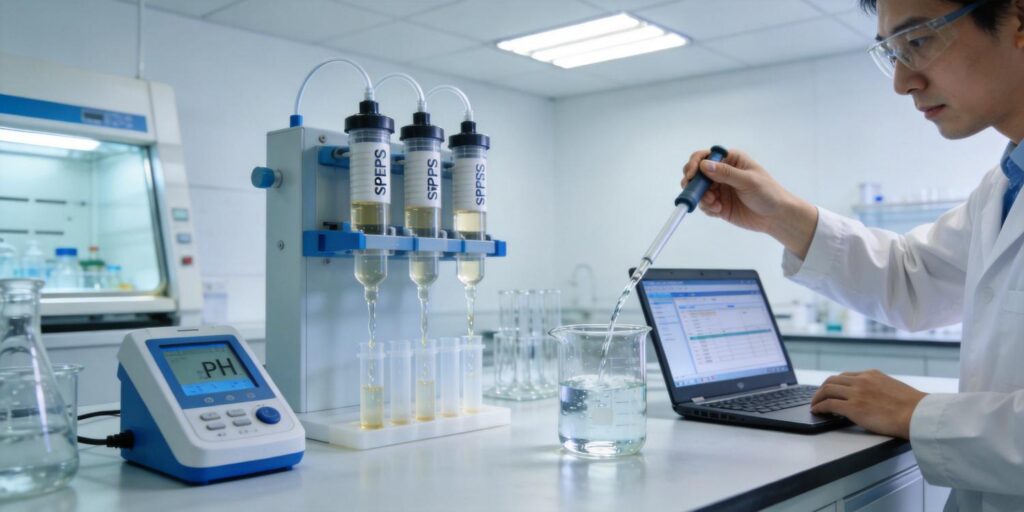
The SPE cartridge must be conditioned to activate the sorbent. For HLB cartridges, condition with 5 mL of methanol followed by 5 mL of deionized water. For silica gel, condition with 5 mL of hexane. The concentrated dust extract (1 mL) is then loaded onto the cartridge at a flow rate of 1 mL/min. If the extract contains particulate matter, it should be filtered through a 0.45 µm PTFE syringe filter beforehand.
Washing Steps Removing Co-Extracted Matrix Components
After sample loading, the cartridge is washed to remove interfering matrix components such as lipids, pigments, and phthalates. For HLB cartridges, wash with 5 mL of 5% methanol in water (v/v) followed by 5 mL of hexane. The hexane wash elutes some non-polar interferences while retaining BFRs on the sorbent. For silica gel, a wash with 5 mL of hexane is sufficient to remove aliphatic hydrocarbons.
Elution Solvents for Flame Retardants
BFRs are eluted from the SPE cartridge using a solvent that disrupts the non-polar interactions. For HLB cartridges, use 5 mL of hexane:dichloromethane (1:1, v/v) or 5 mL of acetone:hexane (1:1). For silica gel, elute with 5 mL of hexane:ethyl acetate (4:1). The eluate is collected in a glass tube and concentrated to 0.5 mL under nitrogen for GC-MS analysis. Recoveries typically exceed 85% for most PBDE congeners.
GC-MS Analysis Workflow
The concentrated eluate is analyzed by gas chromatography-mass spectrometry (GC-MS) in electron ionization (EI) or negative chemical ionization (NCI) mode. A DB-5MS capillary column (30 m × 0.25 mm × 0.25 µm) is commonly used with a temperature program from 80°C (hold 1 min) to 300°C at 10°C/min. Quantification is performed using isotope dilution with 13C-labeled internal standards. For high-resolution mass spectrometry (HRMS), magnetic sector instruments offer enhanced selectivity for trace-level detection.
Quality Control
Method blanks, spiked blanks, and duplicate samples are analyzed to ensure data quality. Limits of detection (LOD) for individual BFRs range from 0.1 to 1 ng/g dust.
Environmental Health Implications
Indoor dust ingestion is a major exposure pathway for flame retardants, leading to potential endocrine disruption, neurotoxicity, and carcinogenicity. Children are at higher risk due to their developing systems and higher dust intake. Regulatory actions, such as the Stockholm Convention listing of certain PBDEs, have driven phase-outs, but legacy contamination persists. Regular monitoring using reliable SPE methods supports risk assessment and policy-making.
For further reading on high-throughput SPE formats suitable for large-scale dust studies, explore our 96-well plate options. Our MAX, MCX, WAX, and WCX cartridges also offer tailored selectivity for acidic/basic analytes if co-extracted interferences require alternative cleanup.