Understanding Plant Alkaloids: Chemical Properties and Isolation Challenges
Alkaloids are nitrogen-containing organic compounds that exhibit significant pharmacological activities. Found in approximately 20% of plant species, these basic compounds often possess complex heterocyclic structures and varying polarities. Their basic nature, typically with pKa values ranging from 6 to 10, makes them ideal candidates for ion-exchange solid-phase extraction (SPE). The challenge in isolating alkaloids lies in separating them from abundant neutral plant components such as chlorophyll, waxes, and lipids.
Extraction from Dried Plant Material
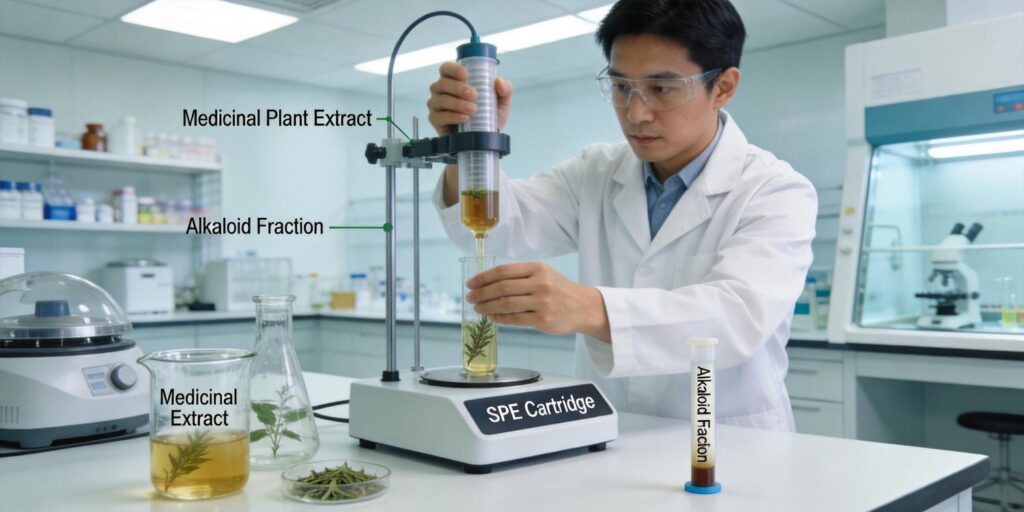
Before SPE, alkaloids must be extracted from dried plant material. A common approach involves grinding the plant material and using acidified methanol (e.g., 0.1% HCl in MeOH) to protonate the alkaloids, facilitating their release from cellular matrices. Ultrasonication or Soxhlet extraction for 30–60 minutes improves yields. After filtration and centrifugation, the crude extract contains alkaloids, neutral compounds, and pigments. This extract is then diluted with water to reduce organic solvent content to below 10% for optimal SPE loading.
MCX SPE Sorbent Selection for Basic Compounds
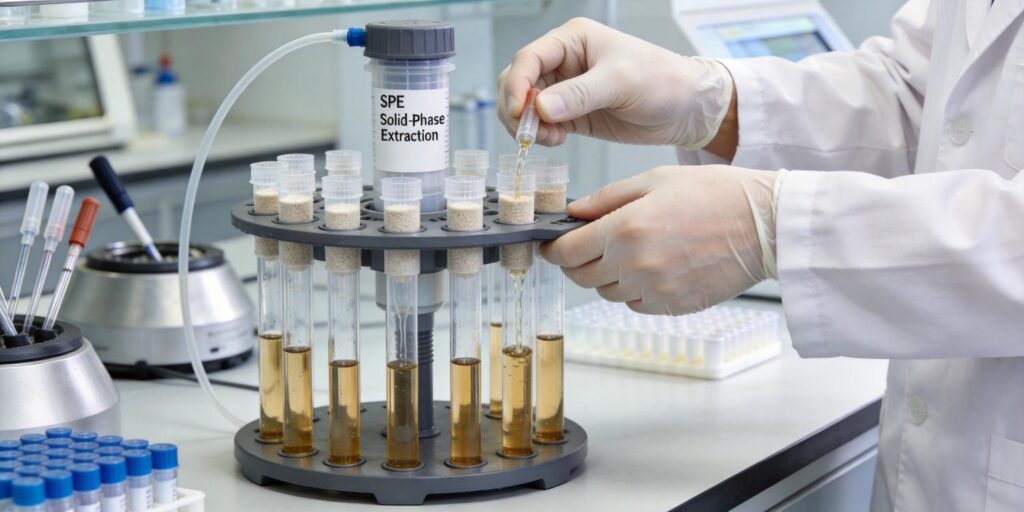
For the isolation of alkaloids, mixed-mode cation-exchange (MCX) sorbents are the preferred choice. MCX combines a reversed-phase hydrophobic backbone (typically C18 or polymeric) with a strong cation-exchange sulfonic acid group. This dual retention mechanism allows MCX to capture protonated (positively charged) alkaloids via ionic interactions, while neutral compounds pass through or are washed away. The strong cation exchanger (pKa ~1) ensures retention even in low pH conditions. Poseidon Scientific MCX SPE Cartridges offer high reproducibility and loading capacity (up to 10% w/w alkaloid-to-sorbent), making them suitable for both analytical and preparative phytochemical workflows.
Conditioning and Loading Procedures
Proper conditioning of the MCX sorbent is critical for consistent results. The general sequence is:
- Condition with 2–3 bed volumes of methanol to wet the hydrophobic phase.
- Equilibrate with 2–3 bed volumes of 0.1% formic acid (or 0.1N HCl) in water to protonate the sulfonic acid groups and the alkaloids.
- Load the acidified plant extract (pH 2–3) at a flow rate of 1–2 mL/min for cartridges. Avoid exceeding the sorbent capacity—typically 5–10 mg alkaloid per gram sorbent.
Washing to Remove Neutral Plant Components
After loading, a washing step removes neutral and acidic interferents. Two sequential washes are recommended:
- Wash 1: 0.1% formic acid in water (2–3 bed volumes) to remove salts and polar neutrals.
- Wash 2: 100% methanol or acetonitrile (2–3 bed volumes) to elute hydrophobic neutral compounds like chlorophyll and lipids that are retained by reversed-phase interactions.
At this stage, alkaloids remain protonated and bound to the cation-exchange sites.
Elution Using Basic Organic Solvents
To release alkaloids, the ion-exchange interaction is disrupted by increasing pH. Elution is performed with a basic organic solvent mixture, typically 5% ammonium hydroxide in methanol. The ammonia deprotonates the alkaloids, neutralizing their charge. Use 2–4 bed volumes of elution solvent, collecting the alkaloid-rich fraction. For higher selectivity, a gradient of increasing ammonia concentration (1–10%) can be applied. The eluate is then evaporated and reconstituted in a suitable solvent for analysis.
HPLC or LC-MS Analysis
The final SPE eluate is suitable for direct injection into HPLC or LC-MS systems. Typical reversed-phase C18 columns with mobile phases containing 0.1% formic acid and acetonitrile provide good separation. LC-MS using electrospray ionization in positive mode is ideal for alkaloid detection, as they readily form [M+H]+ ions. Quantification can be performed using external standards. Expected recovery rates for alkaloids like caffeine, berberine, or morphine range from 80–99% with high reproducibility (RSD < 10%).
Application in Phytochemical Research
MCX SPE has become a staple in phytochemical laboratories for targeted alkaloid isolation. Applications include:
- Standardization of herbal extracts for quality control (e.g., berberine in Berberis species).
- Metabolomic profiling of complex plant matrices.
- Preparation of alkaloid-enriched fractions for bioactivity assays.
- Cleanup prior to high-resolution mass spectrometry for structural elucidation.
For high-throughput needs, the 96-Well SPE Plate format is available, which uses the same MCX chemistry in a parallel processing plate. This format significantly increases sample throughput while maintaining selectivity.
Summary of Recommended SPE Protocol for Alkaloids
| Step | Solvent | Volume | Purpose |
|---|---|---|---|
| Condition | MeOH | 2 BV | Wet sorbent |
| Equilibrate | 0.1% FA in H₂O | 2 BV | Activate cation-exchange |
| Load | Acidified extract (pH 2-3) | ~10 mg alkaloid/g sorbent | Retain alkaloids |
| Wash 1 | 0.1% FA in H₂O | 2 BV | Remove polar neutrals |
| Wash 2 | MeOH | 2 BV | Remove hydrophobic neutrals |
| Elute | 5% NH₄OH in MeOH | 2-4 BV | Neutralize and release alkaloids |
For additional SPE sorbent options and accessories, explore HLB, MAX, WAX, and WCX cartridges for method development flexibility.