Introduction
UV filters from sunscreens are increasingly detected in recreational waters such as swimming pools, posing potential ecological and human health risks. Solid-phase extraction (SPE) is a powerful technique for concentrating these trace organic contaminants prior to analysis. This article provides a technical guide on SPE method development for extracting UV filters from swimming pool water, from sample collection to LC-MS analysis.
Occurrence of Sunscreen UV Filters in Recreational Waters
UV filters like oxybenzone, octinoxate, and avobenzone are common ingredients in sunscreens. They enter swimming pool water through bathers and can persist due to recirculation and chlorination. Studies have reported concentrations ranging from ng/L to µg/L in pool water, which may affect aquatic organisms and human health through dermal absorption or accidental ingestion. Monitoring these compounds is crucial for regulatory compliance and risk assessment.
Sample Collection and Filtration Protocols
Collect pool water samples in amber glass bottles to prevent photodegradation. Use pre-cleaned PTFE or glass containers; avoid plastic as UV filters can adsorb to polyethylene. Filter samples through 0.45 µm glass fiber filters (GF/F) within 24 hours to remove particulate matter. Add a preservative like ascorbic acid (0.1% w/v) to quench residual chlorine, which can degrade UV filters. Store samples at 4°C in the dark and extract within 48 hours to minimize losses.
SPE Sorbent Selection for Hydrophobic UV Filter Compounds
UV filters are predominantly hydrophobic (log Kow 3–6), so reversed-phase sorbents are ideal. HLB (Hydrophilic-Lipophilic Balanced) cartridges are widely recommended due to their ability to retain both polar and nonpolar compounds. Alternatively, C18 sorbents or polymeric phases like MAX (Mixed-mode Anion eXchange) can be used for specific analyte classes. For swimming pool water, HLB provides optimal retention of diverse UV filters with minimal breakthrough.
Conditioning and Loading Procedures
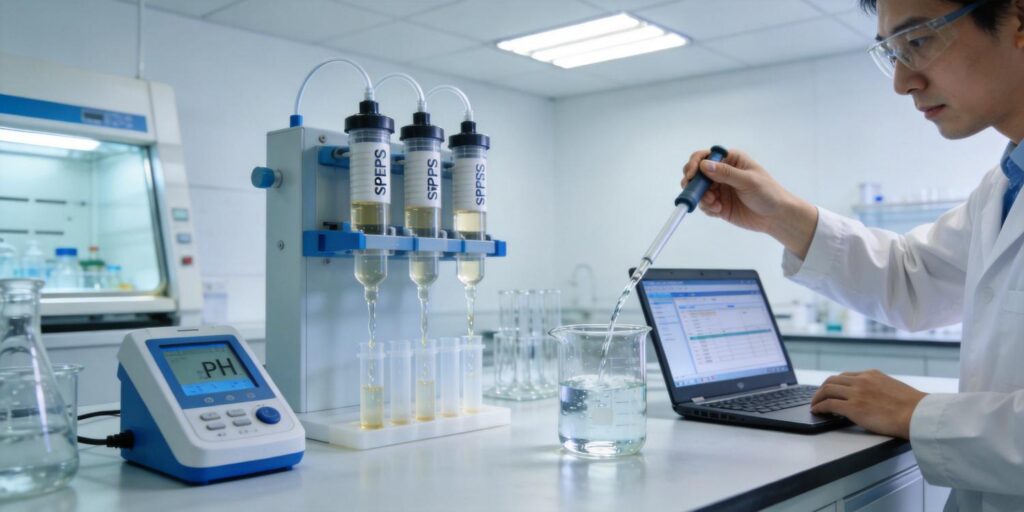
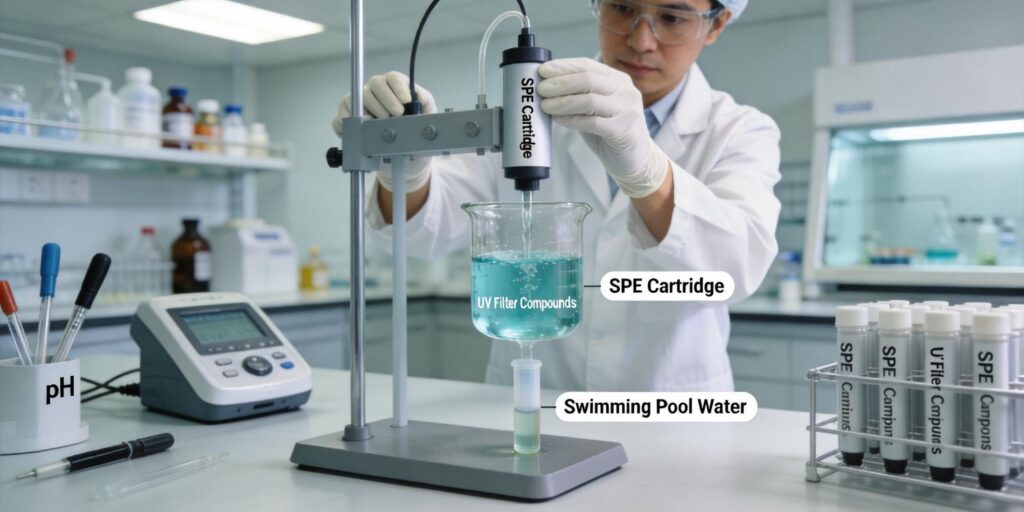
Condition the SPE cartridge sequentially with 5 mL of methanol (MeOH), 5 mL of Milli-Q water, and 5 mL of sample-buffered water (pH 6–7). Load 500–1000 mL of filtered pool water onto the cartridge at a flow rate of 5–10 mL/min using a vacuum manifold or peristaltic pump. Ensure the bed does not dry out; maintain a thin layer of liquid above the sorbent. After loading, dry the cartridge under nitrogen for 20 minutes to remove residual water.
Washing Steps Removing Salts and Organic Matter
Pool water contains high levels of salts and dissolved organic matter that can interfere with analysis. Wash the cartridge with 5 mL of Milli-Q water to remove salts, followed by 5 mL of 5% MeOH in water to elute weakly retained interferents. For cleaner extracts, a second wash with 5 mL of 10% MeOH can be included. Avoid high organic percentages that may prematurely elute target analytes.
Elution Solvents for UV Filters
Elute trapped UV filters with 5–10 mL of a suitable solvent or mixture. Pure MeOH or acetonitrile (ACN) often provides >90% recovery. For very hydrophobic compounds, use ACN:MeOH (1:1, v/v) or ethyl acetate. Collect eluate in a glass tube and evaporate to near dryness under nitrogen at 40°C. Reconstitute in 200–500 µL of MeOH or mobile phase for LC-MS analysis. Recommended SPE products for this step include MCX (Mixed-mode Cation eXchange) if acidic UV filters are present, or WAX (Weak Anion eXchange) for anionic compounds.
LC-MS Detection Methods
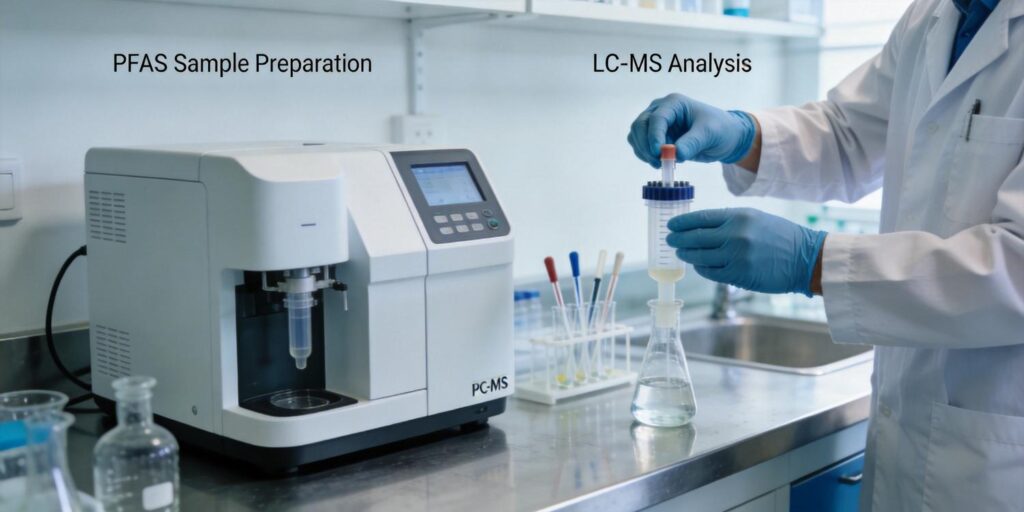
Separate UV filters using a reversed-phase C18 column (e.g., 100 mm × 2.1 mm, 1.7 µm) with a mobile phase gradient of water/MeOH or water/ACN (both with 0.1% formic acid). Use electrospray ionization in positive mode for most UV filters. Quantification by multiple reaction monitoring (MRM) with two transitions per analyte ensures selectivity. Deuterated internal standards (e.g., oxybenzone-d3) correct for matrix effects. Limit of detection (LOD) can reach 1 ng/L with preconcentration.
Environmental Monitoring Applications
This SPE-LC-MS method is applicable beyond swimming pools to lakes, rivers, and coastal waters. It supports studies on UV filter fate, transport, and ecological effects. Routine monitoring can help enforce regulations such as the EU Water Framework Directive. For high-throughput screening, 96-well SPE plates offer parallel processing of multiple samples, increasing laboratory efficiency.
Conclusion
Optimized SPE using HLB cartridges provides robust extraction of UV filters from swimming pool water. Careful control of sampling, filtration, and SPE conditions ensures reliable data for environmental monitoring. By selecting appropriate sorbents and elution solvents, laboratories can achieve high recoveries and low detection limits, supporting both research and regulatory compliance.