Analytical Challenges in Lipid-Rich Biological Tissues
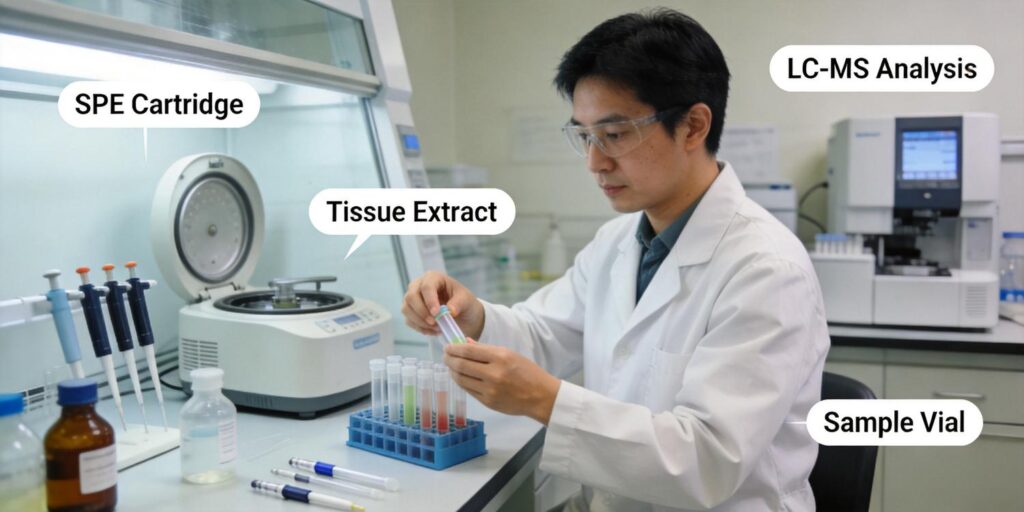
Analyzing lipid-rich biological tissues, such as brain, adipose, liver, or milk, presents unique challenges for liquid chromatography-tandem mass spectrometry (LC-MS). These matrices contain high levels of triglycerides, phospholipids, and cholesterol esters that can co-extract with target analytes, leading to severe ion suppression or enhancement in the electrospray ionization source. Matrix effects can reduce sensitivity, compromise accuracy, and increase variability. In addition, lipids can precipitate during solvent evaporation or clog columns, shortening instrument uptime. Solid-phase extraction (SPE) is a powerful cleanup technique to address these issues, enabling reliable quantification of small molecules, peptides, or metabolites in fatty samples.
Tissue Homogenization and Solvent Extraction
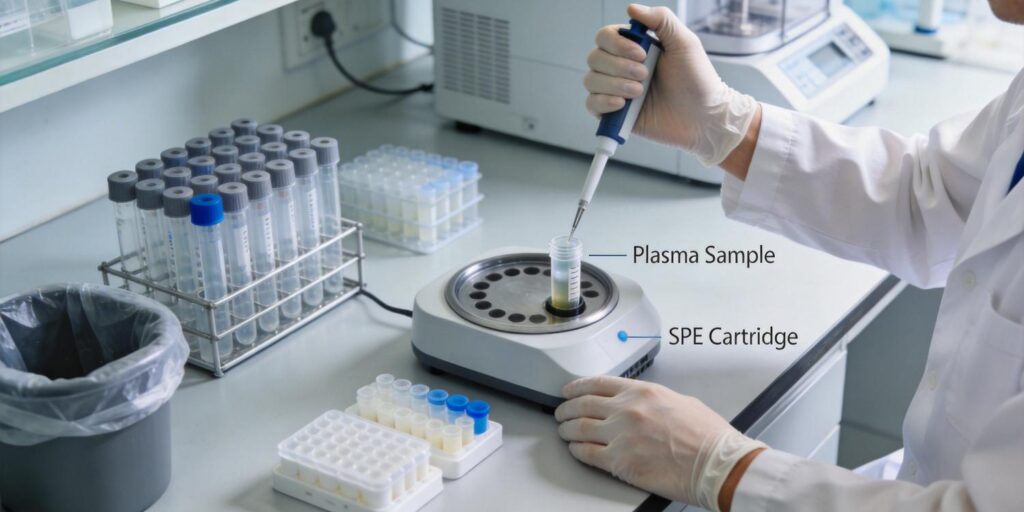
Effective SPE cleanup begins with proper sample preparation. Tissues should be homogenized in a suitable solvent system that disrupts cellular membranes and solubilizes both analytes and lipids. Common approaches include using protein precipitation solvents like acetonitrile or methanol, or liquid-liquid extraction with methyl tert-butyl ether (MTBE) or chloroform/methanol mixtures. For lipid-rich tissues, a modified Folch or Bligh-Dyer extraction can partition lipids into an organic phase while target analytes remain in the aqueous phase. Centrifugation at high speed (e.g., 10,000–15,000 × g) pellets cellular debris and facilitates phase separation. The resulting supernatant or aqueous layer is then diluted with an appropriate loading solvent (e.g., 5–10% organic in water) to ensure compatibility with the SPE sorbent.
SPE Sorbent Selection for Lipid Removal
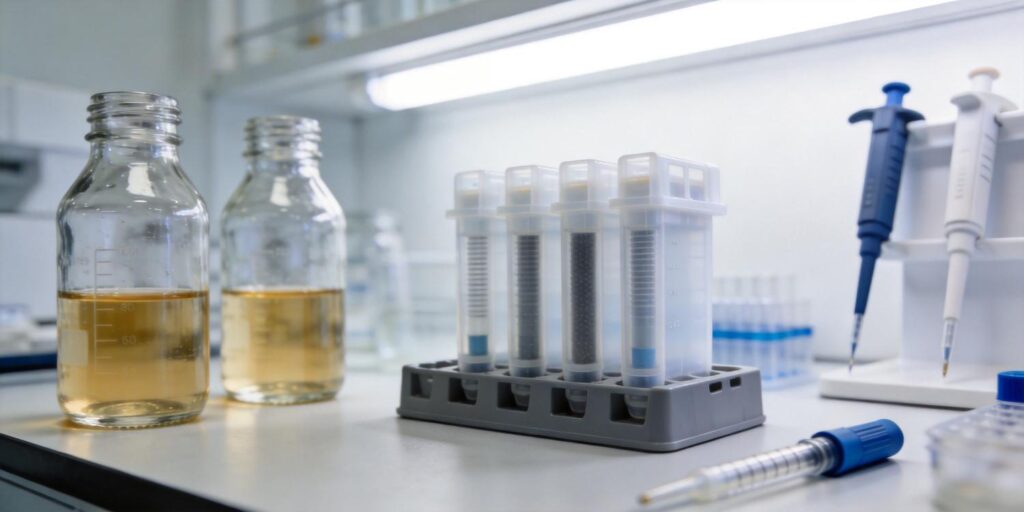
Choosing the right SPE sorbent is critical for maximizing lipid removal while retaining target analytes. For lipid-rich tissues, several sorbent chemistries are effective:
- Mixed-mode reversed-phase/weak anion exchange (WAX) or strong cation exchange (SCX): These resins can retain acidic or basic analytes while hydrophobic lipids pass through or are selectively washed. Poseidon Scientific’s WAX SPE cartridges and WCX SPE cartridges are designed for such applications.
- Zirconia-coated or hybrid silica sorbents: These provide Lewis acid-base interactions to bind phospholipids effectively. For example, hybrid SPE (e.g., HLB SPE cartridges) offers balanced retention and can be optimized for lipid removal.
- Specialized lipid removal phases: Some SPE products incorporate embedded filters or specific ligands that selectively trap lipids while allowing analytes to elute in a cleaner fraction.
For neutral or hydrophobic targets, a reversed-phase sorbent like C18 may be used, but careful washing with organic solvents is required to elute lipids prior to analyte elution. The table below summarizes common sorbents and their lipid removal characteristics:
| Sorbent Type | Lipid Removal Mechanism | Typical Application |
|---|---|---|
| HLB (hydrophilic-lipophilic balance) | Reversed-phase retention; phospholipids wash away | Broad-spectrum cleanup |
| MAX (mixed-mode anion exchange) | Anionic analytes retained; lipids washed | Acidic analytes |
| MCX (mixed-mode cation exchange) | Cationic analytes retained; lipids washed | Basic analytes |
| WAX (weak anion exchange) | Selective retention of strong acids | Phospholipid removal |
Conditioning and Loading Extracts
Proper conditioning of the SPE cartridge ensures reproducible sorbent wetting and analyte interactions. For most reversed-phase and mixed-mode sorbents, conditioning involves passing an organic solvent (e.g., methanol or acetonitrile) followed by an equilibration step with the loading solvent (typically water or buffer). For lipid-rich extracts, the loading solution should be adjusted to a low organic content (e.g., ≤10% MeOH) to promote analyte retention while minimizing early elution of lipids. The sample is loaded slowly (1–2 mL/min) to allow sufficient interaction time. For large volumes, a higher capacity cartridge such as Poseidon Scientific’s MAX SPE cartridges can handle up to several milliliters of extract without breakthrough.
Washing Steps Reducing Lipid Interference
A well-designed wash step is the cornerstone of lipid removal in SPE. After loading, a wash with a weak solvent mixture (e.g., 5% methanol in water) removes polar interferences while retaining analytes. To specifically remove lipids, a wash with a higher organic content (e.g., 40–60% methanol or acetonitrile) can elute neutral lipids without affecting charged analytes retained by ion exchange. Alternatively, a wash with 0.1% formic acid or ammonium hydroxide (depending on analyte charge) can displace protein-bound lipids. For phospholipid-rich matrices, a wash with 100% isopropanol has been reported to effectively remove phospholipids while retaining small molecule analytes on mixed-mode sorbents. It is advisable to test multiple wash compositions and volumes (typically 1–2 column volumes) to optimize the balance between lipid removal and analyte recovery.
Elution of Target Analytes
After washing, target analytes are eluted with a solvent that disrupts the retention mechanism. For reversed-phase sorbents, elution with 100% methanol or acetonitrile is common. For mixed-mode ion exchange, an organic solvent containing a volatile acid (e.g., 5% formic acid in methanol for cation exchange) or base (e.g., 5% ammonium hydroxide in methanol for anion exchange) is used. The elution volume is typically 1–2 column volumes, collected in a clean vial. The eluate can be evaporated to dryness under nitrogen and reconstituted in a mobile-phase-compatible solvent for LC-MS injection. For high-throughput workflows, Poseidon Scientific’s 96-well SPE plates enable parallel elution using vacuum manifold or positive pressure systems.
LC-MS Analysis Improvements
SPE cleanup of lipid-rich tissues directly translates to better LC-MS performance. Reduced lipid content minimizes ion suppression, leading to improved signal-to-noise ratios and lower limits of detection. Chromatographic peak shape sharpens as column loading of unwanted matrix components decreases. Additionally, fewer non-volatile lipids entering the ion source reduce source contamination, requiring less frequent cleaning and improving system robustness. Case studies show that SPE-processed brain tissue extracts (e.g., using MCX SPE cartridges) can achieve 50% without cleanup. Furthermore, the removal of phospholipids reduces the risk of carryover, enabling more reliable quantitation in pharmacokinetic and toxicological studies.
Method Reproducibility Considerations
To ensure method reproducibility, several factors must be standardized. First, tissue homogenization should be consistent—use a bead-beater or probe sonicator with defined time and power settings. Second, the SPE protocol should be validated across multiple cartridge lots to assess lot-to-lot variability. Poseidon Scientific provides certificates of analysis for each batch. Third, internal standards (e.g., isotopically labeled analogs) should be added at the homogenization step to correct for recovery variations. Fourth, the drying and reconstitution steps must be controlled (e.g., evaporate to dryness under a gentle nitrogen stream at 40°C). Finally, periodical monitoring of lipid removal efficiency using a phospholipid-specific LC-MS/MS transition (e.g., m/z 184 → 184 for phosphatidylcholines) can flag potential method drift. By following these guidelines, analysts can develop robust SPE methods for lipid-rich tissues that deliver consistent, high-quality data for LC-MS analysis.