Sources of Estrogenic Compounds in Water Systems
Endocrine-disrupting compounds (EDCs), particularly steroid hormones such as 17β-estradiol (E2), estrone (E1), and 17α-ethinylestradiol (EE2), enter surface waters through multiple pathways. Municipal wastewater treatment plant effluents are primary contributors, as conventional biological treatment fails to completely remove these micropollutants. Agricultural runoff from livestock operations adds natural hormones, while industrial discharges from pharmaceutical manufacturing introduce synthetic analogs. Incomplete removal leads to ng/L to μg/L concentrations in receiving waters, causing adverse effects on aquatic organisms—feminization of male fish and altered reproductive cycles being well-documented. Understanding these sources is critical for designing monitoring programs that protect ecosystem health and drinking water supplies.
Sampling and Filtration of Surface Water
Representative surface water sampling requires careful consideration of temporal and spatial variability. Grab samples are common, but composite sampling over 24 hours better captures fluctuating hormone levels. Use amber glass bottles (1 L) pre-cleaned with methanol and baked at 400 °C to prevent adsorption losses. Immediately upon collection, filter samples through 0.7 μm glass fiber filters (e.g., Whatman GF/F) to remove suspended solids. This step prevents clogging of the solid-phase extraction (SPE) cartridge and reduces matrix interferences. Acidification to pH 3 with sulfuric acid or formic acid is recommended for acidic analytes, but for neutral steroid hormones, maintaining native pH (typically 6–8) is acceptable. Store samples at 4 °C and process within 48 hours to minimize biodegradation.
HLB SPE Cartridge Selection for Steroid Hormones
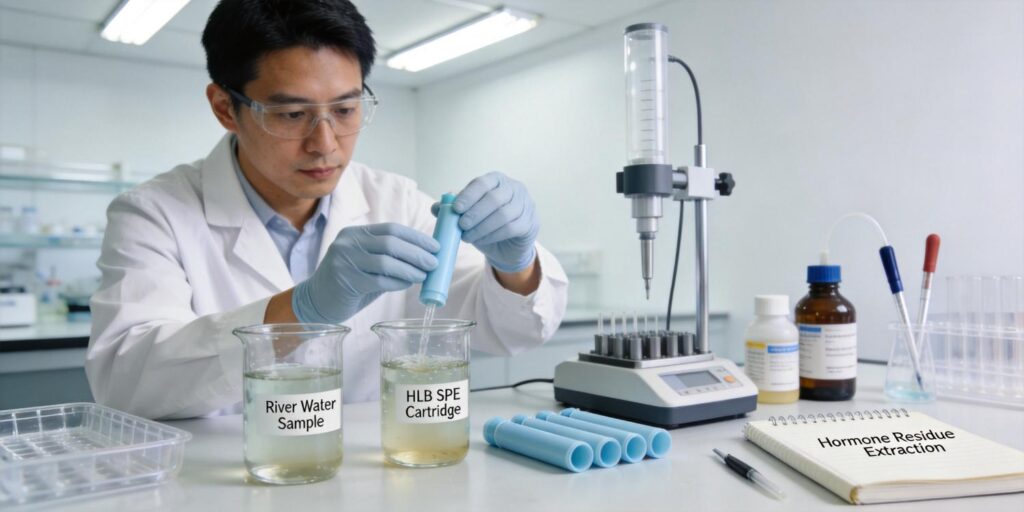
For trace-level hormone analysis, HLB (Hydrophilic-Lipophilic Balance) SPE cartridges are the industry standard. These water-wettable polymeric sorbents (e.g., Oasis HLB, or Poseidon HLB equivalents) provide broad-spectrum retention via reversed-phase and weak cation-exchange mechanisms. The 200 mg/6 mL format is ideal for 500–1000 mL surface water samples, offering sufficient capacity without excessive elution volumes. HLB sorbents tolerate pH extremes (pH 1–14) and resist drying out, making them robust for field applications. Compared to C18 silica, HLB provides higher recoveries for polar hormones like estriol (E3) and better batch-to-batch reproducibility. For laboratories seeking cost-effective alternatives, Poseidon Scientific’s HLB cartridges deliver equivalent performance at competitive pricing.
Conditioning and Loading Procedures
Proper conditioning is essential for reproducible retention. Sequentially pass 3 mL of methanol, 3 mL of deionized water, and 3 mL of sample-matched buffer through the cartridge at 1–2 mL/min. Avoid letting the sorbent dry between conditioning and loading. Load the filtered water sample at a flow rate of 5–10 mL/min using a vacuum manifold or positive pressure system (e.g., Phenomenex Extrahera). For volumes >500 mL, consider using a larger cartridge (500 mg/6 mL) or inline SPE systems. The breakthrough volume for steroid hormones on 200 mg HLB typically exceeds 1 L, but verify experimentally for each matrix. After loading, wash with 5 mL of 5% methanol in water to remove salts and polar interferents without eluting target analytes.
Washing Steps to Remove Dissolved Organic Carbon
Dissolved organic carbon (DOC) and humic substances from surface water can suppress ionization in LC-MS/MS and accumulate on the analytical column. A tailored wash step using 5 mL of 40% methanol in water effectively removes hydrophobic DOC while retaining steroid hormones. For samples with high DOC (e.g., >10 mg/L), a two-step wash—first 5% methanol/water, then 40% methanol/water—improves cleanup. Alternatively, a hexane wash (5 mL) can remove nonpolar lipids, though it may partially elute nonpolar hormones. Always collect and analyze wash fractions during method development to confirm target compounds remain on the cartridge. The goal is to achieve a balance between matrix removal and recovery >80% for all analytes.
Elution Solvents Optimized for Hormones
Methanol is the standard elution solvent for steroid hormones from HLB cartridges. Use 3 mL of methanol followed by 3 mL of 2% formic acid in methanol to ensure complete elution of both neutral and slightly acidic analytes. For higher recoveries of estrogens, some methods recommend 4 mL of acetone or acetonitrile. Collect eluate in 10 mL glass tubes and evaporate under nitrogen at 40 °C to near dryness. Reconstitute in 100–200 µL of 50:50 methanol:water containing 0.1% formic acid. Vortex and sonicate for 30 seconds, then centrifuge at 10,000 g for 10 minutes to remove particulates. The final extract represents a 1000–5000-fold concentration factor, achieving detection limits in the sub-ng/L range.
LC-MS/MS Detection Workflow
Separate hormones using a C18 reversed-phase column (2.1 mm × 100 mm, 1.7 μm) with a mobile phase gradient of water and methanol (both with 0.1% NH₄OH for enhanced ionization in negative mode). The following gradient is typical: 0–1 min, 30% B; 1–6 min, 30–90% B; 6–8 min, 90% B; 8–9 min, 90–30% B; 9–12 min, 30% B. Inject 10 µL of extract. Use electrospray ionization (ESI) in negative mode with multiple reaction monitoring (MRM). Common transitions: E1 (269→145), E2 (271→145), EE2 (295→145). The MAX SPE cartridges can serve as an alternative cleanup step if additional ion suppression occurs. Calibrate using matrix-matched standards from 0.1–100 ng/L. Add isotopically labeled internal standards (e.g., E2-d4) before extraction to correct for recovery losses.
Environmental Monitoring Implications
Reliable quantification of steroid hormones in surface water is essential for regulatory compliance (e.g., EU Water Framework Directive Watch List) and ecological risk assessment. The HLB SPE-LC-MS/MS method described achieves method detection limits (MDLs) of 0.05–0.5 ng/L, sufficient to detect estrogenic activity at levels known to cause biological effects. Regular monitoring programs using this workflow can identify pollution hotspots, evaluate wastewater treatment efficacy, and track the effectiveness of mitigation measures. For high-throughput monitoring, 96-well SPE plates offer parallel processing of multiple samples, reducing labor and solvent consumption. By adopting standardized protocols like this, environmental agencies and contract laboratories can generate comparable data, supporting global efforts to safeguard water quality.