Antibiotic Contamination Concerns in Honey Production
Honey is a natural product prized for its purity, yet veterinary antibiotic residues—primarily tetracyclines (TCs) and sulfonamides (SAs)—are frequently detected due to their use in beekeeping for controlling bacterial diseases like American foulbrood. These residues pose risks of allergic reactions, antibiotic resistance propagation, and regulatory non-compliance. Maximum residue limits (MRLs) set by the European Union (EU) and the U.S. Food and Drug Administration (FDA) are stringent, often below 50 μg/kg. Solid-phase extraction (SPE) combined with liquid chromatography-tandem mass spectrometry (LC-MS/MS) is the gold standard for achieving the necessary sensitivity and selectivity.
Sample Dilution and Extraction Strategies
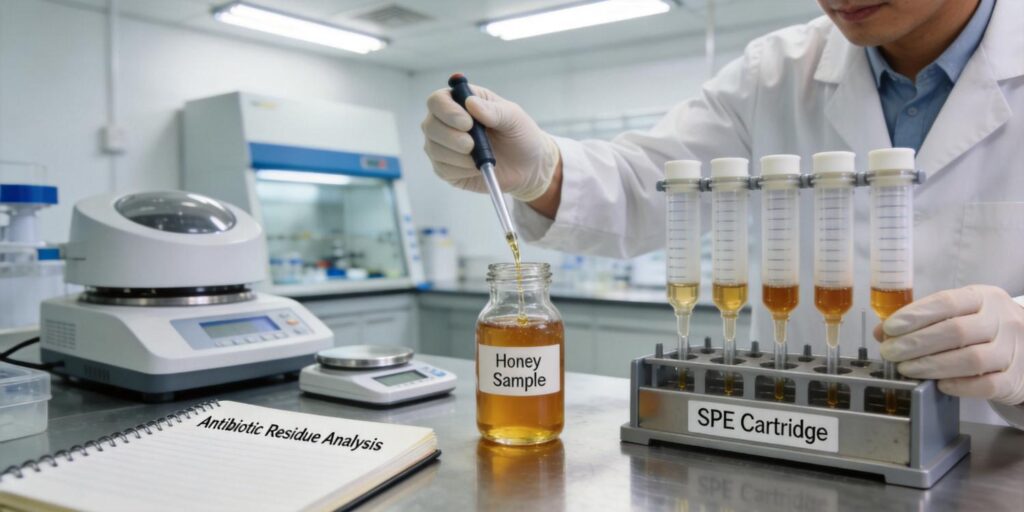
Honey’s high viscosity and sugar content (>70%) complicate direct extraction. A common approach involves diluting 2–5 g of honey with 10–20 mL of acidified water (pH 2–3) or McIlvaine buffer (citrate-phosphate, pH 4) containing EDTA (0.1 M) to chelate metal ions that reduce tetracycline recovery. The mixture is vortexed, sonicated for 10 minutes, and centrifuged at 4,000 rpm for 10 minutes to remove particulates. For sulfonamides, methanol:water (1:1, v/v) is sometimes used to enhance solubility. The supernatant is then subjected to SPE cleanup.
SPE Sorbent Selection for Tetracycline and Sulfonamide Antibiotics
HLB SPE cartridges (hydrophilic-lipophilic balanced, e.g., Waters Oasis HLB or equivalent) are widely recommended for multi-class antibiotic extraction due to their ability to retain both polar tetracyclines and moderately polar sulfonamides. Alternatively, MAX SPE cartridges (mixed-mode strong anion exchange) can selectively isolate acidic sulfonamides, while WCX SPE cartridges (weak cation exchange) may be used for tetracyclines at low pH. For broad-spectrum screening, HLB provides simplicity and robustness.
Conditioning and Loading Honey Extracts
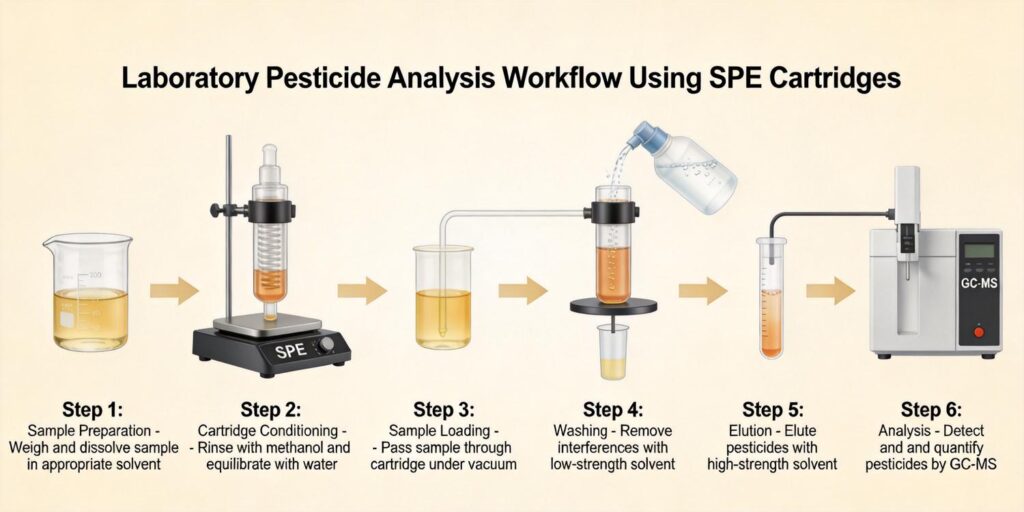
HLB cartridges (60 mg, 3 mL) are conditioned with 3 mL methanol followed by 3 mL water at a flow rate of 1 mL/min. The diluted honey extract is loaded at 0.5–1 mL/min to ensure efficient analyte retention. After loading, the cartridge is washed with 3 mL of 5% methanol in water to remove sugars and polar interferences without eluting the antibiotics. For MAX or WCX sorbents, additional pH adjustments during loading may be required (e.g., pH 7 for MAX to retain anions).
Washing Steps Removing Sugars
Sugars (glucose, fructose) can cause severe ion suppression in LC-MS/MS. A wash step with 2 mL of a mixture of water:methanol (95:5, v/v) containing 0.1% formic acid effectively removes sugars while retaining tetracyclines (pKa ~3–7) and sulfonamides (pKa ~5–6). For MAX cartridges, a wash with 2 mL of 5% ammonium hydroxide in water (pH 10) can be used to elute interferences while keeping sulfonamides retained via anion exchange. The cartridge is then dried under vacuum for 5 minutes.
Elution Solvent Combinations
Optimal elution of tetracyclines and sulfonamides from HLB is achieved with 2 × 2 mL of methanol:acetonitrile (1:1, v/v) containing 0.1% formic acid. For MAX, acidified methanol (2 mL of 2% formic acid in methanol) disrupts ion exchange, releasing sulfonamides. For WCX, basic methanol (2 mL of 5% ammonium hydroxide in methanol) elutes tetracyclines. The eluate is evaporated to dryness under nitrogen at 40°C and reconstituted in 200–500 μL of mobile phase (e.g., 0.1% formic acid in water:methanol, 95:5).
LC-MS/MS Quantification
Reversed-phase LC separation uses a C18 column (2.1 × 100 mm, 1.7 μm) with a gradient of 0.1% formic acid in water (A) and 0.1% formic acid in acetonitrile (B) at 0.3 mL/min. MS/MS detection operates in positive electrospray ionization (ESI+) mode with multiple reaction monitoring (MRM) transitions. Typical transitions: tetracycline (m/z 445 → 410), oxytetracycline (m/z 461 → 426), sulfamethazine (m/z 279 → 186), sulfadiazine (m/z 251 → 156). Quantification uses matrix-matched calibration curves (1–200 μg/L) with internal standards (e.g., demeclocycline for TCs, sulfamethoxazole-d4 for SAs).
Method Validation and Regulatory Considerations
Validation parameters include linearity (R² > 0.99), recovery (70–120% at three spiking levels), precision (RSD < 20%), limit of detection (LOD: 1–5 μg/kg), and limit of quantification (LOQ: 5–10 μg/kg). The method should comply with EU Commission Decision 2002/657/EC and FDA guidelines for confirmatory methods. 96-well SPE plates offer high-throughput advantages for laboratories processing large numbers of honey samples. Regular use of reference materials (e.g., FAPAS honey proficiency test) and inter-laboratory validation ensures method reliability. By optimizing SPE conditions, analysts can achieve robust, compliant detection of antibiotic residues in honey.