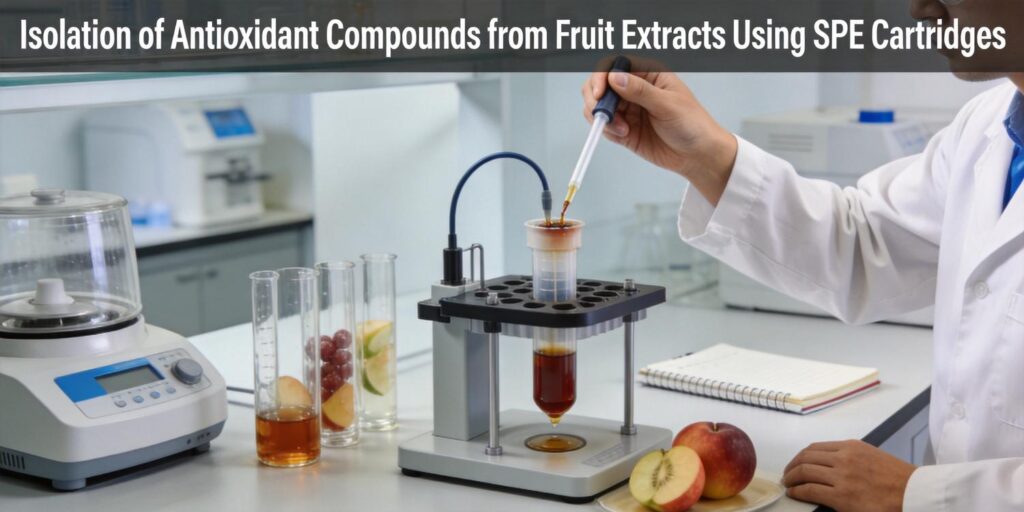
Why SPE Is the Gold Standard for Antioxidant Isolation from Fruit Extracts
Antioxidants such as polyphenols and flavonoids are critical for human health, offering protection against oxidative stress. However, isolating these compounds from complex fruit matrices remains challenging due to co-extraction of sugars, organic acids, and pigments. Solid-phase extraction (SPE) has emerged as the preferred technique for selective enrichment of these bioactive compounds prior to HPLC analysis. This guide provides a technical walkthrough of SPE protocols tailored for fruit antioxidants, with emphasis on sorbent selection, method optimization, and downstream analytical considerations.
1. Antioxidant Compounds in Fruits: Polyphenols and Flavonoids
Fruits are rich sources of antioxidant phytochemicals, notably phenolic acids (e.g., chlorogenic, caffeic, gallic), flavonoids (e.g., quercetin, kaempferol, anthocyanins), and tannins. These compounds vary widely in polarity, acidity, and molecular weight, which directly impacts their retention on SPE sorbents. For instance, anthocyanins are highly polar and pH-sensitive, while flavonoid aglycones exhibit moderate hydrophobicity. Understanding the chemical diversity of the target analytes is essential for choosing the right SPE chemistry and optimizing recovery.
2. Extraction Using Aqueous Organic Solvents
Prior to SPE, antioxidants must be liberated from fruit tissue. Typical extraction protocols employ aqueous mixtures of methanol, ethanol, or acetone, often acidified with HCl or formic acid (0.1–1% v/v) to stabilize anthocyanins and prevent oxidation. For example, HLB SPE cartridges are well-suited for loading such hydroalcoholic extracts due to their balanced hydrophilic-lipophilic retention. The extract should be filtered (0.45 μm) and, if necessary, diluted with water to reduce organic solvent content below 10% to ensure optimal analyte retention during SPE.
3. SPE Sorbent Selection for Antioxidant Enrichment
Selecting the appropriate SPE sorbent is pivotal. For broad-spectrum isolation of polyphenols and flavonoids, reversed-phase sorbents such as C18 or polymeric HLB are most common. However, mixed-mode sorbents offer superior selectivity when targeting specific subclasses. For instance:
- MAX (Mixed-Mode Anion Exchange): Ideal for acidic polyphenols (e.g., phenolic acids) that carry negative charge at alkaline pH.
- MCX (Mixed-Mode Cation Exchange): Retains basic flavonoids (e.g., some alkaloids) while allowing acidic interferences to pass.
- WAX (Weak Anion Exchange): Suitable for very weak acids like certain flavonoid glycosides.
- WCX (Weak Cation Exchange): Selectively binds basic compounds without strong ionic interactions.
For comprehensive metabolomics-style profiling, 96-well SPE plates offer high-throughput parallel processing.
4. Conditioning and Loading Extracts
Proper conditioning activates the sorbent bed. For reversed-phase HLB or C18 cartridges, sequentially apply 1–2 bed volumes of methanol followed by water or loading buffer. Avoid drying the bed between conditioning and loading. Load the filtered fruit extract at a flow rate of 1–2 mL/min. For mixed-mode sorbents, the loading pH must be adjusted to ensure analytes are in the desired ionization state. For example, load acidic polyphenols onto MAX at pH 8–9, and basic flavonoids onto MCX at pH 3–4.
5. Washing Steps Removing Sugars and Acids
After loading, wash the cartridge with 5% methanol in water (or 0.1% formic acid in water for mixed-mode) to elute polar interferences such as sugars, organic acids, and amino acids. A second wash with a higher organic content (e.g., 10–20% methanol) can remove moderately polar pigments without eluting target antioxidants. The wash volume should be 2–3 bed volumes. Monitor the wash effluent visually; colored wash indicates pigment loss that may require optimization.
6. Elution Solvents for Antioxidant Compounds
Elution of retained antioxidants is typically achieved with methanol, acetonitrile, or acidified organic solvents. For reversed-phase sorbents, a step gradient (e.g., 50%, 70%, then 100% methanol) fractionates compounds by polarity. For mixed-mode sorbents, elution requires both organic solvent and pH adjustment:
- MAX: Elute with 5% formic acid in methanol (acidic mobile phase neutralizes anion exchange).
- MCX: Elute with 5% ammonium hydroxide in methanol (basic mobile phase neutralizes cation exchange).
- WAX/WCX: Use appropriate ionic strength and pH shifts (e.g., 1 M formic acid for WAX; 1 M ammonium acetate for WCX).
Collect 1–2 bed volumes, then evaporate under nitrogen and reconstitute in HPLC-compatible solvent.
7. HPLC Analysis
Reversed-phase HPLC with C18 columns (e.g., 250 × 4.6 mm, 5 μm) coupled to diode array detection (DAD) at 280 nm (phenolic acids), 320 nm (flavonols), 360 nm (flavones), and 520 nm (anthocyanins) is standard. Use a gradient of 0.1% phosphoric acid in water (A) and acetonitrile (B) at 1 mL/min. Injection volume of 10–20 μL. Quantification using external calibration with reference standards yields high accuracy. Recoveries typically range 85–105% for most polyphenols.
8. Application in Food Chemistry Research
SPE-HPLC workflows for fruit antioxidants are widely applied in:
- Quality control: Monitoring bioactive markers in juices, wines, and extracts.
- Bioaccessibility studies: Simulating gastrointestinal digestion followed by SPE cleanup.
- Metabolomics: Untargeted profiling of fruit cultivars or processing effects.
The flexibility of sorbent chemistries, especially from Poseidon Scientific’s SPE portfolio, allows researchers to tailor methods for specific analyte classes, from polar anthocyanins to hydrophobic flavonoid aglycones.
Summary Table: Recommended Sorbents for Common Fruit Antioxidants
| Compound Class | Example | Recommended Sorbent |
|---|---|---|
| Phenolic acids | Chlorogenic acid, caffeic acid | MAX or HLB |
| Flavonol glycosides | Quercetin-3-O-glucoside | HLB or WAX |
| Anthocyanins | Cyanidin-3-O-glucoside | HLB (acidic loading) |
| Flavonoid aglycones | Quercetin, kaempferol | C18 or HLB |
For further technical support or to request samples, visit Poseidon Scientific’s 96-well SPE plate page or explore our full line of cartridges.