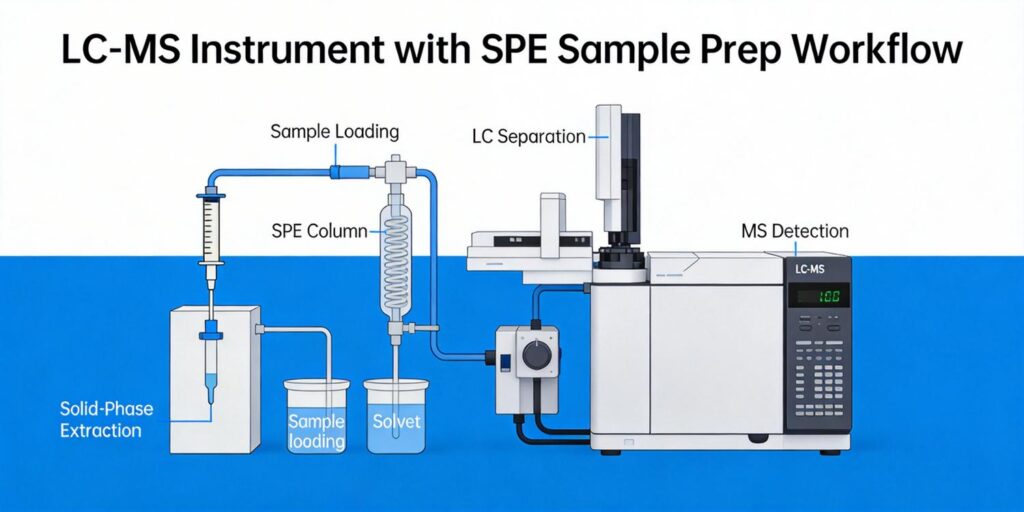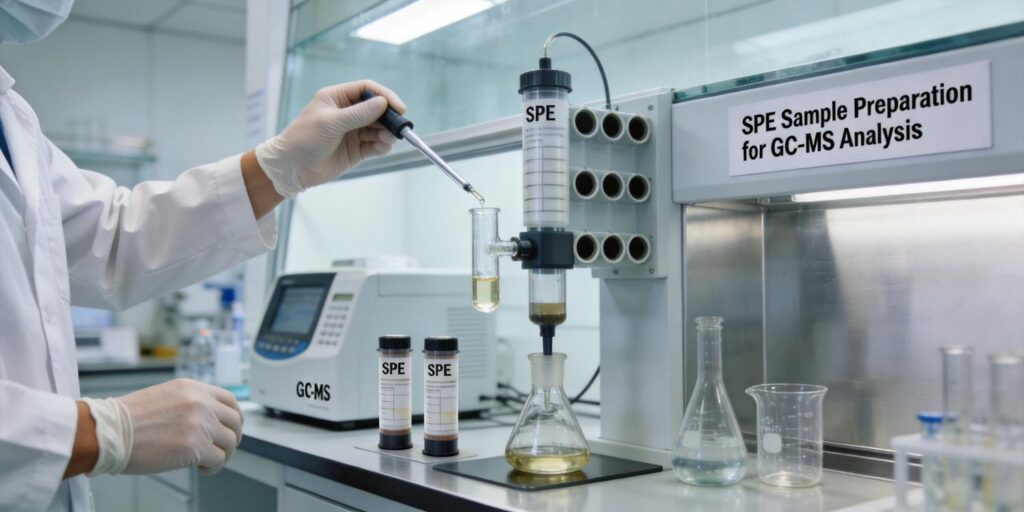
Overview of GC-MS in Environmental Pollutant Analysis
Gas chromatography-mass spectrometry (GC-MS) is a cornerstone technique for detecting and quantifying organic pollutants in environmental matrices. Its high sensitivity, selectivity, and ability to separate complex mixtures make it ideal for analyzing trace-level contaminants in soil, water, and air. Common target analytes include polycyclic aromatic hydrocarbons (PAHs), polychlorinated biphenyls (PCBs), organochlorine pesticides (OCPs), phthalates, and emerging contaminants like per- and polyfluoroalkyl substances (PFAS). Proper sample preparation is critical to achieve reliable results, and solid-phase extraction (SPE) has become the preferred method due to its efficiency, reproducibility, and solvent economy.
Extraction of Soil and Water Samples
Before SPE, environmental samples must be prepared appropriately. For water samples, filtration (0.45 µm) removes suspended solids that could clog the cartridge. Acidification or pH adjustment may be needed to stabilize analytes (e.g., acidic herbicides). For soil or sediment samples, air-drying, grinding, and sieving (typically <2 mm) ensure homogeneity. Soxhlet extraction, pressurized liquid extraction (PLE), or ultrasound-assisted extraction with organic solvents (e.g., hexane/acetone) is commonly used. The resulting extract is then concentrated and solvent-exchanged to a water-miscible phase (e.g., methanol) before SPE loading.
SPE Cartridge Selection for Hydrophobic Compounds
Choosing the right sorbent is key. For nonpolar to moderately polar pollutants like PAHs, PCBs, and OCPs, reversed-phase sorbents such as HLB (hydrophilic-lipophilic balanced) or MAX (mixed-mode anion exchange) cartridges offer excellent retention. HLB sorbents provide high surface area and dual retention mechanisms, making them suitable for a wide polarity range. For acidic or basic analytes, ion-exchange cartridges like MCX (mixed-mode cation exchange) or WAX (weak anion exchange) can be used. High-throughput applications may benefit from 96-well SPE plates.
Conditioning and Loading Extracts
Conditioning of the SPE cartridge ensures reproducible retention. Typically, the sorbent is wetted with methanol or acetonitrile, followed by water or buffer. For reversed-phase SPE, the cartridge should not be allowed to dry after conditioning. The aqueous sample or solvent-exchanged extract is then loaded at a controlled flow rate (1–5 mL/min) to allow sufficient contact time. The analytes are retained, while polar interferences pass through.
Washing Steps Reducing Matrix Interference
After sample loading, a washing step removes undesired matrix components. For reversed-phase SPE, a water or 5% methanol solution can elute salts and polar organic compounds. For mixed-mode sorbents, a pH-adjusted wash (e.g., 2% formic acid for MCX) removes neutral interferences while retaining ionized analytes. This step is critical for reducing matrix effects in GC-MS, such as ion suppression or enhancement.
Elution Solvents Compatible with GC-MS
Elution solvents must be compatible with GC-MS and provide quantitative recovery. Typical eluents include ethyl acetate, acetone, hexane, or dichloromethane, often used in mixtures. For reversed-phase SPE, 1–2 mL of ethyl acetate or hexane/ethyl acetate (1:1) is common. For mixed-mode sorbents, a basic (e.g., 5% NH₄OH in methanol) or acidic (e.g., 2% formic acid in methanol) elution may be required. The eluate should be evaporated or concentrated under a gentle nitrogen stream to ~100–500 µL before injection.
Concentration and Injection Steps
After elution, the extract is often concentrated by evaporation under nitrogen to increase sensitivity. Care must be taken to avoid loss of volatile analytes; a keeper solvent (e.g., toluene) may be added. The final extract is transferred to a GC vial and, if necessary, derivatized (e.g., silylation for phenols). Injection is typically performed in splitless mode (1–2 µL) to maximize signal. Internal standards (e.g., deuterated PAHs) should be added before injection to correct for instrument variability.
Method Validation Parameters
Validating the SPE-GC-MS method ensures its fitness for purpose. Key parameters include:
- Linearity: Calibration curves (e.g., 0.5–100 ng/mL) must have R² > 0.99.
- Accuracy and precision: Recoveries at three spiking levels should be 80–120% with RSD < 20%.
- Limit of detection (LOD) and quantification (LOQ): Typically based on signal-to-noise ratios of 3 and 10, respectively.
- Matrix effects: Assessed by comparing slopes of matrix-matched and solvent-only calibrations.
- Selectivity: No interfering peaks at retention times of target analytes.
Regular use of quality control samples (blanks, duplicates, and spiked matrix) ensures ongoing method robustness.
For reliable and reproducible SPE cartridges and plates, explore the range at Poseidon Scientific.