Purpose of the Washing Stage in SPE
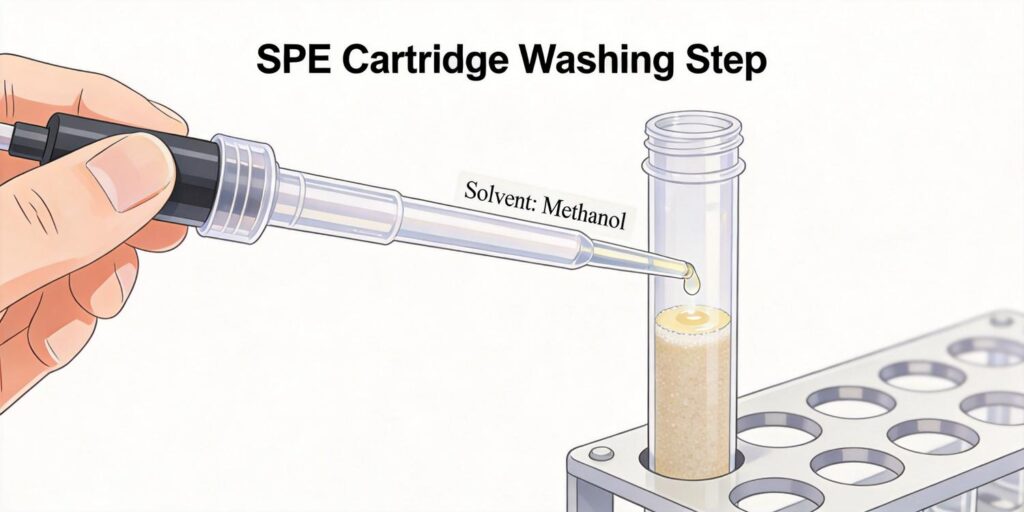
The washing stage in solid-phase extraction (SPE) serves as a critical purification step designed to remove matrix interferences while retaining target analytes on the sorbent bed. As described in fundamental SPE literature, this step follows sample loading and precedes analyte elution, forming the core of the “digital chromatography” process where unwanted components are selectively eliminated.
According to established SPE principles, the washing step “removes excess sample matrix and unretained compounds” while ensuring that “weakly retained materials are washed off using solutions that are stronger than the sample matrix, but weaker than needed to remove compounds of interest.” This delicate balance allows for the removal of interfering impurities that could otherwise compromise analytical accuracy and instrument performance.
The importance of effective washing cannot be overstated. As noted in forensic applications, “interferences are defined as components from your sample that inhibit the ability to accurately quantitate the component(s) of interest.” Proper washing minimizes these interferences prior to further method optimization, enabling accurate analyte quantitation that would otherwise be impossible due to matrix effects.
Mechanisms of Interference Removal
During the washing stage, several mechanisms operate simultaneously:
- Displacement washing: Weakly bound matrix components are displaced by wash solvent molecules
- Solubilization: Interfering compounds are dissolved in wash solvents where they have higher solubility than target analytes
- Selective retention: Target analytes remain bound through stronger interactions with the sorbent phase
- Pore cleaning: Unwanted material is removed from pores and interstices of the packed bed
As described in SPE theory, “the wash solvent also acts in some respects as a displacer” that removes weakly bound components while preserving strongly retained analytes of interest.
Selecting Wash Solvents: A Strategic Approach
Choosing appropriate wash solvents represents one of the most critical decisions in SPE method development. The ideal wash solvent should possess sufficient strength to remove interfering compounds while being weak enough to retain target analytes. This selection process requires careful consideration of several factors.
Key Selection Criteria
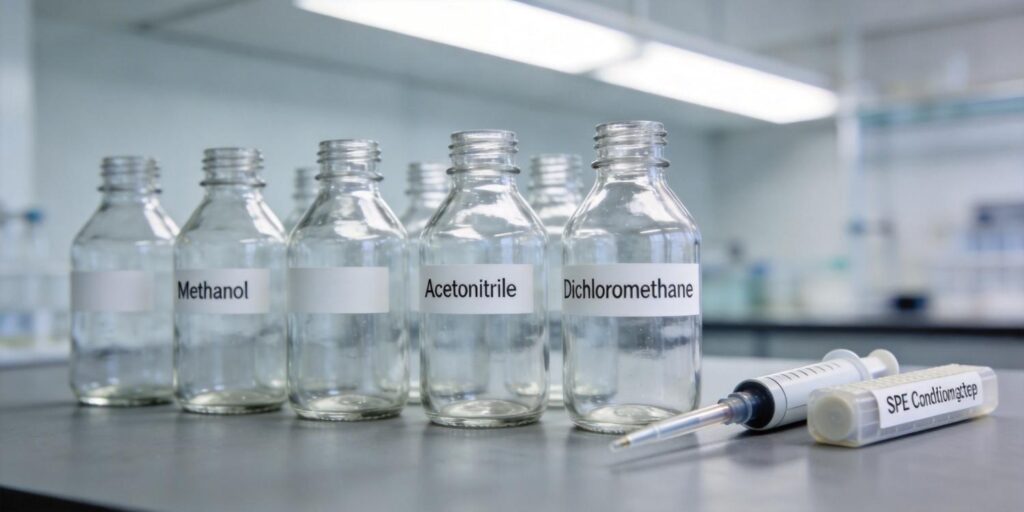
1. Solvent Strength Relative to Analyte Retention: The wash solvent must be weaker than the elution solvent but stronger than the sample matrix. For reversed-phase SPE, this typically involves water-miscible organic solvents like methanol or acetonitrile in aqueous mixtures.
2. Analyte Insolubility: As noted in method development guidelines, “if the analyte is completely insoluble in a solvent, then that solvent should be tested as a wash solvent if improved clean-up is required.” This principle provides a safe starting point for wash solvent selection.
3. Matrix Compatibility: The wash solvent must be compatible with both the sorbent chemistry and the sample matrix. For biological samples like plasma, “the first wash must be aqueous to remove plasma proteins,” followed by organic washes if needed.
Common Wash Solvent Systems
| SPE Mode | Typical Wash Solvents | Purpose |
|---|---|---|
| Reversed-Phase | Water, 5-20% methanol/water, 5-20% acetonitrile/water | Remove polar interferences |
| Normal Phase | Hexane, hexane-dichloromethane mixtures, toluene | Remove non-polar interferences |
| Mixed-Mode | Water, methanol/water with pH modifiers, acetonitrile | Remove both polar and ionic interferences |
| Ion Exchange | Water, buffer solutions, water-miscible organic solvents | Remove neutral and weakly retained ionic compounds |
Systematic Optimization Approach
Method development literature recommends a systematic approach to wash solvent optimization: “For a simple non-polar extraction, the composition of the washing solvent should first be varied using increasing concentrations of methanol or acetonitrile in water. Typically the wash solvent methanol composition is increased in steps of 10% from 100% water through to 100% methanol.”
This gradient approach allows researchers to identify the strongest wash solvent that doesn’t significantly elute target analytes, maximizing interference removal while maintaining recovery.
Balancing Selectivity vs Recovery: The Critical Trade-off
The fundamental challenge in SPE washing optimization lies in balancing selectivity (cleanliness) against recovery (analyte yield). As noted in forensic applications, “there is an optimal balance between sensitivity (recovery) and selectivity or cleanliness of the end product.”
The Recovery-Selectivity Relationship
Recovery represents a relative asset to overall extraction performance. In an optimized method, “recovery is a balance between sensitivity and selectivity. Chromatographic signal-to-noise ratio (S/N) and resolution of interfering substances are paramount to absolute recovery.”
This relationship has practical implications: “If acceptable limits of detection are achieved (with no interfering compounds) at only 30% recovery, then a higher recovery may not be necessary. In fact, a higher target analyte recovery may also increase interferences and noise.”
Practical Optimization Strategies
1. Wash Volume Optimization: “Rinse volumes that are too small may not wash the SPE cartridge adequately and may lead to interferences in the elution. If interferences are detected, increase the rinse volume or increase the wash solvent strength.”
2. Flow Rate Considerations: “If the rinse flow rate is too fast, interferences may not be adequately removed. Diffusion between the packing material and the rinse reagent may be enhanced at slower flow rates.”
3. Sequential Washing: Multiple wash steps with different solvents can provide enhanced selectivity. For example, an aqueous wash followed by a weak organic wash can remove different classes of interferences.
Evaluating the Trade-off
When optimizing washing conditions, evaluate method performance based on the optimal recovery needed to sustain required signal-to-noise ratios, not on absolute percent recovery. As one expert notes, “The goal is to get the highest recovery in as few steps as possible,” but this must be balanced against extract cleanliness requirements.
Example Protocols: Practical Applications
Protocol 1: Reversed-Phase SPE for Pharmaceutical Analysis
Application: Extraction of drug compounds from plasma samples
Washing Procedure:
- After sample loading, wash with 2 mL of water to remove plasma proteins and salts
- Follow with 1 mL of 5% methanol in water to remove polar interferences
- Optional: Wash with 0.5 mL of pure acetonitrile for persistent interferences (if analyte is insoluble in acetonitrile)
Rationale: This sequential approach removes progressively less polar interferences while maintaining drug retention on C18 sorbent.
Protocol 2: Normal Phase SPE for Lipid Analysis
Application: Clean-up of lipid extracts from food matrices
Washing Procedure:
- After loading sample in hexane, wash with 2 mL of n-hexane-dichloromethane (7:3, v/v)
- Follow with 1 mL of pure hexane to remove residual dichloromethane
Rationale: The hexane-dichloromethane mixture removes moderately polar interferences while retaining target lipids on silica or diol phases.
Protocol 3: Mixed-Mode SPE for Forensic Applications
Application: Extraction of basic drugs from urine
Washing Procedure:
- Wash with 3 mL of water to remove unretained compounds
- Wash with 3 mL of 0.1 M sodium acetate (pH 4.5) to remove acidic interferences
- Wash with 3 mL of methanol to remove neutral organic compounds
Rationale: This multi-step washing leverages both reversed-phase and ion-exchange mechanisms to achieve high selectivity for basic drugs on mixed-mode sorbents like MCX.
Protocol 4: Environmental Sample Clean-up
Application: Extraction of pesticides from water samples
Washing Procedure:
- After loading, wash with 3 mL of 50:50 acetonitrile/deionized water
- Dry cartridge by centrifugation (1000-1500 rpm for 5 minutes) to remove excess water
Rationale: The acetonitrile/water mixture removes moderately polar matrix components while maintaining pesticide retention. Drying prevents dilution of the elution solvent.
Advanced Considerations and Troubleshooting
Persistent Interferences
When standard washing procedures fail to remove persistent interferences, consider these advanced strategies:
- Test pure acetonitrile as washing solution: “If the analyte is completely insoluble in a solvent, then that solvent should be tested as a wash solvent if improved clean-up is required.”
- Investigate alternative sorbents: Different manufacturers or functionalities may provide better selectivity
- Consider mixed-mode sorbents: These provide orthogonal retention mechanisms for enhanced selectivity
- Optimize wash solvent pH: For ionizable compounds, pH adjustment can dramatically affect interference removal
Common Washing Problems and Solutions
| Problem | Possible Causes | Solutions |
|---|---|---|
| Low recovery after washing | Wash solvent too strong | Decrease organic content, test weaker solvents |
| Persistent interferences | Insufficient wash volume or strength | Increase volume, test stronger solvents, add sequential washes |
| Inconsistent results | Variable flow rates | Standardize flow rates, use controlled vacuum/pressure |
| Carryover between samples | Inadequate fluid path cleaning | Implement proper cleaning protocols between samples |
Conclusion
The washing stage in SPE represents a critical optimization point where matrix interferences are selectively removed while target analytes are retained. Successful implementation requires careful consideration of wash solvent selection, balancing the competing demands of selectivity and recovery, and systematic optimization based on specific analyte-matrix combinations.
By understanding the fundamental principles outlined here and applying the systematic approaches to method development, researchers can achieve the clean extracts necessary for accurate analytical results across diverse applications from pharmaceutical analysis to environmental monitoring and forensic investigations.
For those seeking optimized SPE solutions, Poseidon Scientific offers a comprehensive range of HLB SPE cartridges, MAX SPE cartridges, MCX SPE cartridges, WAX SPE cartridges, WCX SPE cartridges, and 96-well SPE plates designed to meet diverse sample preparation needs.