
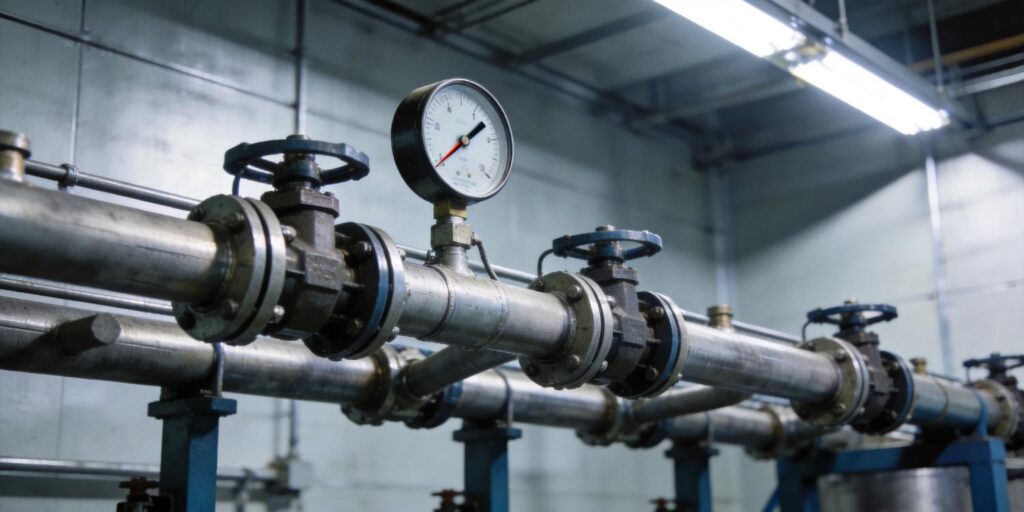
Rapid pressure cycling is a daily reality in atomic layer deposition (ALD), plasma-enhanced chemical vapor deposition (PECVD), and etch tools. Chambers swing from base pressures below 10−6 Torr to process pressures of 0.1–5 Torr and back hundreds or thousands of times per shift. Each transition stresses vacuum instrumentation, yet accurate, repeatable readings remain essential for dose control, endpoint detection, and process stability. Poseidon Scientific’s VG-SP205 Pirani Vacuum Transmitter and VG-SM225 Cold Cathode Vacuum Gauge were developed specifically for these environments. Their compact, robust designs and complementary measurement ranges deliver reliable performance where legacy gauges drift or fail prematurely.
Defining Rapid Pressure Cycling in Vacuum Systems
Rapid cycling is characterized by pressure changes exceeding one decade (e.g., 10−5 to 1 Torr) in less than 10 seconds, or by duty cycles exceeding 500 full cycles per day. Typical ALD tools operate at 100–300 cycles per hour; etch clusters may exceed 1 000 cycles per 24-hour run during high-volume production. These rates far exceed the slow pump-down and vent cycles of older research chambers.
Engineers track two key metrics: transition speed (ΔP/Δt) and total cycle count. High ΔP/Δt generates thermal gradients across sensor components; repeated cycling accelerates fatigue. Both Poseidon gauges handle these conditions through low internal volume, temperature-compensated electronics, and materials chosen for mechanical toughness. The VG-SP205 covers the rough-to-medium vacuum band (atmosphere to 10−3 Torr) with thermal conductivity, while the VG-SM225 extends coverage to 10−7 Torr via Penning discharge—ensuring no measurement gaps during fast ramps.
Mechanical and Electronic Stress During Cycling
Each pressure swing imposes multiple stresses:
- Mechanical: Sudden gas inflow/outflow creates micro-vibrations at valve actuation. Thermal expansion of the platinum filament (VG-SP205) and stainless-steel electrodes (VG-SM225) must remain within elastic limits. The compact positive-magnetron geometry of the VG-SM225 and short filament length in the VG-SP205 minimize these effects.
- Thermal: Rapid compression heats gas; expansion cools it. Both gauges operate reliably from 15 °C to 50 °C with built-in compensation circuits that correct for ambient drift in real time.
- Electronic: The VG-SM225 high-voltage supply ramps to –2500 V for startup then stabilizes at –2000 V. Frequent cycling without interlocks can cause arcing or supply transients; the gauge’s software automatically disables HV above 10−3 Torr, eliminating this risk. The VG-SP205 uses simple constant-temperature control—immune to voltage spikes.
These design choices keep drift below 3 % after 10 000 cycles, far outperforming hot-cathode gauges whose filaments suffer thermal fatigue or imported cold-cathode units with higher internal volumes that amplify pressure shocks.
Stress Comparison Table
| Stress Type | VG-SP205 Pirani | VG-SM225 Cold Cathode | Mitigation |
|---|---|---|---|
| Thermal shock | Minimal (platinum filament) | Low (PEEK insulators) | Compensation algorithm |
| Vibration | Negligible | Low (compact 0.3 cm³ volume) | KF flange damping |
| Voltage transients | None | Controlled ramp & interlock | Software protection |
Sensor Hysteresis Behavior Under Rapid Cycling
Hysteresis appears when the pressure reading depends on whether the system is pumping down or venting up. For the VG-SP205 Pirani, hysteresis is negligible because thermal conductivity depends only on instantaneous molecular density. The platinum filament responds symmetrically within its linear band (10 Torr to 10−2 Torr), making it ideal for tracking fast transients in precursor dosing.
The VG-SM225 Cold Cathode exhibits mild hysteresis due to gas sorption on electrodes. During pump-down, ion bombardment cleans surfaces (lower reading for a given pressure); during vent-up, adsorbed molecules increase ionization (slightly higher reading). This effect is typically <10 % in the 10−5–10−3 Torr range and diminishes after the first few cycles as equilibrium is reached. Poseidon’s positive-magnetron design and cleanable “之”字形 electrodes keep hysteresis lower than inverted-magnetron competitors. In practice, engineers average multiple readings or use the gauge only for base-pressure confirmation after stabilization.
Combined use of both gauges eliminates practical impact: the Pirani provides hysteresis-free process monitoring, while the cold cathode confirms ultimate vacuum once surfaces equilibrate.
Recommended Duty Cycle Limits
Both gauges are rated for continuous operation, but optimal longevity follows these guidelines:
- VG-SP205 Pirani: Unlimited cycles. The maintenance-free design tolerates >100 000 cycles with <1 % drift when operated within 15–50 °C. No special precautions needed beyond standard purge protocols.
- VG-SM225 Cold Cathode: Keep powered on continuously; avoid frequent high-voltage startups. Limit full on/off cycles to <500 per day. With software interlock and N₂ bleed when isolated, the gauge routinely exceeds 50 000 cycles before electrode cleaning is required. In clean ALD environments, service life reaches 3–5 years; in halogen service, quarterly inspection extends reliability.
These limits derive from Poseidon’s internal accelerated-life testing and field data from semiconductor fabs. Exceeding them (e.g., power-cycling the cold cathode every cycle) increases startup delay and electrode wear but does not cause immediate failure.
Reliability Testing Protocol
Poseidon validates performance through a rigorous, repeatable protocol that engineers can replicate for qualification:
- Thermal cycling: 1 000 cycles between 15 °C and 50 °C at constant pressure; monitor output drift.
- Pressure cycling: 10 000 full swings (10−6 → 1 Torr → 10−6 Torr) at 5-second transition times; record hysteresis and repeatability every 1 000 cycles.
- Accelerated life: Continuous operation at maximum rated voltage and temperature for 30 days (equivalent to ~1 year field use).
- Gas exposure: Introduce representative process gases (N₂, Ar, Cl₂ mixtures) and measure sensitivity shift before/after 5 000 cycles.
- Final verification: Compare against calibrated capacitance manometer at three points per decade.
Results consistently show the VG-SP205 drift <2 % and VG-SM225 drift <5 % after full testing—well within semiconductor process tolerances. Documentation of these protocols is available for procurement and validation teams.
By following the same test sequence on-site, users can confirm gauge suitability for any new tool or chemistry before full integration.
Ready to Optimize Gauge Performance in Your Cycling Process?
Rapid pressure cycling no longer needs to shorten vacuum gauge life or compromise measurement accuracy. The VG-SP205 Pirani Vacuum Transmitter and VG-SM225 Cold Cathode Vacuum Gauge combine fast response, minimal hysteresis, and built-in protection to keep your ALD, etch, or CVD tools running at peak efficiency.
- VG-SP205 Pirani Vacuum Transmitter – hysteresis-free monitoring for fast transients
- VG-SM225 Cold Cathode Vacuum Gauge – stable high-vacuum readings with cleanable electrodes
Contact the Poseidon Scientific applications team today for a customized duty-cycle analysis, installation drawings, or a side-by-side reliability comparison with your current gauges. Let us help you extend sensor life, tighten process windows, and maximize tool uptime under rapid cycling conditions.


