Purpose of Cartridge Conditioning
Cartridge conditioning serves multiple critical functions in solid-phase extraction (SPE) protocols. As a product manager at Poseidon Scientific, I’ve observed that proper conditioning is the foundation of successful SPE applications, whether using our HLB, MAX, MCX, WAX, WCX, or 96-well plate formats.
First and foremost, conditioning activates the sorbent functional groups. SPE cartridges are shipped dry for stability and packaging reasons, and a suitable wetting agent must be applied to expand functional binding sites away from the solid surface. This exposure allows for effective interaction with sample analytes during the loading phase. According to forensic extraction literature, characteristics of an ideal conditioning solvent include:
- Miscibility with aqueous matrices (sample and buffers)
- Easy diffusion into sorbent pores (low surface tension)
- High mass transfer of hydrocarbon bonds with sorbent alkyl chains
- Universal elution of polar and nonpolar contaminants on sorbent
Methanol is frequently used in reversed-phase procedures because it meets all these conditions. The conditioning process facilitates extension of functional carbon chains, creating a receptive stationary phase on the silica or resin backbone.
Secondly, conditioning chemically prepares the sorbent environment to allow optimal contact and binding of the sample. Proper pH and ionic strength are important parameters that facilitate mass transfer between the matrix and sorbent. For reversed-phase sorbents, which are effective for extracting compounds from aqueous matrices, they favor retention of “like” hydrocarbon moieties while repelling the polar matrix itself.
A third function is removing dust, fines, and residual polymer impurities from the sorbent. Physical abrasion of silica particles during shipping and storage creates microparticulates and additional silanol binding sites. Methanol (or another polar organic solvent) washes away most impurities and, to a small degree, blocks silanols.
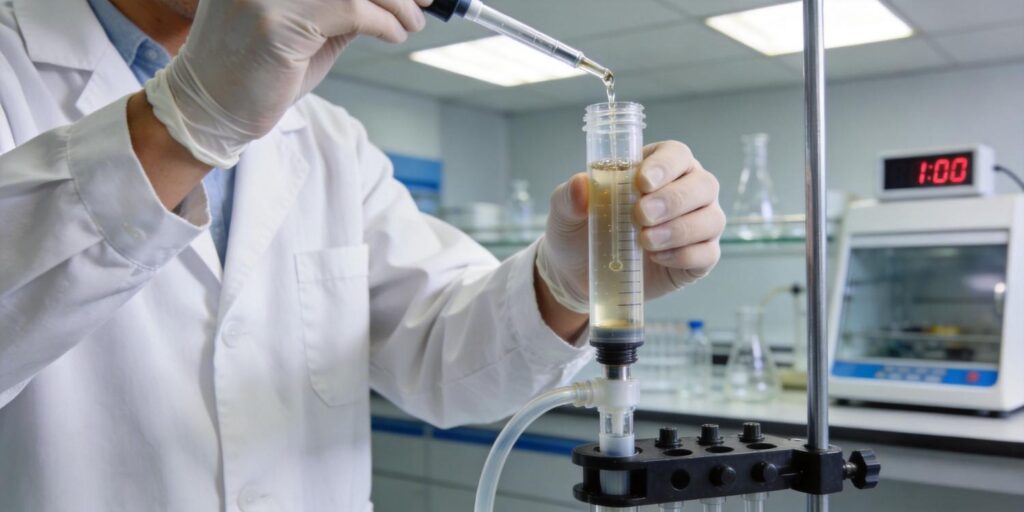
Perhaps most importantly, conditioning ensures the cartridge must not become dry before sample application. As documented in SPE protocols for biological samples, allowing the cartridge to dry out between conditioning and sample loading can destroy the conditioned state of the sorbent bed, leading to poor analyte recovery and reproducibility.
Solvent Sequence Examples
The specific solvent sequence for conditioning depends on the SPE mode and application. Here are several well-documented examples from the literature:
Reversed-Phase SPE for Biological Fluids
For mixed-mode SPE cartridges used in drug screening from plasma and urine, the conditioning protocol typically involves:
- 2 mL methanol – to wet the surface and penetrate bonded alkyl phases
- 2 mL phosphate buffer (0.1 mol/L, pH 6.0) – preferably potassium phosphate
This sequence is followed by sample application, where the cartridge must not become dry before the sample is loaded. The flow rate is typically maintained at 2 mL per minute under light vacuum (2″ Hg).
Environmental Analysis for PAHs
For extraction of polycyclic aromatic hydrocarbons (PAHs) from water using AccuBOND II ODS cartridges:
- 5 mL methylene chloride – prewash to remove contaminants
- 5 mL methanol – conditioning solvent
- 5 mL deionized water – equilibration
- Add ~1 mL deionized water to top of bed – to prevent drying
Drugs of Abuse Testing
For opiate extraction from urine using mixed-mode cartridges:
- 6 mL methanol
- 6 mL 0.1 M K₂HPO₄ (pH 6.0)
All flow rates should not exceed 5 mL/min, and the phase must not be allowed to go dry.
Pharmaceutical Cream Analysis
Different sorbents require specific conditioning sequences:
- C-18 sorbent: 6 mL methanol
- Strong anion exchange (SAX): 6 mL methanol followed by 3 mL methanol/buffer solution (pH 8) (1:1, v/v)
- Strong cation exchange (SCX): 6 mL methanol followed by 3 mL buffer solution (pH 4.5)
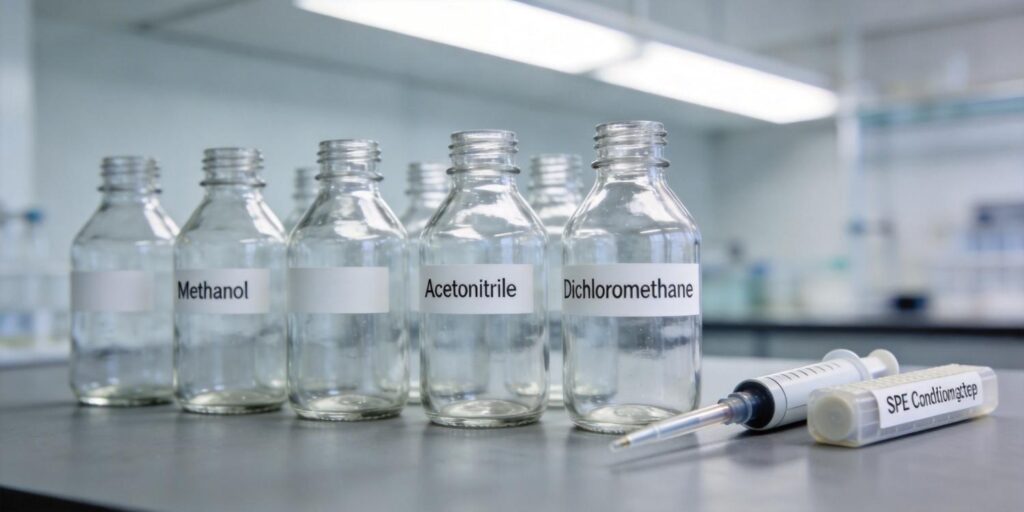
- Diol sorbent: 6 mL dichloromethane followed by 1 mL n-hexane
Differences for Reversed Phase vs Ion Exchange SPE
The conditioning requirements differ significantly between reversed-phase and ion-exchange SPE cartridges, reflecting their distinct retention mechanisms.
Reversed-Phase SPE Conditioning
Reversed-phase sorbents (like our C18, C8, HLB, and MAX cartridges) rely on hydrophobic interactions. When silica particles are bonded with a hydrophobic phase, they become “waterproof” and must be conditioned to interact with aqueous samples. This is accomplished by:
- Organic solvent (methanol or acetonitrile): Penetrates into the bonded layer and permits water molecules and analytes to diffuse into the bonded phase
- Aqueous solution (water or buffer): Removes excess organic solvent prior to adding the sample
The organic solvent wets the surface of the sorbent and penetrates bonded alkyl phases, allowing water to wet the silica surface efficiently. After conditioning, water is passed to remove the excess solvent before adding the sample.
Ion-Exchange SPE Conditioning
Ion-exchange sorbents (like our WCX, WAX, MCX, and MAX cartridges) require conditioning that establishes the proper ionic environment:
- Organic solvent (methanol): To solvate the sorbent and remove impurities
- Buffer at appropriate pH: To establish the correct ionic form of the functional groups
For strong cation exchange (SCX) cartridges, conditioning typically involves methanol followed by an acidic buffer (pH 4.5) to protonate the sulfonic acid groups. For strong anion exchange (SAX) cartridges, methanol is followed by a basic buffer (pH 8) to ensure the quaternary ammonium groups are in their ionic form.
The key difference lies in the second step: while reversed-phase conditioning uses water or a weak buffer primarily to remove excess organic solvent, ion-exchange conditioning uses a specific pH buffer to “charge” the ionic functional groups for optimal analyte retention.
Mixed-Mode Cartridges
Mixed-mode cartridges (like our MCX and MAX products) combine reversed-phase and ion-exchange mechanisms and require conditioning that addresses both retention modes. Typically, this involves methanol followed by a buffer that establishes both the hydrophobic environment and the appropriate ionic state.
Common Mistakes
Based on extensive literature and practical experience, several common mistakes can compromise SPE conditioning effectiveness:
1. Allowing the Cartridge to Dry
The most critical error is allowing the sorbent bed to dry between conditioning and sample application. As emphasized in multiple protocols: “The cartridge must not become dry before sample application.” Drying causes:
- Collapse of solvated functional groups
- Reduced analyte recovery due to poor mass transfer
- Potential channeling in the sorbent bed
To prevent drying, leave approximately 1-2 mm of conditioning solvent above the sorbent bed before sample application.
2. Incorrect Solvent Volumes
Using insufficient solvent volumes for conditioning leads to incomplete solvation of the sorbent. General guidelines include:
- For 100-500 mg cartridges: 2-3 mL per conditioning step
- For 1 g cartridges: 5-6 mL per conditioning step
- For 96-well plates: 200-500 μL per well
Insufficient volumes fail to properly wet the entire sorbent bed, leading to inconsistent results across different positions in a manifold or plate.
3. Excessive Flow Rates
Applying too much vacuum or pressure during conditioning causes channeling. Flow rates between 0.5 and 3.0 mL/min are generally acceptable to allow sufficient solvent-sorbent contact for solvation without causing channeling. Excessive flow:
- Creates channels or tunnels in the sorbent bed
- Reduces available surface area for sample contact
- Decreases sorbent capacity and recovery
4. Incorrect pH for Ion-Exchange SPE
Using the wrong buffer pH for ion-exchange conditioning prevents proper “charging” of the functional groups. For example:
- SCX cartridges require acidic conditions (pH 4.5) to protonate sulfonic acid groups
- SAX cartridges require basic conditions (pH 8) for quaternary ammonium groups
- WCX and WAX cartridges have specific optimal pH ranges depending on their pKa values
5. Skipping the Equilibration Step
Some users omit the aqueous equilibration step after organic solvent conditioning, especially in reversed-phase SPE. This mistake leads to:
- Poor sample compatibility with the sorbent
- Reduced analyte retention due to solvent mismatch
- Potential precipitation of sample components
6. Using Contaminated Solvents
Conditioning solvents containing impurities can introduce contaminants that co-elute with analytes. This is particularly problematic for trace analysis and mass spectrometry applications. Always use high-purity solvents for conditioning steps.
7. Inconsistent Conditioning Between Samples
In manual processing, inconsistent timing or technique between samples leads to variable conditioning. Automation using our 96-well SPE plates can help standardize conditioning across all samples in a batch.
8. Failure to Pre-wash When Necessary
For certain applications, especially with new cartridges or for trace analysis, a pre-wash step with strong solvent (before conditioning) is necessary to remove extractables from the sorbent, frits, and tubing. This step is crucial for achieving low background in sensitive detection methods like GC-MS or LC-MS.
Proper conditioning is not merely a procedural step but a critical determinant of SPE success. At Poseidon Scientific, we design our SPE products—from individual cartridges to 96-well plates—with consistent performance characteristics that respond predictably to proper conditioning protocols. By understanding and implementing these conditioning principles, users can achieve optimal recovery, reproducibility, and cleanliness in their SPE applications.