Understanding pKa and Analyte Ionization in Ion Exchange SPE
The foundation of successful ion exchange solid phase extraction (SPE) lies in understanding the acid dissociation constant (pKa) of your target analytes. The pKa is defined as the pH at which an analyte is 50% ionized, representing the equilibrium point between ionized and non-ionized forms. This concept is critically important because ion exchange interactions occur between a charged sorbent and an analyte of opposite charge.
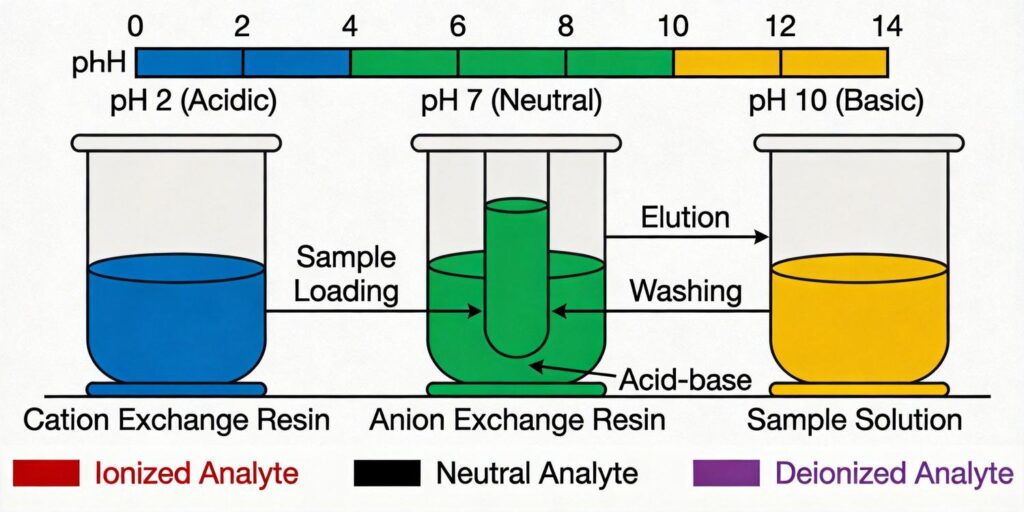
For acidic compounds, the ionization behavior follows a predictable pattern: acidic compounds become negatively charged above their pKa, while basic compounds become positively charged below their pKa. To achieve approximately 100% ionization—essential for optimal retention in ion exchange SPE—you must maintain the sample pH at least 2 full pH units above the pKa for acidic compounds, or 2 full pH units below the pKa for basic compounds.
Consider this practical example: ibuprofen has a pKa of 5.9. When extracted using a hydrophobic mechanism on a C8 copolymeric mixed-mode column, lowering the sample pH from 6.0 to 5.0 increases recovery because you’re decreasing the ionization of the acidic drug, increasing the non-ionic molecular form that interacts better with hydrophobic phases. This demonstrates how understanding pKa values directly impacts extraction efficiency regardless of the retention mechanism employed.
Multiple pKa Considerations
When dealing with compounds having multiple pKa values, it’s essential to use the extreme values to adjust your elution solvents appropriately. The titration curves of pKa values for acidic and neutral drugs versus basic drugs show distinct patterns that must be considered during method development. Comprehensive drug pKa listings are available in reference materials, but when working with unknown analytes, systematic pH profiling becomes essential.
Sample pH Adjustment Methods for Optimal Retention
Proper sample pH adjustment is not merely about achieving a target number—it’s about creating the optimal ionic environment for your specific analytes and sorbent combination. The buffer serves two critical purposes: controlling the pH of the sample (and hence the ionic state of analytes and potential interferences) and modifying the ionic strength of the sample. Both effects improve reproducibility, with proper pH selection always enhancing recovery.
Practical Buffer Preparation Guidelines
When preparing buffers for ion exchange SPE, several practical considerations emerge. A common error involves adjusting pH upward using ammonium hydroxide (NH₄OH) to reach pH 11.0-12.0. If the NH₄OH is old or if there’s less than half a bottle remaining, ammonia evaporation can occur, limiting achievable pH to 8.0-9.0. This manifests as variable recovery from run to run and loss of analyte recovery. Always use fresh reagents and verify pH with a calibrated meter rather than pH paper, which typically has too broad a range for precise method development.
For ion exchange columns specifically, apply 1 mL of buffer to the column after flushing with water to ensure the sorbent pH is optimal for the desired sorbent-analyte interaction. The kinetics of ion exchange are slower than those of non-polar or polar mechanisms due to slow diffusion of ionic species (often dragging with them a sheath of water molecules) and the process of displacing counter-ions associated with the ion exchanger.
Matrix-Specific Considerations
When working with biological matrices like plasma or whole blood, the starting pH dramatically affects recovery of polar and strongly acidic compounds. For comprehensive drug screening procedures, changing the starting pH from 6.0 to 2.2 results in less ionization of acidic drugs and hence better retention on cartridges. However, the amounts of water in sample application and wash steps should be minimized—if not, more polar acidic compounds may be partly washed away. For plasma samples, this means diluting only 1:1 with phosphoric acid at pH 2.2 rather than the fourfold dilution used in original procedures.
Effect of pH on Retention Strength and Selectivity
The relationship between pH and retention strength in ion exchange SPE follows fundamental principles of ionic interactions. When the sample pH maintains analytes in their ionic form and the sorbent carries the opposite charge, strong Coulombic interactions occur. However, these interactions can be modulated through strategic pH adjustments during different SPE stages.
pH Optimization for Mixed-Mode Sorbents
Mixed-mode sorbents like MCX (Mixed-mode Cation eXchange) and MAX (Mixed-mode Anion eXchange) offer unique advantages for pH optimization. MCX sorbents, designed for basic compounds with pKa values between 2-10, feature sulfonic acid groups that remain negatively charged across a wide pH range (0-14). For acidic compounds with pKa values between 2-8, MAX sorbents provide quaternary ammonium groups that maintain positive charge similarly broadly.
The mixed-mode nature of these sorbents allows for sophisticated cleanup strategies. For ionically bound analytes, you can use washes of high organic strength to remove interferences retained by hydrophobic interactions. If your analyte also exhibits hydrophobic binding, you can remove polar interferences ionically similar to your analyte by using aqueous or weak aqueous/organic washes while disrupting ionic binding. Elution then occurs by simultaneously disrupting both ionic and hydrophobic interactions.
Counter-Ion Selectivity and pH Effects
Counter-ion selectivity represents another dimension where pH exerts influence. Different ionic species show varying affinities for ion exchange sorbents, expressed as relative selectivities. Two general trends emerge: selectivity increases as the charge of the ion increases (divalent ions are generally more retentive than monovalent ones), and aqueous solubility and selectivity vary approximately inversely (well-solvated F⁻ is a low selectivity ion while poorly solvated I⁻ has high selectivity).
Secondary interactions must also be considered. For example, benzene sulfonate has very high selectivity for SAX sorbents partly due to non-polar interactions between the analyte and the methyl and propyl groups present on the SAX sorbent. The ability to chelate or form multiple points of interaction between analyte and sorbent also increases selectivity, accounting for the very high selectivity of citrate groups.
Practical Examples with MCX and MAX Sorbents
MCX for Basic Compounds: Propranolol Example
Propranolol, a basic drug with amine functionality, demonstrates optimal extraction on MCX sorbents when the sample pH is maintained at least 2 pH units below its pKa (approximately 9.5 for the amine group). At pH 7.5 or lower, propranolol exists predominantly in its protonated, positively charged form, interacting strongly with the negatively charged sulfonic acid groups on the MCX sorbent (exchange capacity: 1.0 meq/g).
The mixed-mode retention provides additional cleanup advantages. After sample loading at optimized pH, a wash with 2% formic acid can remove acidic and neutral interferences while retaining the basic analyte through ionic interactions. Subsequent washes with methanol remove hydrophobic interferences without disrupting the ionic bond. Final elution with 5% NH₄OH in methanol disrupts the ionic interaction by neutralizing the analyte’s charge while the methanol component addresses any residual hydrophobic interactions.
MAX for Acidic Compounds: Suprofen Example
Suprofen, an acidic compound with carboxylic acid functionality (pKa approximately 4.0), shows optimal retention on MAX sorbents when the sample pH is maintained at least 2 pH units above its pKa. At pH 6.0 or higher, suprofen exists predominantly in its deprotonated, negatively charged form, interacting strongly with the positively charged quaternary ammonium groups on the MAX sorbent (exchange capacity: 0.25 meq/g).
The extraction protocol typically involves conditioning with methanol followed by pH-adjusted buffer, sample loading at optimized pH, washing with 5% NH₄OH to remove basic interferences, and elution with 2% formic acid in methanol. This approach simultaneously disrupts ionic interactions through protonation of the analyte and addresses hydrophobic interactions through the organic solvent component.
Method Development Strategy for Unknown Analytes
For unknown analytes or zwitterionic compounds, systematic pH profiling using sorbent selection plates containing MCX, MAX, WAX, and WCX sorbents provides an efficient discovery approach. Initial experiments should use the biological matrix of interest rather than aqueous solutions alone, as matrix components can dramatically influence sorbent-analyte and analyte-sample interactions.
During pH profiling experiments investigating retention versus sample pH, single determinations may be preferred initially to reduce sample numbers. For each SPE condition tested, include blanks and spikes. The concentration of spiked samples should be sufficiently high to allow for recovery estimation even if interfering peaks are present—typically 1 to 10 μmol/L for UV detection methods, though excessively high concentrations may exceed sorbent capacity.
Troubleshooting Low Recoveries
When encountering low recoveries (below 50%) during method development, systematic investigation should determine whether the issue stems from incomplete retention, loss during washing, or incomplete desorption. Collect all fractions including sample waste and assay for target analyte content. A mass balance calculation will indicate the cause.
For hydrophilic analytes difficult to retain on reversed-phase silica sorbents, consider using ion pairing agents in the dilution buffer. This principle was successfully applied to retention of an experimental drug containing a phosphonic acid function (pKa < 2) by adding 10 mM tetrabutyl ammonium hydroxide to buffers used for diluting samples, substantially increasing recovery across the pH interval studied.
Advanced Optimization Considerations
Final optimization should address precision improvement through replicate assays (4-6 replicates of spiked samples for each condition). Consider ionic strength adjustments through salt addition (commonly sodium chloride) to increase retention of water-soluble components through “salting out” effects. However, be aware that salt addition can have detrimental effects on recovery of hydrophobic sample components by increasing an already strong degree of sorption—sometimes resolved by adding methanol to the sample.
Remember that SPE today has become a precise science. If you’re not achieving 90% absolute recovery of your analyte, your method requires further optimization. The interplay between pH, ionic strength, organic modifiers, and sorbent selection creates a multidimensional optimization space where systematic investigation yields robust, reproducible methods suitable for both research and regulatory applications.
For further information on specific SPE products and applications, visit our MCX SPE Cartridges and MAX SPE Cartridges product pages, or explore our comprehensive 96-well SPE plates for high-throughput applications.