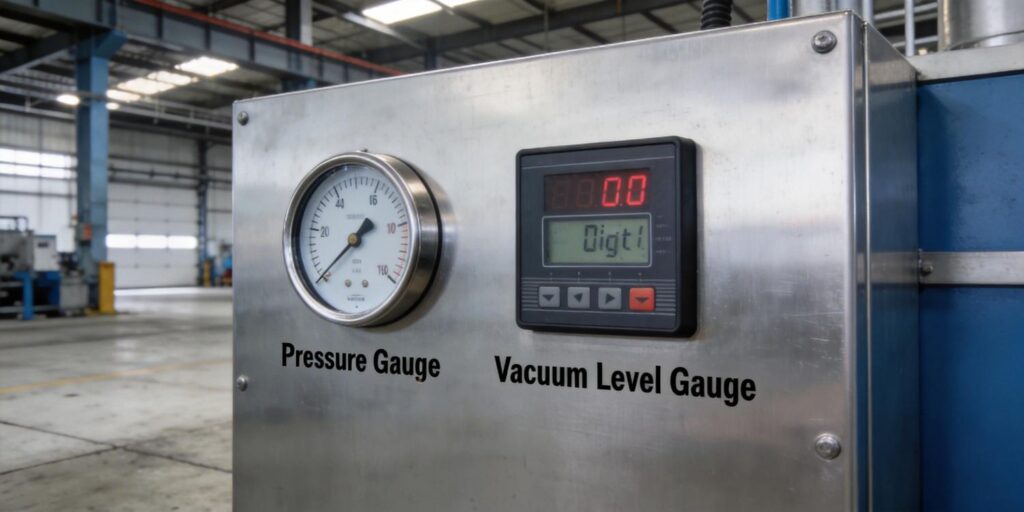
Pump-down Stage Monitoring
Physical vapor deposition (PVD) coating quality starts with a clean, reproducible base vacuum. Residual gases—water vapor, oxygen, or hydrocarbons—can react with sputtered material and degrade film adhesion, stoichiometry, or optical properties. The pump-down phase therefore requires continuous, accurate monitoring from atmosphere down to at least 10−6 Torr.
The Poseidon Scientific VG-SP205 Pirani Vacuum Transmitter covers the roughing leg (760 Torr to 10−3 Torr) with fast response and ±15 % accuracy in its linear region (10 Torr to 10−2 Torr). Once pressure drops below 10−3 Torr, the VG-SM225 Cold Cathode Vacuum Gauge seamlessly takes over, delivering stable ion-current readings to 10−7 Torr. Together, these compact KF25 units provide full-range coverage without the size or cost penalties of traditional wide-range combination gauges.
Optimal placement during pump-down is on the chamber sidewall, approximately midway between the pumping port and the substrate holder. Mounting directly on the pump inlet or blank-off valve measures pump performance rather than chamber conditions, creating a false sense of base pressure. Industry practice—confirmed in vacuum-system design literature and Poseidon’s own installation guides—recommends positioning the gauge where conductance paths to the substrate are representative. This ensures the displayed pressure accurately reflects contamination risk at the wafer or tool surface, directly supporting repeatable film quality.
Deposition Stage Pressure Control
During sputtering or evaporation, process pressure (typically 10−3 to 10−2 Torr with argon or reactive gases) controls mean free path, deposition rate, and film density. Too high and scattering reduces directionality; too low and plasma stability suffers. Precise, real-time control is essential for thickness uniformity and microstructure.
The VG-SP205 Pirani excels here because its operating range aligns perfectly with typical PVD working pressures. Its constant-temperature filament responds quickly to small changes, enabling closed-loop throttle-valve or mass-flow control. For base-pressure verification before gas introduction, the VG-SM225 provides the necessary high-vacuum sensitivity. Many coaters run both gauges simultaneously, using the Pirani for active process control and the cold cathode for interlock protection (e.g., “plasma ignition permitted only below 5 × 10⁻⁶ Torr residual”).
Placement remains on the chamber wall but offset from the gas inlet and target by at least 90–120°. This avoids local pressure spikes or pumping asymmetries that could mislead the controller. In magnetron sputtering systems, locate the gauge outside the racetrack erosion zone to minimize sputter deposition on the sensor while still sampling true process conditions. The resulting pressure stability directly translates to consistent film properties across large substrates or batch runs.
Gas Flow Interaction
Reactive PVD introduces argon, oxygen, or nitrogen through mass-flow controllers, creating dynamic pressure gradients inside the chamber. Gas molecules stream from the inlet toward the pump, producing measurable differences between local and average pressure—sometimes 20–50 % higher near the inlet.
To capture a representative average, mount gauges away from direct line-of-sight of gas inlets and pumping ports. A common best practice is to place the VG-SP205 and VG-SM225 on opposing chamber walls or at 180° from the primary gas manifold. This minimizes Bernoulli-effect errors and ensures the measured pressure correlates with the actual environment experienced by the growing film. For large chambers (>1 m diameter), multiple gauges (one Pirani near the substrate plane, one cold cathode for base monitoring) further improve spatial resolution.
Poseidon’s customizable RS232 protocol allows both units to stream synchronized data to the same PLC or SCADA system, enabling software averaging or differential monitoring. Operators can then adjust flow or throttle settings with confidence, achieving tighter process windows and higher yield.
Gauge Shielding Considerations
Sputtered material travels in straight lines at high velocity and will coat any exposed surface, including gauge electrodes and filaments. Over time, metal or dielectric films alter thermal conductivity (Pirani) or secondary-emission characteristics (cold cathode), shifting calibration and triggering false readings.
Effective shielding uses simple, grounded stainless-steel baffles or tubes with high conductance (≥10 L/s) mounted in front of the gauge port. The baffle blocks line-of-sight sputter flux while allowing free molecular flow of process gas. In practice, a 50–75 mm extension tube with 45° slots or a chevron baffle works well and adds negligible pressure drop. Poseidon’s removable-sensor design on the VG-SM225 makes periodic cleaning (200–500 mesh sanding) fast and inexpensive when shielding eventually saturates.
Shield material must match chamber chemistry—stainless steel for most metal PVD, aluminum or titanium for reactive processes—to avoid galvanic corrosion or outgassing. Properly shielded gauges maintain accuracy for thousands of deposition hours, protecting film quality without frequent maintenance interruptions.
Avoiding Plasma Interference
DC or RF magnetron plasmas generate electromagnetic noise, energetic ions, and secondary electrons that can couple into gauge electronics. Cold-cathode discharges are particularly sensitive because external fields can alter electron trapping or trigger premature avalanche. Pirani gauges are more robust but can still pick up RF pickup on unshielded signal lines.
Best practices include: (1) mounting gauges outside the plasma glow region—typically 10–15 cm from the target racetrack; (2) using fully shielded cables (supplied with both Poseidon models) grounded at one end only; (3) adding a grounded mesh screen or Faraday cage around the gauge body if RF power exceeds 1 kW; and (4) routing signal cables perpendicular to high-voltage feedthroughs. The VG-SM225’s low-impedance 0–10 V output and built-in filtering reject most plasma-induced ripple, while its automatic high-voltage shutdown above 10−3 Torr prevents damage during plasma ignition transients.
These measures ensure stable readings throughout the deposition cycle, eliminating pressure “glitches” that could interrupt process control or trigger unnecessary alarms. In side-by-side testing, properly placed and shielded Poseidon gauges show <5 % deviation from reference capacitance manometers even under intense RF sputtering conditions.
CTA
Strategic gauge placement and shielding directly determine pressure repeatability—and therefore film quality—in PVD coating systems. The Poseidon Scientific VG-SP205 Pirani Vacuum Transmitter and VG-SM225 Cold Cathode Vacuum Gauge combine full-range coverage, compact size, and easy maintenance to deliver reliable monitoring at a fraction of legacy costs.
Discover the VG-SP205 Pirani Vacuum Transmitter for precise process-pressure control and the VG-SM225 Cold Cathode Vacuum Gauge for dependable base-vacuum assurance. For deeper guidance, read our companion article Selecting Vacuum Gauges for PVD and Coating Equipment.
Need help designing gauge ports, baffle drawings, or custom RS232 protocol for your specific coater? Our applications team offers free placement reviews and sample units. Contact us today to optimize your vacuum monitoring and elevate film quality.
Written by Liam, Product Manager, Vacuum Gauges – Poseidon Scientific