
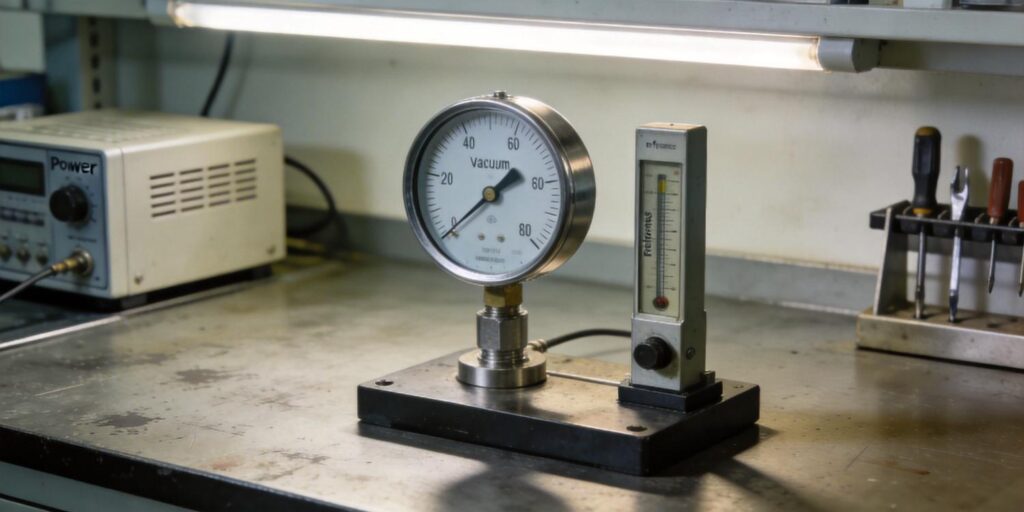
ISO Calibration Recommendation Overview
Vacuum gauge calibration practices are guided by international standards, but they emphasize risk-based decisions rather than rigid schedules. ISO 3567:2015 specifies the method for calibrating vacuum gauges by direct comparison with a reference gauge under controlled conditions. It defines traceability to national metrology institutes (such as NIST or PTB) and outlines uncertainty budgets, but it does not mandate a fixed recalibration interval. Instead, frequency falls under the user’s quality management system—typically ISO 9001 for general manufacturing or ISO 17025 for accredited calibration laboratories.
Most gauge manufacturers, including legacy suppliers such as INFICON and MKS, publish recommendations of 12 months for traceability in non-critical applications. For Poseidon Scientific’s VG-SP205 Pirani Vacuum Transmitter and VG-SM225 Cold Cathode Vacuum Gauge, factory calibration establishes the precise voltage-to-pressure mapping using certified reference instruments. The resulting calibration certificate accompanies each unit, ensuring initial accuracy within published specifications (±15 % in the linear region for the Pirani, ±20 % for the cold cathode in its primary range). Users are encouraged to treat the annual mark as a baseline rather than an absolute requirement, aligning with the flexibility built into ISO 3567 and modern process-oriented quality frameworks.
This approach reflects the reality that vacuum gauges are not passive sensors; their performance depends on operating environment, gas composition, and contamination levels. Fixed annual intervals can waste resources in stable systems while falling short in aggressive semiconductor or coating applications.
Process Criticality Analysis
The correct calibration interval begins with a failure-mode and effects analysis (FMEA) of the specific vacuum process. In low-stakes laboratory setups—such as general research chambers where pressure serves only as a rough indicator—annual calibration often suffices because measurement uncertainty has minimal impact on outcomes. However, in high-value semiconductor load locks, mass spectrometers, scanning electron microscopes, or vacuum heat-treatment furnaces, pressure data directly influences safety interlocks, process endpoints, and product yield.
For example, in a load-lock application, the inner gate valve must not open until the chamber reaches ≤5 × 10⁻⁶ Torr. A 30 % drift in the VG-SM225 reading could allow premature valve actuation, introducing moisture or particles and scrapping an entire wafer lot. In PVD coating systems, contamination-induced offset in the cold-cathode discharge can shift reported pressure by an order of magnitude, leading to incorrect deposition rates or film stoichiometry errors. Poseidon’s compact, maintainable design (KF25 flange, removable sensor head on the VG-SM225) was developed precisely for these critical environments, where downtime for full replacement is unacceptable.
Criticality scoring is straightforward: score the process on (1) cost of scrap per batch, (2) safety impact, and (3) regulatory requirements (SEMI, ISO 13485 for medical devices). If the combined score exceeds a company-specific threshold, shift from calendar-based to condition-based calibration.
Drift Monitoring Method
Modern vacuum systems already collect rich data streams; turning that data into proactive drift detection is straightforward and cost-free. The recommended method uses statistical process control (SPC) on the gauge outputs themselves:
- Establish baseline: After initial installation and stabilization, record pressure at three reproducible test points—atmosphere (Pirani), 1 Torr (Pirani linear region), and 10−5 Torr (cold cathode)—under identical gas (air or N₂) and temperature conditions.
- Periodic check: Every 30–90 days (or after 500 cycles), repeat the measurements using the same protocol. The VG-SP205 and VG-SM225 RS232 outputs (customizable protocol available at 5–10 unit volumes) stream raw voltage, status codes, and calculated pressure directly to a PLC or SCADA system for automated logging.
- Control-chart analysis: Plot readings on X-bar and R charts. Set control limits at ±2σ from baseline. A point outside limits or a run of seven consecutive points trending upward/downward triggers investigation.
- Cross-verification: For highest confidence, temporarily install a portable reference gauge (e.g., capacitance manometer for 10−3–10 Torr) at the same port and compare. The Poseidon pair’s complementary ranges allow the Pirani to validate the cold cathode at the 10−3 Torr crossover point.
This method detects drift caused by temperature compensation limits (Pirani) or surface contamination (cold cathode) long before it affects process control. In clean environments, Poseidon gauges typically show <5 % drift over 12 months; in moderately contaminated service, the cleanable electrode design restores performance without full recalibration.
When Annual Calibration Is Insufficient
Calendar-based annual calibration fails in four common scenarios:
- High contamination load: Oil backstreaming or process by-products deposit carbon films on cold-cathode electrodes, shifting the discharge characteristic within 3–6 months. The VG-SM225’s removable head allows in-situ cleaning with 200–500 mesh sandpaper, restoring original performance without sending the unit out.
- Extreme temperature cycling: Operation outside the 15–50 °C compensated range (common in vacuum furnaces) accelerates Pirani filament resistance drift.
- High cycle count: Semiconductor tools running 24/7 with 50+ load-lock cycles per day accumulate mechanical and electrical stress faster than annual service can address.
- Gas-composition variability: Processes using He, Ar, or reactive gases alter thermal conductivity (Pirani) or ionization efficiency (cold cathode). Factory calibration is performed in air; significant gas changes require re-mapping or more frequent verification.
In these cases, drift-monitoring data will flag the need for recalibration or maintenance well before the 12-month mark, preventing unplanned downtime and yield loss.
Cost-Risk Analysis
A quantitative comparison reveals why many forward-thinking fabs and OEMs have moved to process-based intervals. Annual calibration for a typical pair (Pirani + cold cathode) incurs:
- Labor and shipping: $600–1,200 per gauge
- Tool downtime: 4–8 hours at $500–2,000/hour lost production
- Total annual cost per tool: $3,000–8,000
Risk side: undetected 20–50 % drift in a critical load lock can scrap one batch ($10,000–100,000) or trigger a full chamber requalification ($50,000+). Using SPC monitoring reduces the probability of undetected drift to <1 % while cutting calibration events by 50–70 % in stable processes.
Poseidon’s design further tilts the economics: the VG-SP205 Pirani is essentially maintenance-free (3–5 year filament life), and the VG-SM225’s cleanable electrodes extend service life without replacement. Combined with low initial cost (30–60 % below imported equivalents) and protocol customization, total ownership cost drops dramatically. Many customers report ROI on the monitoring approach within the first year.
For applications requiring accredited traceability (ISO 17025), schedule a full calibration only when drift charts indicate it—typically every 18–24 months in clean systems—while still satisfying audit requirements through documented SPC records.
CTA
Choosing between annual and process-based calibration ultimately comes down to matching interval to actual risk and data. Poseidon Scientific’s VG-SP205 Pirani Vacuum Transmitter and VG-SM225 Cold Cathode Vacuum Gauge are engineered for long-term stability, easy in-situ maintenance, and seamless data integration—making condition-based calibration both practical and economical.
Explore the VG-SP205 Pirani Vacuum Transmitter for reliable roughing-stage monitoring and the VG-SM225 Cold Cathode Vacuum Gauge for stable high-vacuum performance.
Need help setting up SPC charts, customizing RS232 output for your PLC, or performing an on-site drift audit? Our applications engineering team offers free calibration-interval assessments and sample units for evaluation. Contact us today to optimize your vacuum measurement strategy and reduce total cost of ownership.
Written by Liam, Product Manager, Vacuum Gauges – Poseidon Scientific


