Elution Strength Principles
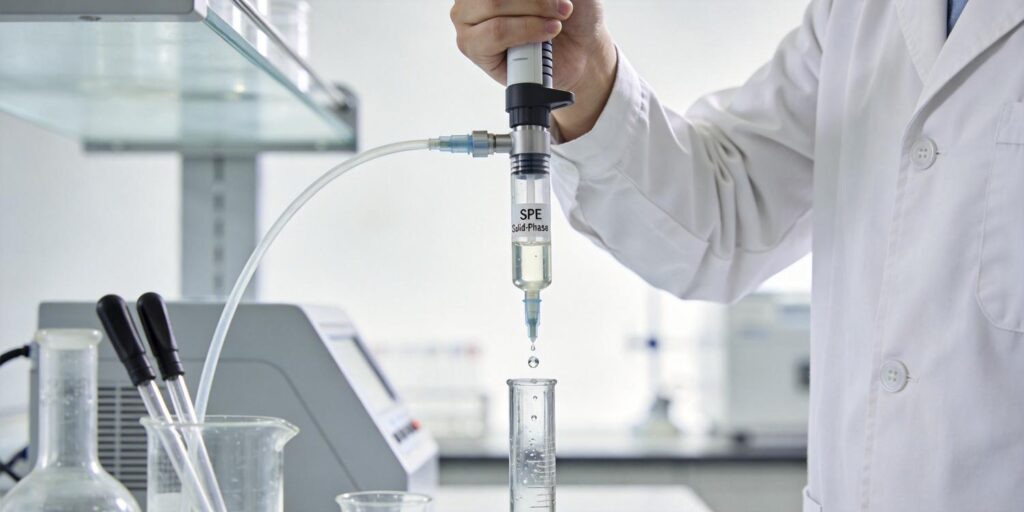
Successful solid-phase extraction (SPE) elution fundamentally depends on selecting a solvent with the highest eluotropic strength toward the specific sorbent being used. This approach minimizes total elution volume while maximizing the concentration effect of SPE, which is particularly important for trace enrichment applications. The elution process involves creating a distribution where the analyte has greater affinity for the liquid phase than the solid phase, characterized by a very small capacity factor (k’).
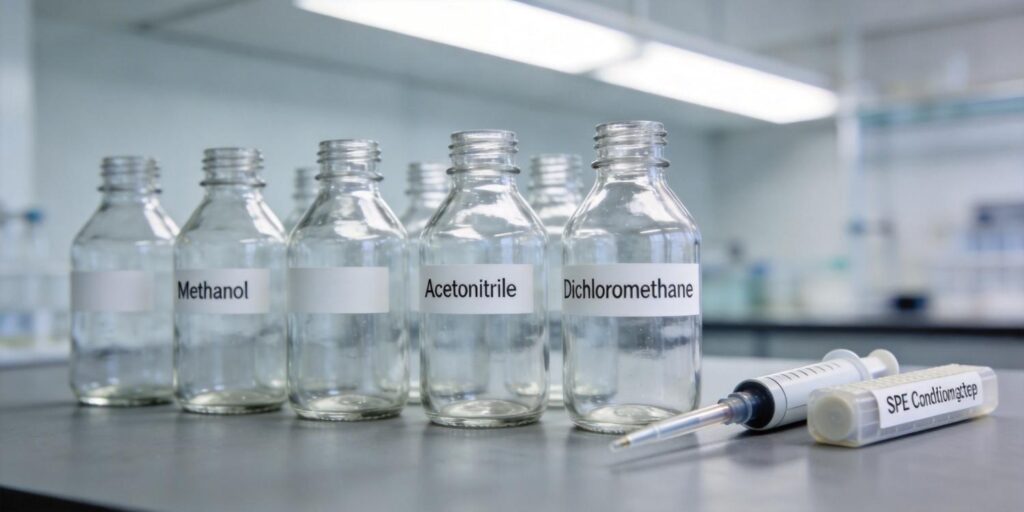
Elution strength follows predictable patterns based on solvent polarity and interaction mechanisms. For reversed-phase sorbents, solvents can be arranged in increasing order of expected eluotropic strength: acetic acid, methanol, acetonitrile, acetone, ethyl acetate, diethyl ether, methyl tert-butyl ether, methylene chloride, benzene, and hexane. However, this order can be disrupted by secondary interactions between polar functional groups on analyte molecules and the sorbent surface, as well as analyte solubility considerations.
One critical consideration often overlooked is the presence of adsorbed water on SPE sorbent surfaces. A strong, nonpolar solvent such as hexane may fail to effect elution if a layer of adsorbed water exists on the sorbent surface. Polar solvents or solvents capable of hydrogen-bonding with adsorbed water typically prove more effective in such scenarios. This explains why methanol and acetonitrile remain the most universal elution solvents for reversed-phase applications.
Selective Desorption Strategies
Selective desorption represents an advanced elution strategy that can be used to fractionate components into hydrophilic and hydrophobic fractions. For example, when picloram and 2,4-D are sorbed onto a reversed-phase octadecyl SPE column, the two compounds can be completely separated into distinct fractions by eluting the more hydrophilic picloram with acetic acid (25%) in water, followed by elution of the more hydrophobic herbicide 2,4-D with methanol.
This fractionation approach has proven particularly valuable in environmental applications, such as aquatic toxicity identification evaluations developed by the U.S. Environmental Protection Agency. Each fraction can be subsequently tested for its contribution to overall wastewater sample toxicity. For fractionation of samples containing very hydrophobic toxicants (with log Pow values in the range of 2.5-7), modified elution systems using methanol-water and methanol-methylene chloride mixtures have demonstrated superior performance.
Solvent Polarity Considerations
Solvent polarity represents one of the most critical parameters in SPE elution optimization. The eluotropic series provides a systematic framework for understanding solvent strength relative to different sorbent types. For alumina as the sorbent, solvents can be arranged in order of increasing eluting strength, with a similar order applying to silica-based sorbents, though with different magnitude effects.
Understanding the eluotropic series allows analysts to select solvents that are miscible with each other, effectively wet specific surfaces, serve as effective eluting agents, and contribute to overall processing efficiency. The qualitative principle of “like dissolves like” remains fundamentally important, with solvents having significantly different eluotropic values typically being non-miscible and possessing different surface wetting abilities.
Practical Polarity Effects
Research has demonstrated remarkable differences in elution abilities between seemingly similar solvents. For instance, methanol (E0 = 0.95) and acetonitrile (E0 = 0.65) show dramatically different abilities to elute tertiary nitrogen bases like pentacaine and stobadin from conventional C18 sorbents. Methanol can achieve recoveries up to 98%, while acetonitrile may show virtually no elution power in certain applications.
These differences suggest the presence of analyte-sorbent polar interactions that are interrupted by the more polar methanol. The larger E0 value for methanol, coupled with its greater eluting power in these cases, implies significant numbers of polar regions in C18 sorbents capable of binding basic compounds through secondary interactions.
For hydrophobic phases, typical elution solvents range from nonpolar to polar organic solvents, with specific choices depending on the analyte characteristics. Common elution solvents include methanol and acetonitrile for reversed-phase applications, while ethyl acetate and acetone work well for polar organics on normal-phase sorbents.
Acid/Base Modifiers for Ion Exchange SPE
Ion exchange SPE represents a fundamentally different elution paradigm where pH manipulation becomes the primary elution mechanism rather than solvent polarity. Ionic bonds are sufficiently strong to allow analytes to remain bound while interferences are washed away with high percentages (up to 100%) of polar or nonpolar organic solvents, provided the pH remains within appropriate ranges.
pH Control Principles
For successful ion exchange elution, the elution solvent must have sufficient pH strength to reverse electrostatic bonds. For cation exchange applications frequently used for basic (alkaline) drug extraction, base drugs are ionized by pH adjustment 2 units below their pKa, resulting in high-energy electrostatic bonds to charged acidic sorbents. Elution solvents typically utilize ammonium hydroxide to reverse the ionic state of drugs with subsequent release from ionic bonds.
It is critical that the pH of the elution solvent be at least 2 units above the analyte pKa to fully protonate the compound. However, ammonium hydroxide presents practical challenges as it quickly weakens when exposed to air, necessitating fresh preparation shortly before use. Stock sources of ammonium hydroxide can also weaken over time, recommending purchase of small bottles to maintain consistent pH strength.
Mixed-Mode Elution Strategies
Copolymeric ion exchange sorbents enable sophisticated elution strategies that simultaneously disrupt multiple interaction mechanisms. For ionically bound analytes, washes of high organic strength effectively remove interferences retained by hydrophobic interactions. When analytes also exhibit hydrophobic binding capabilities, polar interferences ionically similar to analytes can be removed using aqueous or weak aqueous/organic washes while disrupting ionic binding.
Elution in mixed-mode systems requires simultaneous disruption of both ionic and hydrophobic interactions. A practical example involves using methylene chloride-isopropanol-ammonium hydroxide mixtures that simultaneously disrupt ionic interactions while providing sufficient organic character to overcome adsorption due to packing material. This approach often proves superior to simple methanol/ammonium hydroxide mixtures (98:2), as the diluted-strength elution solvent allows more ionic and polar interferences to remain on the column while eluting only desired analytes.
Compatibility with LC-MS
LC-MS compatibility represents a critical consideration in modern SPE elution solvent selection, particularly as LC-MS usage continues to accelerate in pharmaceutical, environmental, and clinical applications. The ideal elution solvent should not only effectively desorb analytes but also be compatible with subsequent analytical instrumentation.
Direct Injection Compatibility
When possible, selecting elution solvents suitable for direct injection into HPLC columns eliminates evaporation and reconstitution steps, improving throughput and reducing potential analyte losses. For example, samples adsorbed on C18 sorbents may be fully eluted with a 1:1 methanol:25mM KH2PO4 (pH 7) solvent/buffer mixture, with aliquots analyzed without evaporation or dilution. This technique works best when full recovery can be achieved using small volumes (typically 100 μL) of eluting solvent, maintaining high analyte concentrations required for low detection limits.
An alternative approach involves elution with small volumes of non-aqueous solvents such as acetonitrile containing 0.1% trifluoroacetic acid or 5% triethylamine in methanol, followed by dilution with largely aqueous buffers. This strategy maintains compatibility with LC-MS systems while providing effective elution.
Solvent Property Considerations
Several solvent properties become particularly important for LC-MS compatibility:
- Chromophoric Nature: UV cut-off values become critical when eluted samples will be prepared for liquid chromatographic analysis without evaporation. Common solvents like acetonitrile (UV cut-off ~190 nm) and methanol (UV cut-off ~205 nm) provide excellent transparency for UV detection.
- Volatility: While lower volatility solvents like n-propanol (b.p. 98°C) may have advantages in conditioning and wash steps, more volatile elution solvents like methanol (b.p. 65°C) prove necessary for sample evaporation stages. Some solvents, including acetonitrile (83.7% by weight in azeotrope, b.p. 76.5°C) and isopropanol (87.4%, b.p. 80°C), form azeotropic mixtures with water, acting as effective drying agents during evaporation.
- Ion Suppression/Enhancement: Solvent composition significantly impacts ionization efficiency in mass spectrometry. Acidic modifiers like formic acid or acetic acid typically enhance positive ion mode detection, while ammonium hydroxide or other basic modifiers improve negative ion mode performance.
Practical LC-MS Optimization
For LC-MS applications, the elution solvent should be the weakest solvent that completely disrupts all binding mechanisms (hydrophobic, polar, and/or ion exchange) while maintaining compatibility with the analytical system. Flow rates during elution become particularly critical for analyte recovery, with slower flow rates generally preferred to allow kinetic transfer of analyte from stationary to mobile phase.
Gravity flow often provides optimal results, though a short application of vacuum or pressure may initiate flow followed by gravity continuation. Attention to correct pH, polarity, and solubility yields both optimal recovery and selectivity while maintaining LC-MS compatibility. When working with particularly complex samples, even optimized SPE may require additional cleanup steps, such as simple wash and back-extractions, to render samples sufficiently clean for determinant LC-MS results.
By carefully considering elution strength principles, solvent polarity, acid/base modifiers for ion exchange applications, and LC-MS compatibility requirements, analysts can develop robust SPE methods that deliver high recovery, excellent selectivity, and seamless integration with modern analytical instrumentation.