Remote Mounting Requirement
Industrial vacuum furnaces operating above 800 °C—such as vacuum annealing, tempering, or brazing systems—present a fundamental challenge for pressure measurement: the process chamber itself exceeds the safe operating temperature of any electronic vacuum gauge. Poseidon Scientific’s VG-SP205 Pirani Vacuum Transmitter and VG-SM225 Cold Cathode Vacuum Gauge are both rated for 15–50 °C ambient conditions. Direct flange mounting on a hot chamber wall would destroy the electronics, melt insulators, and invalidate calibration within minutes.
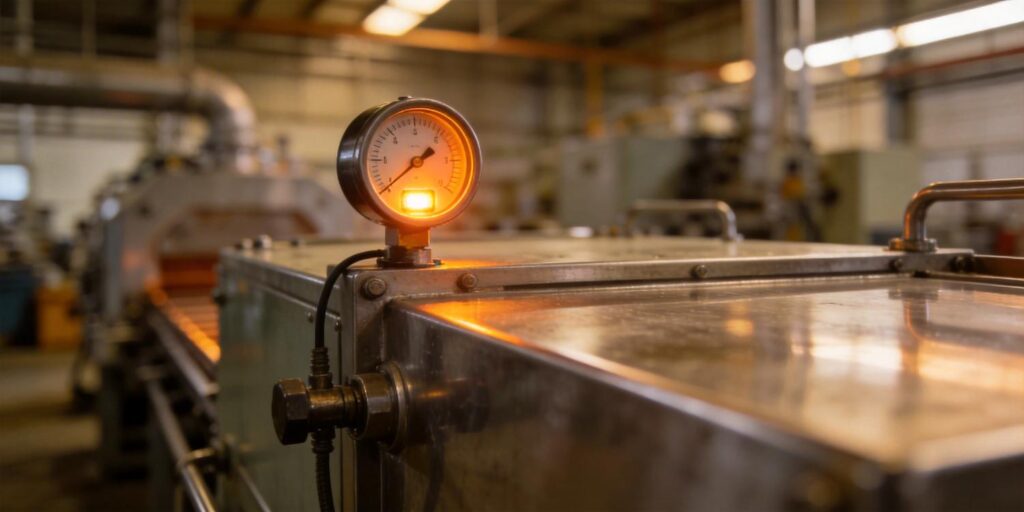
Remote mounting therefore becomes mandatory. Engineers route the gauge to a cooler location using a high-conductance extension tube (typically 300–800 mm long, KF25 or CF40) connected to a dedicated measurement port on the chamber. This isolates the sensor head from radiant heat while still sampling true chamber pressure in the molecular-flow regime. The compact footprint of both Poseidon gauges (163 × 92 × 65 mm, <200 g) makes them ideal for these remote installations; they fit easily into tight furnace enclosures or control-cabinet racks where larger legacy gauges from INFICON or MKS would require costly custom brackets.
Without proper remote placement, operators risk either gauge failure or inaccurate readings caused by thermal gradients. Poseidon’s design philosophy—low-cost, maintainable, and protocol-flexible—was developed specifically for these heat-treatment environments where every additional component inflates system cost.
Thermal Isolation Methods
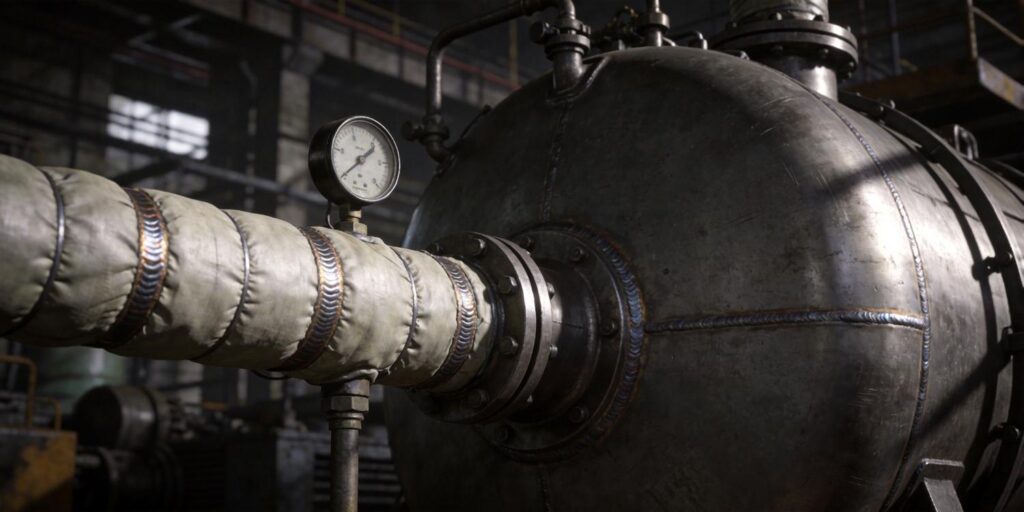
Effective thermal isolation combines geometry, materials, and active cooling. The most common approach is a stainless-steel extension tube with low thermal conductivity and high vacuum conductance. A 500 mm KF25 tube typically drops the gauge-end temperature below 40 °C even when the chamber is at 1000 °C, provided the tube is shielded from direct radiation.
Additional proven techniques include:
- Radiation baffles or chevron shields inside the tube to block line-of-sight heat transfer.
- Water-cooled adapter flanges at the gauge end (common in continuous-operation furnaces).
- Flexible bellows sections with external heat sinks or forced-air cooling for systems requiring vibration isolation.
- Multi-stage conductance limiters for ultra-high-temperature zones (>1200 °C) to further reduce heat load.
Because the VG-SM225 uses a positive-magnetron Penning discharge and the VG-SP205 relies on a platinum filament, neither sensor is sensitive to moderate temperature gradients once the electronics stay within spec. Poseidon’s PEEK insulators and stainless-steel electrodes maintain mechanical integrity and low outgassing even after repeated thermal cycles, unlike some ceramic-based competitors that crack under differential expansion. Field data from vacuum heat-treatment lines show that properly isolated Poseidon pairs deliver stable readings for 3–5 years without thermal-induced drift.
Pressure Monitoring Stages
Vacuum heat-treatment cycles involve distinct pressure regimes, each demanding accurate monitoring for process control and safety interlocks. A typical cycle includes:
- Roughing/pump-down (atmosphere to 10−3 Torr): The VG-SP205 Pirani provides fast, linear response in the 10 Torr to 10−2 Torr band where most oil or moisture is removed. Its ±15 % accuracy ensures repeatable pump-down times and prevents premature heating.
- High-vacuum base pressure (10−3 to 10−6 Torr): The VG-SM225 Cold Cathode takes over, confirming low residual gas levels before ramping temperature. This step is critical to avoid oxidation or carburization on sensitive alloys.
- Process/backfill stage (10−2 to 10 Torr with inert gas such as N₂ or Ar): The Pirani again becomes the primary sensor for controlling partial pressure and flow. Many furnaces hold a controlled “soft vacuum” during tempering; the VG-SP205’s gas-composition tolerance (factory-calibrated for air/N₂) keeps readings reliable.
- Cool-down and venting: Return to atmosphere with the Pirani for safe door opening.
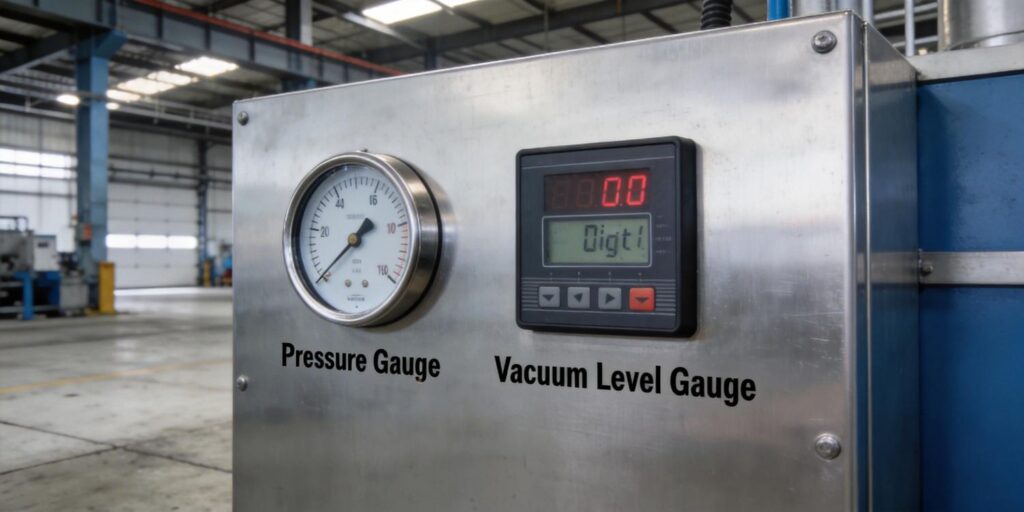
The seamless crossover at 10−3 Torr is handled automatically by PLC logic using the 0–10 V analog outputs or RS232 data stream. Poseidon’s customizable protocol (available at 5–10 unit volumes) packages both gauge readings into a single frame, simplifying furnace controller integration and eliminating extra I/O modules.
Signal Routing
Remote mounting often places gauges 10–30 m from the main control cabinet. Poseidon supports both analog (0–10 V) and digital (RS232) outputs, but RS232 is strongly preferred for long runs in electrically noisy furnace environments containing VFD pumps, induction heaters, and high-current contactors.
Recommended routing practices:
- Use the factory-supplied shielded twisted-pair cable (RJ45 connector) with the shield grounded at the controller end only.
- Limit analog runs to 30 m maximum; extend RS232 to 25 m with low-capacitance cable (or 15 m standard).
- Route cables in grounded metal conduit, perpendicular to power lines, and away from RF sources.
- For plant-wide systems, prepare for the future RS485 option (board revision) that supports 1200 m multidrop networks.
The VG-SM225’s built-in high-voltage protection and status LED, combined with the VG-SP205’s error-code output, provide immediate diagnostics if noise or attenuation occurs. Many heat-treatment OEMs report that Poseidon’s digital interface reduces commissioning time by 40 % compared with analog-only legacy gauges.
Durability Considerations
Furnace atmospheres contain potential contaminants—backstreaming pump oil, metal vapors, or residual process gases—that accelerate electrode fouling in cold-cathode gauges. The VG-SM225’s fully removable sensor head allows in-situ cleaning with 200–500 mesh sandpaper in under 10 minutes, restoring original performance without breaking chamber vacuum or sending the unit out. The VG-SP205 Pirani, with its platinum filament and sealed design, is essentially maintenance-free for 3–5 years in clean heat-treatment service.
Both gauges use vacuum-grade materials (stainless-steel electrodes, PEEK insulators, NdFeB magnets) rated for repeated thermal cycling and low outgassing (≤10−11 Pa·m³/s leak rate). The positive-magnetron geometry of the VG-SM225 keeps magnetic field localized, avoiding interference with nearby thermocouples or control electronics. In aggressive carburizing or nitriding furnaces, the cleanable cold cathode provides a clear uptime advantage over sealed, non-serviceable competitors that must be replaced entirely after contamination.
Combined with 30–60 % lower acquisition cost than imported equivalents and protocol customization, Poseidon gauges deliver the lowest total cost of ownership for high-temperature vacuum furnaces while meeting the durability demands of 24/7 production.
CTA
Selecting the right vacuum gauges for furnaces above 800 °C requires remote mounting, effective thermal isolation, and sensors matched to every cycle stage. The Poseidon Scientific VG-SP205 Pirani Vacuum Transmitter and VG-SM225 Cold Cathode Vacuum Gauge deliver full-range coverage, easy remote installation, robust signal integrity, and field-cleanable durability—at a price point that fits aggressive OEM budgets.
Explore the VG-SP205 Pirani Vacuum Transmitter for reliable roughing and backfill control and the VG-SM225 Cold Cathode Vacuum Gauge for stable high-vacuum verification.
Need a thermal-isolation tube drawing, custom RS232 protocol for your furnace PLC, or a side-by-side durability comparison with your current gauges? Our applications engineering team offers free remote-mounting reviews, sample units, and heat-treatment-specific installation guides. Contact us today to optimize your vacuum furnace monitoring and keep production running at peak efficiency.
Written by Liam, Product Manager, Vacuum Gauges – Poseidon Scientific