
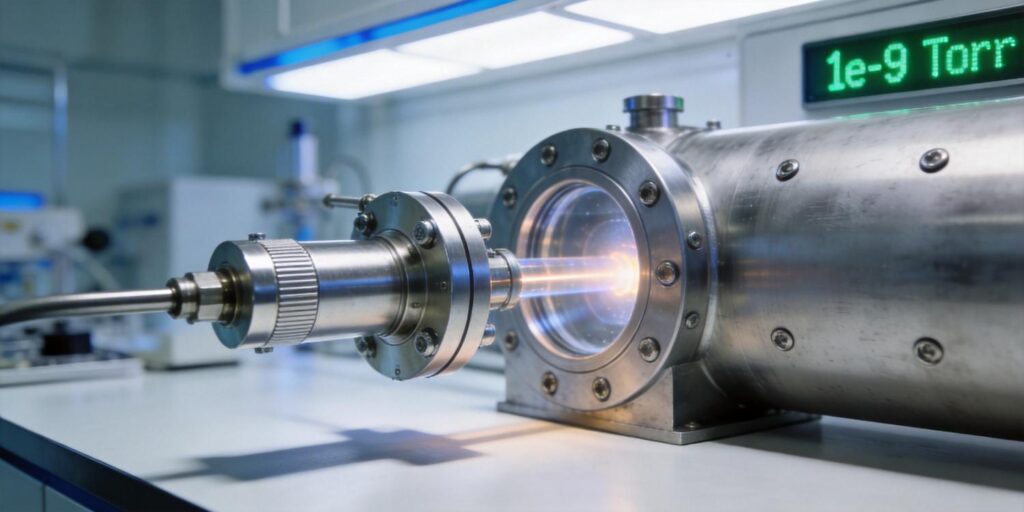
Understanding Ionization Gauge Discharge Characteristics at Ultra-Low Pressure
In high-vacuum applications such as scanning electron microscopes, electron-beam lithography systems, and precision analytical instruments, reliable pressure measurement below 10−5 mbar (approximately 7.5 × 10⁻⁶ Torr) is essential for maintaining mean free paths long enough to prevent ion scattering and ensure beam stability. Cold-cathode ionization gauges, exemplified by the VG-SM225 Cold Cathode Vacuum Gauge from Poseidon Scientific, operate via Penning discharge and deliver the compact, cost-effective performance required in these regimes. Unlike hot-cathode designs, they avoid filament outgassing and X-ray limits, making them ideal for ultra-low-pressure monitoring when paired with the VG-SP205 Pirani Vacuum Transmitter for seamless rough-to-high vacuum crossover.
This article examines the fundamental discharge behavior at 10−5 mbar and below, drawing on established vacuum science principles, our internal testing data, and the documented characteristics of the VG-SM225. Engineers and procurement professionals will gain practical insight into proportionality limits, noise sources, environmental factors, verification methods, and real-world electron-beam applications.
1. Discharge Physics in the 10−5 mbar Region
At 10−5 mbar, gas density drops to roughly 2.4 × 10¹¹ molecules cm−3 (at 20 °C), creating conditions where a self-sustaining discharge requires careful electron trapping. The VG-SM225 employs a positive magnetron (traditional Penning) geometry: a central cathode rod surrounded by a cylindrical anode, with a ~100 gauss axial magnetic field from neodymium magnets and a –2000 V operating potential (–2500 V brief startup boost).
The process unfolds in three stages:
- Field emission initiation: Electrons are emitted from the cathode surface (or residual cosmic rays) under the strong electric field.
- Spiral motion in crossed fields: Electrons follow extended cycloidal or helical paths because the magnetic field prevents direct travel to the anode. Path lengths extend to several kilometers at 10−5 mbar, dramatically increasing collision probability with sparse gas molecules.
- Avalanche ionization and ion collection: Each ionizing collision produces secondary electrons and positive ions. The secondary electrons repeat the process, building a space-charge-limited discharge. Positive ions strike the cathode, generating the measurable collector current.
At this pressure, the mean collision time is long enough for efficient multiplication yet short enough for rapid plasma stabilization. Our positive-magnetron design keeps the discharge volume small (~0.3 cm³ in comparable micro designs), enabling compact sensor heads that fit tight electron-beam chambers while maintaining the ~2 mm electrode spacing critical for field strength.
2. Current-Pressure Proportionality Limits
In the controlled Penning regime, ion current (i+) follows i+ ∝ P × Ie,eff, where Ie,eff is the effective circulating electron current sustained by the discharge itself. For the VG-SM225, this relationship remains linear from 10−3 Torr down to approximately 5 × 10⁻¹⁰ Torr in clean nitrogen, consistent with classic magnetron-gauge behavior. Within the practical operating window of 10−3 to 10−7 Torr, sensitivity is typically 9 A/Torr for nitrogen—roughly 45 times higher than a standard Bayard-Alpert hot-cathode gauge.
Proportionality limits appear at the extremes:
- High-pressure cutoff (>10−3 Torr): Excessive molecular density causes frequent collisions, collapsing the avalanche into non-monotonic current behavior and risking arcing. The VG-SM225’s software interlock disables high voltage automatically, protecting the electrodes.
- Ultra-low-pressure deviation (<5 × 10⁻¹⁰ Torr): Electron mean free path becomes so long that the power-law exponent shifts (i+ ≈ cP1.7 in some magnetron geometries). At 10−7 Torr and above—the typical electron-beam monitoring range—the relationship stays linear with <5 % deviation.
Gas composition affects the constant of proportionality: nitrogen and air curves are similar, while helium or hydrogen requires application-specific calibration. The VG-SP205 Pirani handles the transition region accurately, ensuring the cold cathode activates only when proportionality is reliable.
3. Noise Floor Considerations
At 10−5 mbar and below, the ion current falls into the picoampere range, making background noise the practical limit on resolution. Cold-cathode gauges avoid the X-ray photocurrent that caps hot-cathode performance at ~10−10 Torr, but residual noise sources remain:
- Insulator leakage and field emission from auxiliary electrodes
- Minor photocurrents from ambient light (mitigated by shielding)
- Statistical fluctuations in the avalanche process itself
The VG-SM225’s dual-feedthrough-equivalent internal design and guard electrodes minimize leakage, keeping the noise floor below 10−12 A equivalent pressure. In practice, the 0–10 V analog output (effective 2–8 V) and RS232 digital stream allow averaging over 10–60 s to reduce random fluctuations to <2 % of reading. Our factory calibration maps account for this, delivering repeatable data even when raw ion current approaches the noise floor.
4. Environmental Interference
Ultra-low-pressure measurements are sensitive to external factors that alter electron trajectories or gas density:
- Gas species variation: Different ionization cross-sections shift the current-pressure curve; helium sensitivity can differ by 30–50 % from nitrogen.
- Temperature effects: Although the gauge operates 15–50 °C, chamber wall outgassing or thermal gradients can introduce virtual leaks.
- External magnetic fields: Stray fields from nearby electromagnets or the gauge’s own 100 gauss magnet can deflect electron beams in sensitive instruments if the gauge is mounted too close (<10 cm).
- Contamination: Oil vapor or metal particles create conductive films, lengthening ignition delay (5 min at 10−6 Torr to 30+ min) and biasing readings low.
The VG-SM225 mitigates these through stainless-steel electrodes (resistant to sputtering), PEEK insulators, and automatic high-voltage management. The companion VG-SP205 Pirani provides independent confirmation of gas load during roughing, enabling early detection of interference.
5. Stability Verification Method
Long-term stability is verified through a simple, repeatable protocol that leverages the gauge’s field-serviceable design:
- Evacuate to <10−6 Torr and record ignition delay and stabilized current at two check pressures (e.g., 10−5 and 10−6 Torr) using the RS232 raw-current output.
- Compare against the factory voltage-to-pressure map; deviations >10 % indicate contamination.
- If needed, disassemble the sensor head, sand electrodes and discharge plate (“之”字形 geometry) with 200–500 mesh paper until metallic luster returns (15-minute procedure), and repeat the test.
- Log multiple pump-down/vent cycles to quantify hysteresis.
In clean electron-beam service, this verification confirms <5 % drift per year. The process requires no factory return and restores original sensitivity without recalibration.
6. Application Example in Electron-Beam Systems
Scanning electron microscopes (SEM) and electron-beam lithography tools demand vacuum levels of 10−5 to 10−7 Torr in the column and chamber to maintain beam focus and minimize charging artifacts. The VG-SM225 is mounted via KF16/KF25 port on a cooled manifold outside the hot filament region, with a short extension tube ensuring conductance-limited measurement accuracy.
In a typical SEM installation, the VG-SP205 monitors the foreline during pump-down; once pressure drops below 10−3 Torr, the VG-SM225 activates via software interlock. Real-time RS232 data feed the instrument control software, triggering beam-on only after stable pressure and ignition confirmation. This setup has been validated in multiple scanning electron microscope platforms, delivering the compact footprint and low magnetic leakage required near sensitive electron optics—while the customizable protocol integrates directly with existing LabVIEW or PLC sequences. Operators achieve >99.9 % uptime with electrode cleaning required only every 2–3 years in clean service.
Conclusion: Reliable Ultra-Low-Pressure Monitoring with Cold-Cathode Technology
The Penning discharge in cold-cathode gauges like the VG-SM225 provides robust, linear current-pressure response at 10−5 mbar and below, free of X-ray limitations and filament contamination. By understanding discharge physics, proportionality boundaries, noise floors, and environmental factors—and applying straightforward stability checks—engineers can achieve the measurement confidence demanded by today’s electron-beam and high-vacuum systems. The Poseidon pair, with its small size, field-cleanable design, and customizable digital output, delivers this performance at manufacturing costs 30–50 % below imported alternatives.
Need tailored discharge characterization or configuration advice for your electron-beam system? Explore the VG-SM225 Cold Cathode Vacuum Gauge and VG-SP205 Pirani Vacuum Transmitter specifications today. Request a sample unit for your vacuum test stand, a custom RS232 protocol optimized for electron-beam interlocks, or a complete system diagram with noise-floor and interference mitigation. Our application engineers will deliver application-specific guidance—often within 48 hours—designed to ensure stable discharge and beam performance in your exact environment. Contact Poseidon Scientific now and elevate your ultra-low-pressure monitoring reliability.


