Analyte Polarity Mapping: The Foundation of SPE Method Development
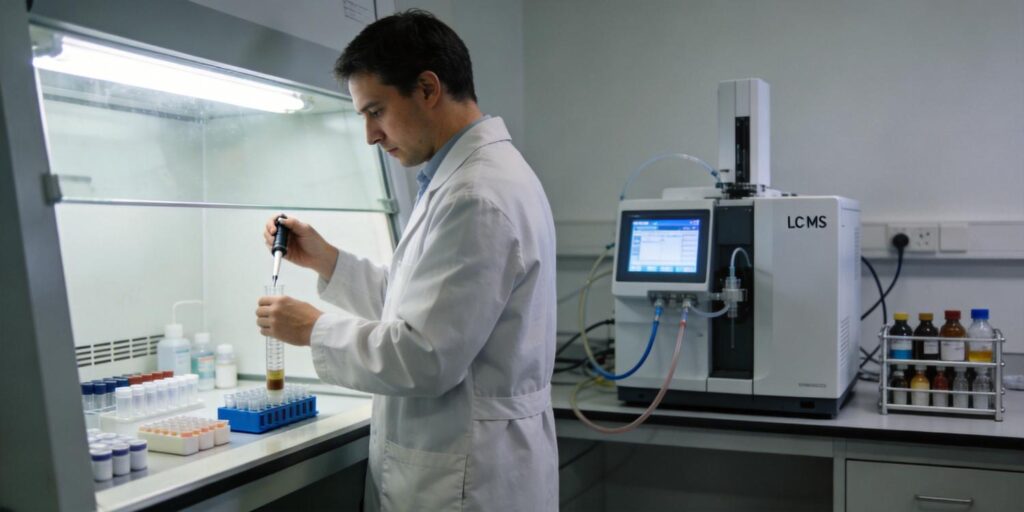
Successful SPE method development for LC-MS trace analysis begins with comprehensive analyte characterization. Before selecting any cartridge or solvent, you must map the polarity, pKa values, and functional groups of your target compounds. According to established SPE principles, this initial “homework” determines which extraction mechanisms are permitted by your analyte and sample matrix.
For trace analysis applications, where detection limits often reach parts-per-billion or lower, understanding analyte solubility and stability becomes critical. The effective acidity or basicity of functional groups near bonded silica surfaces may differ significantly from quoted pKa values measured under ideal conditions. As noted in SPE literature, “Care must be taken when applying these data during the SPE method development process. For example, quoted pKa values pertain to very specific conditions of temperature, concentration, and environment.”
Cartridge Selection Strategy
Cartridge selection follows directly from your polarity mapping results. For LC-MS trace analysis, consider these key factors:
- Reversed-phase cartridges (C18, C8, C2, Phenyl, ENV PS-DVB) for non-polar to moderately polar compounds
- Mixed-mode cartridges (HLB, MCX, MAX, WAX, WCX) for compounds with both hydrophobic and ionic characteristics
- Ion-exchange cartridges (SCX, SAX) for strongly ionic compounds
- Normal-phase cartridges (Silica, CN, Diol, Amino) for polar compounds
For trace analysis, low extractable levels from packing, tubes, and frits become particularly important for compatibility with sensitive MS detectors. As documented in SPE guidelines, “Pre-washed packings, frits, and tubes” help minimize background interference in high-sensitivity work.
Conditioning Solvents: Preparing the Sorbent Surface
Proper conditioning ensures the sorbent surface is activated and ready to interact with your analytes. The standard approach involves:
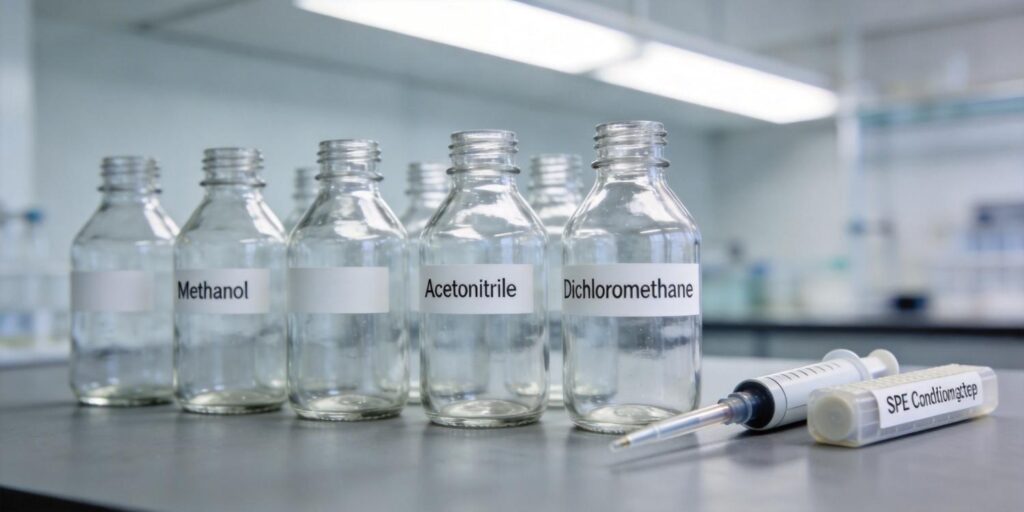
- Strong solvent (typically methanol or acetonitrile) to wet the surface and penetrate bonded alkyl phases
- Weak solvent (water or aqueous buffer matching your sample matrix) to remove excess organic solvent
For reversed-phase applications, “Methanol wets the surface of the sorbent & penetrates bonded alkyl phases, allowing water to wet the silica surface efficiently.” The conditioning solvent should be at least as strong as your planned elution solvent to prevent premature analyte elution during loading.
Loading pH Control: Maximizing Retention
pH control during sample loading represents one of the most powerful tools in SPE method development. For ionizable compounds, adjusting the pH to suppress ionization dramatically increases retention on reversed-phase sorbents:
- Acidic compounds: Load at pH 2-3 units below pKa to maintain neutral form
- Basic compounds: Load at pH 2-3 units above pKa to maintain neutral form
- Zwitterionic compounds: Requires careful pH optimization or mixed-mode approaches
In mixed-mode applications, pH adjustment serves dual purposes. As described in SPE protocols: “At pH 3.3, acidic, neutral, and some weakly basic drugs behave as relatively nonpolar compounds, and are retained on the cartridge by the hydrophobic groups of the sorbent, while other basic drugs behave as charged species, and are adsorbed by the negative ionic groups of the sorbent.”
Sequential Wash Design: Removing Interferences
Well-designed wash steps remove matrix interferences while retaining target analytes. The wash strategy should progress from weak to stronger solvents:
- Initial aqueous wash: Removes salts, sugars, and highly polar interferences
- Intermediate organic wash: Typically 5-20% organic solvent in water to remove moderately polar interferences
- pH-adjusted wash: For mixed-mode cartridges, adjusts pH to enhance selectivity
As noted in SPE optimization guidelines, “To remove unwanted, weakly retained materials, wash the packing with solutions that are stronger than the sample matrix, but weaker than needed to remove compounds of interest.” For trace analysis, consider eliminating unnecessary wash steps to minimize analyte loss—the initial water wash can often be omitted without affecting purity.
Gradient Elution Solvents: Maximizing Recovery
Elution solvent selection balances complete analyte recovery with minimal co-elution of interferences. For trace analysis, consider these approaches:
- Step-gradient elution: Progressive increases in solvent strength
- pH-assisted elution: Changing pH to disrupt ionic interactions
- Mixed-solvent elution: Combinations that disrupt multiple interaction mechanisms
Elution volume optimization is particularly important for trace analysis. Research shows that “several smaller eluent aliquots can improve recovery” compared to a single large volume. Allow the cartridge to soak with eluent for 0.5-1 minute to enhance recovery, especially for strongly retained analytes.
Elution Volume Optimization
Studies demonstrate clear relationships between elution volume and recovery. For example, when eluting NBQX from mixed-mode cartridges, recovery increased progressively with elution volume: 0.5 mL yielded partial recovery, while 2.0 mL provided complete elution. However, larger volumes require subsequent concentration steps, potentially increasing analyte loss.
Validation Metrics for Trace Analysis
Comprehensive validation ensures your SPE method meets trace analysis requirements:
| Parameter | Acceptance Criteria | Trace Analysis Considerations |
|---|---|---|
| Recovery | 70-120% (ideally >80%) | Consistent across concentration range; matrix effects minimized |
| Precision | RSD <15% (ideally <10%) | Intra-day and inter-day variability assessed |
| Linearity | R² >0.99 | Across expected concentration range, including LOQ |
| LOD/LOQ | Signal-to-noise >3/10 | Matrix-matched calibration for accurate determination |
| Selectivity | No interference at retention times | Blank matrix extracts analyzed for background |
| Carryover | <20% of LOQ | High-concentration samples followed by blanks |
Matrix Effect Evaluation
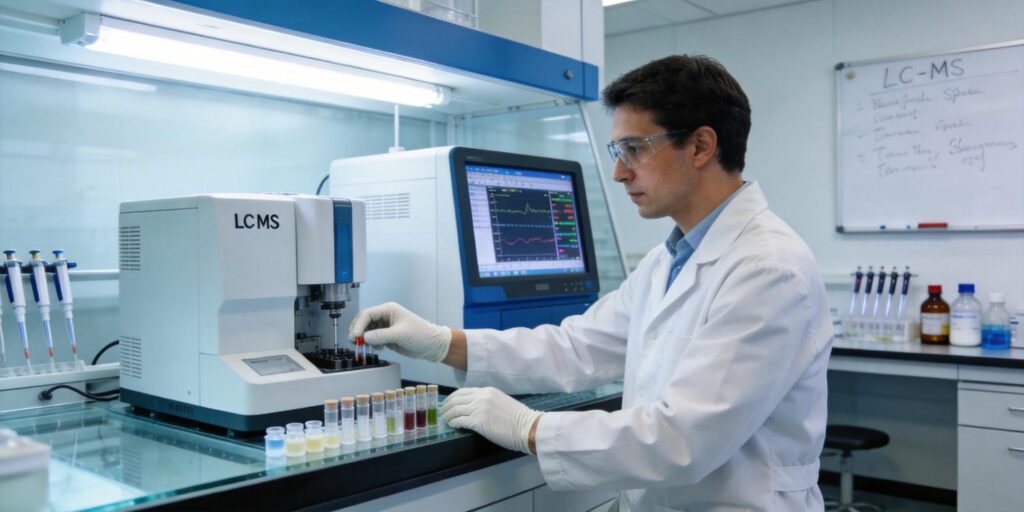
For LC-MS applications, matrix effects represent a critical validation parameter. Evaluate ion suppression/enhancement by comparing analyte response in neat solvent versus post-extraction spiked matrix. Signal variation should typically be <20% for robust trace analysis methods.
Practical Implementation Tips
Based on extensive SPE experience, these practical tips enhance trace analysis success:
- Flow rate control: Maintain 1-3 drops/second during loading for optimal recovery; slower flow rates generally improve retention
- Cartridge drying: For GC or evaporation steps, dry cartridges thoroughly using vacuum (≥10″ Hg for 4 minutes) or centrifugation (5000 rpm for 5 minutes)
- Residual solvent management: Remove all strong prewash solvents before conditioning and loading to prevent premature elution
- pH verification: Confirm actual pH of buffers on cartridge, not just in stock solutions
- Mass balance tracking: During development, analyze all fractions (load effluent, washes, eluate) to account for 100% of analyte
Advanced Considerations for Complex Matrices
For particularly challenging trace analysis applications, consider these advanced strategies:
- On-line SPE-LC-MS: Direct coupling eliminates evaporation losses and improves sensitivity
- Heart-cutting techniques: Collecting only the middle portion of the eluate reduces matrix interference
- Dual-cartridge approaches: Sequential extraction with different chemistries for comprehensive cleanup
- 96-well plate formats: For high-throughput applications, ensuring consistent flow across all wells
Successful SPE method development for LC-MS trace analysis requires systematic optimization of each parameter while considering their interactions. By following this structured approach—from initial analyte characterization through comprehensive validation—you can develop robust methods that deliver the sensitivity, selectivity, and reproducibility required for today’s demanding trace analysis applications.
For more information on specific SPE cartridges suitable for your trace analysis needs, explore our comprehensive product lines including HLB SPE cartridges, MAX SPE cartridges, MCX SPE cartridges, WAX SPE cartridges, WCX SPE cartridges, and 96-well SPE plates.