
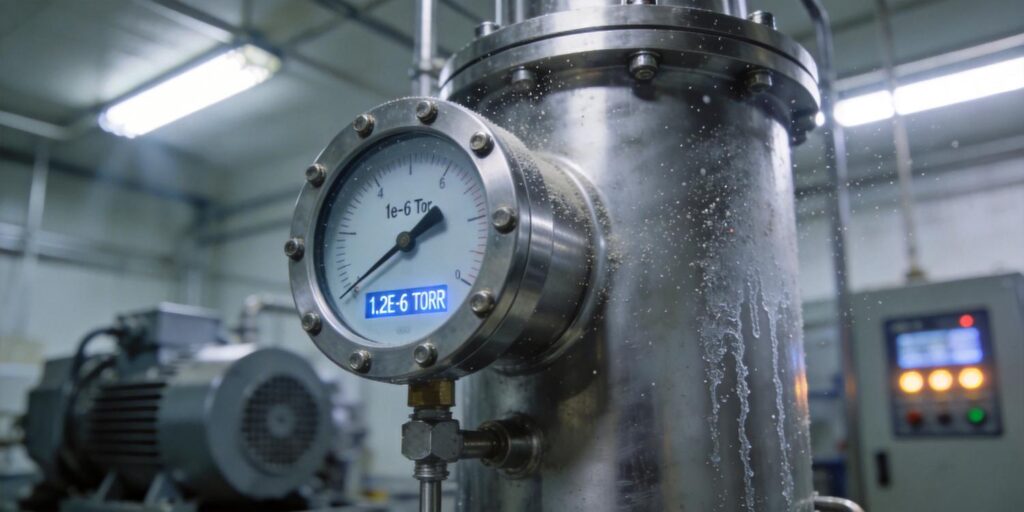
Defining the Plateau Phenomenon in Vacuum Pump-Down
During a typical vacuum pump-down cycle in systems like mass spectrometers, scanning electron microscopes, or heat-treatment furnaces, pressure initially drops exponentially as the pump evacuates bulk gas. However, engineers often observe a “plateau”—a region where the pressure decline flattens or halts temporarily, as indicated by stable readings on gauges such as the Poseidon Scientific VG-SP205 Pirani Vacuum Transmitter or VG-SM225 Cold Cathode Vacuum Gauge. This phenomenon, well-documented in vacuum literature, occurs when the rate of gas removal equals the influx from internal sources, preventing further net reduction until conditions change.
Mathematically, in an ideal leak-free system with constant pumping speed S (liters/s) and volume V (liters), pressure follows p(t) = p0 exp(-S t / V). Real systems deviate due to additional gas loads, creating a knee or plateau in the log-pressure vs. time curve around 10−2 to 10−4 Torr, depending on chamber size and materials. The VG-SP205 Pirani, with its linear response from 10 to 10−2 Torr, captures this transition accurately, while the VG-SM225 takes over below 10−3 Torr for precise high-vacuum diagnostics.
This plateau frustrates process timelines but signals underlying issues that, once addressed, can restore efficient evacuation. Understanding its causes—rooted in foundational vacuum physics—empowers teams to optimize systems without unnecessary downtime.
Differentiating Outgassing from Leaks
Outgassing and leaks are the primary culprits behind plateaus, but distinguishing them is critical for effective troubleshooting. Outgassing refers to the release of adsorbed, dissolved, or trapped gases from chamber walls, fixtures, and components. In unbaked stainless-steel systems, water vapor dominates (>80%), with hydrogen and CO/CO2 contributing at lower pressures. The outgassing rate Q (Pa·m³/s·m²) typically follows Q = Q0 t−n, where n ≈ 1 for many materials, leading to a slowly decreasing gas load over time.
Leaks, conversely, introduce external gas (usually air) at a constant rate Qleak = L · patm, where L is the leak conductance. This results in a steady ultimate pressure pu = Qleak / S, independent of time.
To differentiate:
- Perform a rate-of-rise test: Isolate the chamber from the pump and monitor pressure increase via RS232 output from the VG-SM225 or VG-SP205. A constant dp/dt indicates a leak; a decelerating rise (often ∝ t−0.5 for diffusion-limited outgassing) points to outgassing.
- Use residual gas analysis (RGA): High H2O or H2 suggests outgassing; N2/O2 ratios matching air (78:21) confirm leaks.
- Helium spray test: Probe suspected areas with helium while monitoring the VG-SM225 ion current. Immediate spikes signal leaks; no response leans toward outgassing.
In clean research systems, outgassing often dominates plateaus above 10−5 Torr, while leaks become evident at base pressure. The Poseidon gauges’ customizable protocol enables automated logging of these tests, integrating seamlessly with PLCs for rapid diagnosis.
Pump Speed Mismatch as a Contributing Factor
A plateau can also arise when the effective pumping speed fails to overcome the gas load at a given pressure regime. Pump speed S varies with pressure: Mechanical roughing pumps (e.g., rotary vane) maintain near-constant S down to 10−2 Torr, but high-vacuum pumps like turbomolecular or diffusion types exhibit S(p) curves with knees where speed drops.
For instance, if a turbopump’s crossover pressure is mismatched to the forepump, the system may stall around 10−3 Torr as the turbo cannot yet engage fully. Similarly, undersized pumps for large volumes extend the time to deplete initial gas, masking as a plateau when outgassing begins to compete.
Calculate required S using pu = Q_total / S_eff, where Q_total includes outgassing and leaks. For a 100-liter chamber with typical stainless-steel outgassing Q ≈ 10−6 Pa·m³/s·m² after 1 hour (A = 1 m²), targeting 10−5 Torr (1.33 × 10⁻³ Pa) demands S_eff > 75 liters/s. The VG-SP205 Pirani monitors roughing speed accurately, while the VG-SM225 confirms high-vacuum engagement—its software interlock prevents premature activation, avoiding mismatch-induced stalls.
Procurement note: Poseidon’s compact gauges fit systems where larger pumps are infeasible, but always verify S against expected Q from material data sheets.
Conductance Limitations in System Design
Even with adequate pump speed, restrictions in gas flow—conductance limitations—can create apparent plateaus by reducing effective S at the chamber. Conductance C (liters/s) for molecular flow through a tube is C = (3.81 √(T/M)) (d³ / L), where d is diameter (cm), L length (cm), T temperature (K), M molecular mass.
Short, wide tubes maximize C; narrow or long connections throttle flow, yielding S_eff = S · C / (S + C). For a 100 liters/s pump connected via a 1 m long, 2 cm diameter tube (C ≈ 10 liters/s for N2), S_eff drops to ~9 liters/s—a 90% loss, stalling pump-down.
In complex geometries like baffled traps or valved manifolds, cumulative conductance further limits performance. Plateaus around 10−4 Torr often trace to this: Initial viscous flow evacuates quickly, but molecular regime exposes bottlenecks.
Diagnostic tip: Measure pressure gradients across suspected restrictions using multiple gauges. The VG-SM225’s small footprint allows placement at key points without altering conductance.
Diagnostic Workflow for Plateau Resolution
A systematic workflow isolates the cause efficiently:
- Log the curve: Use RS232 from VG-SP205/VG-SM225 to plot log p vs. t. Identify plateau pressure and duration.
- Rate-of-rise test: Valve off pump, record dp/dt over hours. Constant rate = leak; decaying = outgassing.
- Leak hunt: If leak suspected, spray helium and monitor ion current spikes.
- RGA if available: Identify gas species to confirm outgassing (H2O/H2) vs. leak (air peaks).
- Check conductance: Calculate C for plumbing; compare pressures upstream/downstream.
- Pump verification: Isolate pump and measure standalone speed against specs.
- Cross-check gauges: Use VG-SP205 for rough, VG-SM225 for high—mismatch may indicate gauge error.
This sequence, taking 1–4 hours, resolves 90% of cases without disassembly. Automated scripts via customizable protocol streamline logging for multi-chamber systems.
Corrective Engineering Solutions
Once diagnosed, implement targeted fixes:
- For outgassing: Bake at 150–250 °C for 4–8 hours under vacuum. Reduces Q by 10–100×. Poseidon gauges tolerate system bakes with HV disabled.
- For leaks: Seal with epoxy (temporary) or weld/replace. Use helium mass spectrometer for micron-level detection.
- For pump mismatch: Upgrade forepump or add booster stages. Ensure crossover at 10−3 Torr via interlock.
- For conductance: Shorten/widen tubes; remove unnecessary baffles. Aim for C > 2S to minimize loss.
- Preventive: Select low-outgassing materials (e.g., electropolished stainless); pre-bake components; use traps for backstreaming.
In heat-treatment furnaces, combining bake-out with larger conductance ports cuts pump-down time by 50%. For mass specs, low-outgassing PEEK insulators in the VG-SM225 extend plateau-free operation.
Conclusion: Turning Plateaus into Performance Gains
Pressure plateaus during pump-down signal opportunities to refine your vacuum system, not inherent flaws. By understanding outgassing dominance, leak constancy, pump mismatches, and conductance bottlenecks—and applying a structured diagnostic workflow—engineers achieve faster cycles and lower base pressures. The Poseidon VG-SP205 Pirani and VG-SM225 Cold Cathode pair provide the precise, integrated tools to monitor and resolve these issues efficiently, at costs 30–50% below competitors.
Frustrated by persistent plateaus in your vacuum process? Explore the VG-SM225 Cold Cathode Vacuum Gauge and VG-SP205 Pirani Vacuum Transmitter specifications. Request a sample pair, custom RS232 diagnostic script, or a tailored pump-down optimization consultation. Our team delivers solutions grounded in vacuum fundamentals—contact Poseidon Scientific today to eliminate plateaus and boost your system efficiency.


