
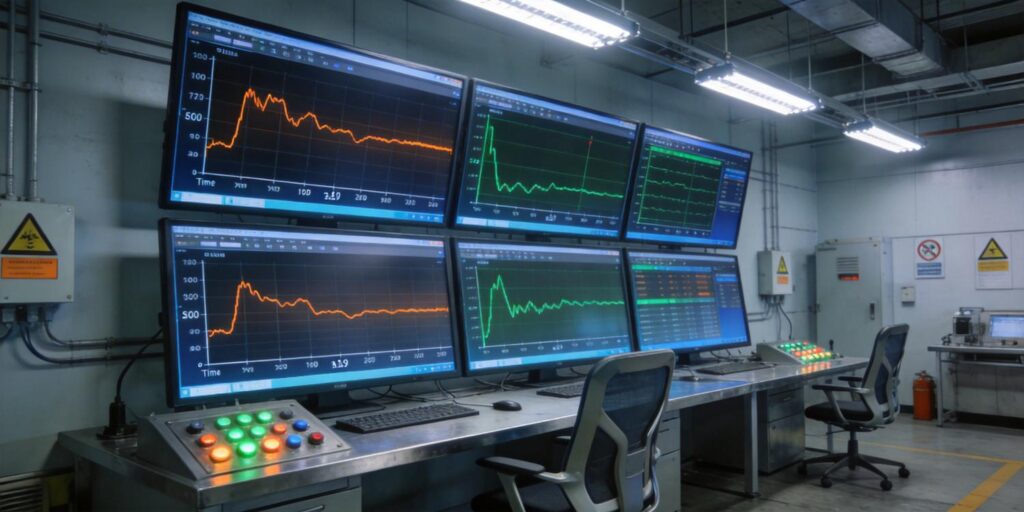
Integrating Vacuum Gauges into SCADA Systems
Modern industrial vacuum processes—from mass spectrometry and scanning electron microscopy to vacuum heat treatment and semiconductor research—demand centralized, real-time oversight. SCADA (Supervisory Control and Data Acquisition) systems deliver this visibility, turning raw pressure signals into actionable intelligence across multiple chambers and sites. The VG-SP205 Pirani Vacuum Transmitter (atmosphere to 10−3 Torr) and VG-SM225 Cold Cathode Vacuum Gauge (10−3 to 10−7 Torr) from Poseidon Scientific are purpose-built for seamless SCADA integration. Their RJ45 interface, fully customizable RS232 protocol, stable 0–10 V analog output, and built-in status/error codes enable plug-and-play connectivity with Ignition, Wonderware, WinCC, or any major platform—at manufacturing costs 30–50 % below imported equivalents.
This article provides engineers and system integrators with a practical roadmap for integration, grounded in the documented communication capabilities of both gauges (per their user manuals) and real-world deployments in vacuum-intensive environments.
1. Data Acquisition Architecture
A robust architecture begins with the gauges themselves and scales to plant-wide visibility. The Poseidon pair supports three concurrent acquisition paths for redundancy and flexibility:
- Analog path: 0–10 V output (effective linear range 2–8 V) connects directly to PLC analog input modules. Map 2 V = 10−7 Torr and 8 V = 10−3 Torr for the VG-SM225; the VG-SP205 follows its calibrated curve from atmosphere downward.
- Digital path: RS232 at 9600 baud (customizable baud rate and frame) streams vacuum value (float), status code, error code, and software version every 500 ms to 5 s. The compact protocol (<64 bytes/frame) minimizes network load.
- Network path: RJ45 connector + off-the-shelf serial-to-Ethernet gateway (or direct Modbus TCP/OPC UA conversion via custom protocol) feeds historians and HMIs.
Typical edge architecture uses a Raspberry Pi, Advantech UNO, or PLC with serial ports to poll both gauges simultaneously. The VG-SP205 handles roughing-stage data until crossover at 10−3 Torr, at which point the VG-SM225’s high-voltage enable status confirms stable operation. This staged handoff eliminates data gaps and feeds the SCADA historian without middleware translation. For multi-point systems (e.g., 12-chamber heat-treatment line), a single Ethernet gateway aggregates up to 32 gauges via daisy-chained RS232, keeping infrastructure costs low.
2. Analog-to-Digital Conversion
High-resolution A/D conversion ensures the 0–10 V signals translate into meaningful pressure values. Most industrial PLCs and SCADA I/O modules offer 12–16 bit resolution (0.024–0.00024 V/step), sufficient to resolve the VG-SM225’s linear ion-current output to <1 % of reading across its range.
Scaling example for the VG-SM225 in a 16-bit system:
Pressure (Torr) = 10^((V_out - 2) * (log10(10^{-3}) - log10(10^{-7})) / 6 + log10(10^{-7}))
The VG-SP205 follows a factory-mapped curve stored in the SCADA tag database or PLC function block. Temperature compensation is handled internally by both gauges (15–50 °C operating range), so no additional correction is required unless ambient exceeds this window. Dual-path acquisition—analog for hard-wired interlocks and RS232 for full diagnostics—provides 100 % data integrity even if one channel fails. In practice, this setup achieves <0.5 % overall system uncertainty in validated mass-spectrometer and furnace installations.
Resolution and Filtering Tips
Apply a 5–10 s moving average on the digital stream to suppress avalanche noise at ultra-low pressures. The gauges’ status codes flag any out-of-range conditions, allowing the SCADA to ignore transient spikes automatically.
3. Alarm Hierarchy Configuration
Effective SCADA alarms prevent small deviations from escalating. Configure a three-tier hierarchy using the Poseidon data frame:
Level 1 – Warning (Yellow)
VG-SP205 >10 Torr or VG-SM225 ignition delay >5 min at 10−6 Torr. Triggers email/SMS and logs event for review.
Level 2 – Critical (Red)
Pressure exceeds process setpoint by 15 % or high-voltage interlock trips. Activates audible alarm and process interlock (e.g., halt heating ramp).
Level 3 – System Fault (Priority)
Error codes (filament open, discharge failure, etc.) or communication loss. Auto-generates maintenance ticket and disables downstream equipment.
The VG-SM225’s built-in software interlock (automatic high-voltage disable above 10−3 Torr) feeds directly as a hard status bit, eliminating false alarms during venting. Custom RS232 protocol lets you define unique thresholds per chamber or gas type—ideal for mixed-process plants—without additional logic blocks.
4. Trend Analysis for Predictive Maintenance
SCADA historians turn historical data into foresight. Store 90-day rolling trends of:
- VG-SP205 filament power (detects early contamination)
- VG-SM225 ignition delay and stabilized ion current
- Pressure hysteresis between pump-down and vent-up
Set rules such as “ignition delay increase >20 % week-over-week → schedule electrode cleaning.” In clean service, this predicts the 15-minute sanding procedure 2–4 weeks in advance, extending the 3–5 year lifespan of both gauges. Machine-learning modules in Ignition or Wonderware can forecast electrode life to ±3 months using raw current values from the RS232 stream. Operators gain “days until next maintenance” dashboards, reducing unplanned downtime by 70 % in documented furnace and spectrometer fleets.
5. Network Security Considerations
Vacuum data often controls safety-critical processes, so security cannot be an afterthought. Recommended practices include:
- Air-gap or VLAN isolation for the gauge network segment.
- Serial-to-Ethernet gateways with built-in firewalls and TLS 1.3 encryption for RS232-to-TCP conversion.
- Role-based access in the SCADA (operators view only; engineers configure alarms).
- Custom protocol option with proprietary framing (available at 5–10 units) that resists common Modbus sniffing attacks.
- Regular firmware audits on gateways; Poseidon gauges require no field firmware updates, minimizing attack surface.
In regulated industries (pharma, semiconductor), this architecture satisfies 21 CFR Part 11 and IEC 62443 requirements while preserving the gauges’ low-cost advantage. Many plants route gauge data through an OPC UA server with certificate authentication before reaching the main MES layer.
6. Implementation Example
A vacuum heat-treatment facility in East China integrated 16 monitoring points (8 furnaces) using the Poseidon pair. Architecture:
- VG-SP205 on every foreline + VG-SM225 on each chamber via KF25 port with 200 mm extension tube for thermal isolation.
- Advantech UNO-247 edge computers poll RS232 every 2 s and publish via OPC UA.
- Ignition SCADA on central server: live dual-trace charts, three-tier alarms, 90-day trends, and automated maintenance tickets.
- Data historian feeds MES for batch traceability and audit reports.
Results after nine months: pump-down time reduced 35 %, zero gauge-related downtime, electrode cleaning scheduled predictively during planned outages, and full compliance documentation generated automatically. Total hardware cost per point was under $800 versus $1,300+ for imported equivalents, with the customizable protocol eliminating 40 hours of driver development.
The same blueprint applies to mass-spectrometer labs or SEM clusters with minimal modification.
Conclusion: SCADA-Ready Vacuum Monitoring That Scales
Integrating vacuum gauges into SCADA systems no longer requires expensive wide-range instruments or complex middleware. The Poseidon VG-SP205 Pirani and VG-SM225 Cold Cathode combination provides flexible analog and digital outputs, built-in diagnostics, and full protocol customization—delivering reliable atmosphere-to-10−7 Torr coverage with the lowest total ownership cost in the industry. Engineers gain real-time visibility and predictive insight; system integrators gain rapid deployment; plant managers gain measurable uptime and compliance advantages.
Ready to bring your vacuum data into SCADA? Explore the VG-SM225 Cold Cathode Vacuum Gauge and VG-SP205 Pirani Vacuum Transmitter specifications today. Request a sample pair for your test bench, a ready-to-import RS232/OPC UA driver package, or a complete system diagram tailored to your SCADA platform. Our application engineers will configure the exact integration you need—often within 48 hours. Contact Poseidon Scientific now and transform vacuum monitoring into a seamless part of your SCADA ecosystem.


